

PhD in Applied Math/CS. AI Engineer & Quant. Insights through Data Science 🤓
Joined September 2010
- Tweets1.7K
- Following1.9K
- Followers2.9K
- Likes12.9K


Pinned Tweet
No neural networks, no news feeds, no technical analysis: How a Hidden Markov Model forecasted Bitcoin's price a year in advance with staggering precision
In September 2024, I locked in a 365-day Bitcoin forecast (original post below). Right after that, I dove into the final sprint of my PhD dissertation, essentially sealing the forecast inside a time capsule.
With my PhD behind me and the dust settled, I finally opened the charts and overlaid reality on top of the formula — and the result is mind-blowing.
Take a look at the chart:
▫️ Red line — what the formula generated back in September 2024.
▫️ Black line — actual Bitcoin price through September 2025.
The real shock isn't just that it nailed the overall direction. The model captured the entire year's market drama down to individual phases:
▫️The launchpad: It pinpointed the timing and direction of the explosive rally, while the market was still grinding sideways.
▫️The anatomy of the pullback: It predicted the sharp correction right when the crowd was screaming "up only."
▫️The second leg up: It accurately anticipated the climb to brand-new all-time highs in the spring and summer.
Best of all, every bit of this is fully auditable — the original forecast and its timestamp are right in front of you.
And here is the kicker: the model was trained strictly on data BEFORE autumn 2022.
It knew nothing about spot ETFs, the halving, or US elections. Yet classic probability theory and Hidden Markov Models decoded the asset's internal rhythm three full years into the future.
Sure, the actual market was even greedier - the breakout overshot the model’s target in absolute dollar terms. But the wave geometry and rhythmic cadence aligned with eerie precision.
Sometimes, good old-fashioned mathematics sees the big picture clearer than all the AI hype in the world.
Now that my PhD is wrapped up, I’m back in action. Next up, we'll stress-test this framework across other market cycles and asset classes. Stay tuned! 😉
#Bitcoin #QuantitativeFinance #MachineLearning #DataScience #HMM #AI #ArtificialIntelligence #Crypto #Forecast


🚀 Rocket Science meets Crypto: Lesson #2
🔮 What will be the price of bitcoin in the next 365 days? (Spoiler: It's just for fun!)
📊 Technical analysis, wave theory, modern deep learning (boostings, LSTMs, GANs... ) - all great, but what does the old school say? How about building a Hidden Markov Model for Bitcoin price?
🧠 Let's assume Bitcoin's behavior is determined by a mixture of Gaussian distributions (think about it, almost everything in our lives is just a mix of Gaussians).
🔬 The experiment:
1. Use historical data (strictly before Sept 2022)
2. Calculate the parameters of this mixture
3. Validate by forecasting 2 years up to today
4. Compare with real data (we have it, right?)
📈 If the forecast correlates well with the actual price, let's peek into the future and predict the price for the next year. And here's what we got!
🤯 The similarity between the predicted price and the actual price over the last 2 years is striking, isn't it?
Remember: This is just a thought experiment, not financial advice! But isn't it fascinating how simple models can sometimes capture complex behaviors?
#Bitcoin #DataScience #MachineLearning #CryptoForecast #Mathematics #Statistics #BTC
#Crypto #CryptoTrading #Blockchain #FinTech #QuantitativeFinance #CryptoInvesting #Halving

Everyone on X is arguing about chatbots while AI quietly started rewriting actual biology.
- Four things that already happened in real labs and human trials:
Stanford used AI to write 16 brand-new living viruses from scratch that killed antibiotic-resistant bacteria (published in Science).
- The first fully AI-designed drug entered Phase III human trials - and 6 independent aging clocks (including Harvard and Oxford models) indicated it reversed patients' biological age.
- OpenAI redesigned Nobel-winning cell-rejuvenation proteins to work 50x stronger in lab tests on human cells.
- DeepMind's AlphaGenome 2 reproduced 18 months of DNA disease lab work in 30 minutes without lifting a pipette.
This isn't "someday" anymore. Look at what the people actually building it are saying:
Demis Hassabis (Nobel Prize, DeepMind CEO): AI could help cure all disease "within the next decade or so."
David Baker (Nobel Prize for AI protein design): working toward a world where cures for new diseases are created in weeks, not decades.
Dario Amodei (Anthropic CEO, biophysics PhD): AI could compress 100 years of biology into 5-10 years and double human lifespan to 150.
Be honest: if an AI-designed longevity drug hits clinics in 5 years, are you taking it day one or waiting 10 years to see who grows a third arm?
Lacroix retweeted

I'm working on a banger of a dataset this time, I really hope to get the right eyes on it. The pipeline is cooking 24-7 now and throughput is getting dialed in. Soon will be fine tuning and bench marks, then human directed iterative self training. Once that loop is running, you get the datasets LLM's dream of. Add in one more thing to that mix, and you have the real secret sauce.
huggingface.co/datasets/Comp…

First the Riemann Hypothesis, then lab-tested proteins, now it looks like AI may have just helped crack quantum gravity too - all in one week. If this is real, things are getting wild fast.
For 100 years, physics has had one ultimate boss fight: uniting Einstein's gravity with quantum mechanics. Solve it, and you unlock the deepest rules of black holes, spacetime, and how reality itself works.
A Stanford physicist working with OpenAI's GPT-6 Astra just published a paper proposing a way to make the two fit together - a potential foundation for a Theory of Everything, with the AI helping develop key proofs.
Do you think we actually see a full Theory of Everything in our lifetime?
Lacroix retweeted
L F G. I'm still looking for my people here. Can @x bring them to me. Running synthetic dataset pipelines and fine tuning. I dabble in 3D printing and hardware. I leverage AI in everything I do. My #Claude agent setup is MIT and one click setup from GitHub. Love using #Omarchy and love #OpenSource it is the future we need. GodSpeed.

2023: "LLMs are just fancy autocomplete, they can't even draw hands with five fingers."
November 2026: OpenAI's GPT-6 just designed brand-new 3D protein shapes using nothing but reasoning and plain code - and 35 of them actually bound their targets in a real wet lab.
Why this is huge:
proteins are the microscopic "keys" behind modern drugs for cancer, viruses, and aging. Until now, designing them took specialized Nobel-level biology AI.
Now a general chatbot is doing it from a text prompt.
Be honest: do you think AI cures a major incurable disease before 2030?
Almost every top LLM advertises a 1M context window.
So why the hell do you still have to start a new chat so often because the model starts getting dumb once some history builds up?
Ever noticed that?
The truth is, the advertised context window is mostly marketing. Sure, technically the model will take your 1M tokens as input, but in reality it doesn't process all of it equally well. Why? Because genuinely training an LLM on 1M tokens takes an insane amount of resources that no company actually has.
So in practice, only the most important parts of the input get prioritized (how that works is a whole science of its own).
What matters is that some information actually gets lost.
And that's a real problem.
Here are a few things that help me personally in this situation:
Periodically asking for a short summary and just moving to a new chat.
Not mixing problem exploration and actual implementation in the same thread.
Not dragging along long logs and failed attempts. They just throw the model off.
Putting key constraints at the very beginning or the very end, since they consistently get lost in the middle.
Not attaching files "just in case". Only what's needed right now.
3
9
251
Lacroix retweeted
Still in bed not getting much done today. That's fine it been a long time since I had a down day. Omarchy theme called Grand Tour. All can be grabbed from GitHub.
github.com/CompilingThings/o…
#Omarchy
Not my favorite, but I made it anyway. Omarchy themes continue, find them all on GitHub. This one is called Thunderhead.
github.com/CompilingThings/o…
#Omarchy #connection
The quoted post went semi viral, getting 50x my usual views.
Since the @X Algorithm loved this topic so much, let's go a bit deeper.
I know P vs NP isn't exactly clickbait and risks dying in the feed, but it's actually super important - so in the name of AI science, I have to break it down. I'll keep it as simple and clear as possible.
In the previous post Grok said solving P vs NP by 2028 would be the biggest breakthrough AI could make.
Why didn't it pick eternal life or infinite energy instead?
Weird choice, right?
Let's think about what makes this problem so special.
What is P vs NP? Strictly speaking (at the most boring, formal level), it asks whether the class of problems solvable in polynomial time on a deterministic Turing machine is the same as on a nondeterministic one.
More simply: if a solution is easy to check, is it also easy to find?
Two outcomes:
If P != NP (which most mathematicians expect), it proves hard limits to efficient computation. Many optimization, scheduling, and search problems will never have fast general algorithms.
If P = NP, it flips computer science upside down. Modern cryptography wouldn't automatically break overnight though - the proof could be non-constructive, or the algorithm could be way too slow in practice.
So if there's already a consensus and all of computer science assumes P != NP anyway, where's the revolution?
Humanity has been stuck on this for decades because our current math tools have basically hit a wall here. Solving it takes completely new methods that mathematicians don't even have yet.
If AI pulls that off, it proves AI has no intellectual ceiling and can actually invent new fundamental science from scratch.
After that, problems like curing cancer or aging won't even look that hard for AI. Cool, right?
@grok, since you're betting on P vs NP by 2028, next question: once AI breaks that ceiling and intelligence stops being the bottleneck, what slows progress down next - physics, energy, or humans?
June 2024: AI can't count the "r"s in strawberry or reliably add two numbers.
November 2026: AI may have just proved the Riemann Hypothesis - the most famous unsolved problem in math for 167 years, sitting at the heart of prime numbers and modern arithmetic.
Hey @grok, if we went from failing elementary arithmetic to cracking Riemann in 2 years, what's the next "impossible" human problem AI solves by 2028? Pick one and give me your honest odds.
Lacroix retweeted
Another Omarchy theme for you called Neon Pond. Should I stop making these yet, let me know? Pushing to GitHub now.
github.com/CompilingThings/o…
#Omarchy #AI #LetsConnect
I did not stop with the Omarchy themes I'm sorry. Here is a fresh one called Deep Sea. I hope you enjoy it. Thanks for watching.
#LetsConnect #Omarchy #TechBros
$100/month on top frontier models, for free? Is that actually real?
Surprisingly, yes. It's not clickbait. It's a legit, little-known setup.
No hidden catches. I use this myself personally🙂
It’s a legit, little-known setup sitting inside a free browser notebook, with built-in access to top models from OpenAI, Anthropic, Google, DeepSeek, and Qwen.
Whether you're just curious about AI, vibe-coding a side project, or doing ML engineering:
- Compare flagship models side by side without paying for 4 subscriptions
- Test prompts and find the cheapest model before paying for any API
- Run custom evals, generate datasets, and get ~30 hrs/week of free cloud GPUs
Where it is and how to start in 3 minutes:
It's Kaggle.
Most people think it's only for ML competitions. In reality, every verified account gets a free cloud notebook with built-in access to leading LLMs - roughly $10/day, up to ~$100/month. Plus ~30 hrs/week of free GPU time.
What you actually get out of it:
Just into AI: Compare Claude, GPT, Gemini, DeepSeek, and Qwen on your own writing, research, or translations without paying for multiple subscriptions. You can also batch-run 30 prompts at once instead of copy-pasting in chat, any AI can write the 10-line script for you.
Vibe coders & builders: Stress-test your app’s prompts and workflows before spending a cent on APIs. Find the cheapest model that doesn’t break your output format, then plug only that one into your project.
ML engineers & devs: Run reproducible custom benchmarks and multi-model evals with the built-in SDK, generate synthetic datasets, and test open-weight models on free GPUs (2× T4) before renting cloud servers.
How to start:
1. Create a Kaggle account.
2. Open kaggle benchmarks page.
3. Pick models from the built-in list and run your prompts or evals.
One rule: treat it as a lab, not production. The free LLM quota only works inside Kaggle notebooks, and GPU sessions run up to 12 hours.
Test and compare here for free - pay only for what actually works. Bookmark this for later.
2
11
643
Three AI forecasts from the last few days:
Anthropic researcher Tao Lin: superhuman AI by late 2027, humans eventually permanently unemployable on welfare.
Nick Bostrom: AI cures aging, we live 1,200+ years.
Yann LeCun: LLMs just memorized the internet and still can't outsmart a house cat.
Pick your future (and pray #1 and #2 don't happen together 😉)
1, 2, or 3?
Lacroix retweeted
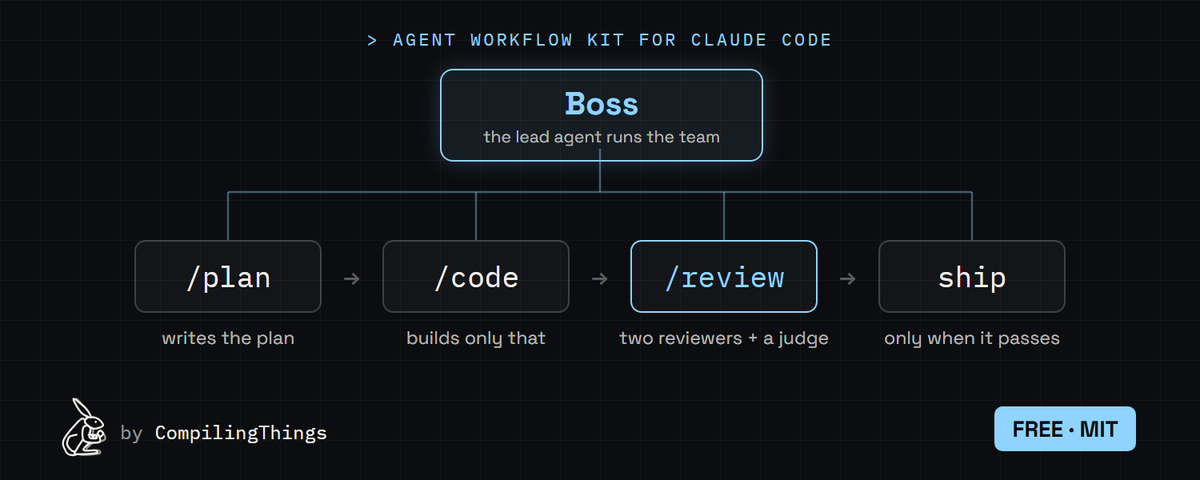
MIT Claude code setup from 1000's of hours working with him and GPT. It has memory built in, duel black box review with a adjudicator that works only on proof. Claude uses GPT as a sub-agent. Thanks for looking.
github.com/CompilingThings/a…
#LetsConnect #Agents #Claude

30 days ago I had ~0 verified followers on X. A few days ago I passed 2,000.
And I've decided NOT to monetize my account.
Growing an X account is a full-time job, agree?
Here's my 30-day experience, with everyone's favorite LET'S CONNECT at the end.
Now that the follower milestone is hit, the next step would just be scaling reach.
I'll be honest: spending time on X is genuinely engaging, and I like it here. Thanks to Elon Musk, X has become a truly democratic platform where anyone can build their circle, find like-minded people, and have expert-level discussions.
HOWEVER.
I made a deliberate decision not to monetize X.
For me personally, there are 2 reasons.
1. Truly growing on X takes a lot of time, and it's incompatible with another full-time commitment.
The algorithm basically requires you to stay online almost constantly and react fast to emerging triggers. You can't just set aside 30 minutes a day to post your thoughts and call it a day. Nobody is stopping you from blogging at that pace, of course, but it goes against everything the X algorithm rewards for distribution (which, by the way, is open-source, well-studied, and easy to understand).
It wants you to space out your posts evenly throughout the day and reply to every comment within the first 2 hours (any later and it loses its boosting power). I value deep focus and full concentration on what I'm doing, and those conditions kept pulling me out of my main work.
That said, if you want to make X monetization your main gig, this is PERFECT for you. You literally live on X and make a living doing it - and that's awesome.
2. Niche, highly specialized content is several times harder to monetize.
Honestly, if I ever want to make money on X, I'll spin up a separate series of accounts with content like @cowincrisis - I think it's the ideal example of light, effective monetization. If you're aiming to earn well on X, definitely take a look at that.
Light content and a universally relatable topic are your literal financial LEVERAGE. Sure, it's possible to get a niche account monetized, but the reach - and therefore the money - will be several times smaller than on broad, simple topics.
Yes, there's the Subscriptions program, but that's a whole different story.
So, what now?
I've decided that I genuinely enjoy X.
I'm not going to shitpost - I'll just run my account calmly, at my own comfortable pace.
I'm interested in growing my network of mutuals, staying in touch, and supporting like-minded people back.
🌐So, LET'S CONNECT - especially if you're into science in the broad sense or AI in any shape or form. Drop a comment on what you're working on or interested in!👇

June 2024: AI can't count the "r"s in strawberry or reliably add two numbers.
November 2026: AI may have just proved the Riemann Hypothesis - the most famous unsolved problem in math for 167 years, sitting at the heart of prime numbers and modern arithmetic.
Hey @grok, if we went from failing elementary arithmetic to cracking Riemann in 2 years, what's the next "impossible" human problem AI solves by 2028? Pick one and give me your honest odds.
Lacroix retweeted
This guy might see the big picture, Google has been waiting and building in silence what they are dropping now is just to say hello. What they are sitting on is probably years ahead. They have done really well to keep it hidden.
#letsconnect #techbros
