





Ontobug: Store OWL ontologies, SHACL shapes and RDF data as a cypher graph database.
One DB, several subgraphs.
Based on Ontolith by @Volland84


Ladybug Database retweeted

What I love most is how @lbugdb is being built: in the open, under an MIT license, with a growing OSS community (and their agents) hunting for performance gaps. This is a great time to be building!
Huge props to @arundsharma and his tireless efforts in reviewing PRs and improving Ladybug, all year 🤠
Read the post all the way to the end to see where graph lakehouses are going. The future looks bright! ☀️
4/4
thedataquarry.com/blog/celeb…


We embed duckdb too. It's very good!
But we also support native ADBC and native postgres clients.
xitter.cf/ajassy/status/21054796…

A painful part of working with your data has always been that your live data and historical data are stuck in separate systems: the order a customer just placed lives in your database, while their last five years of orders sit in a data lake in S3.
And answering a real question usually needs both at once (is this a normal purchase for them, or should we flag it?), and to do that you had to move the data together first, copying history out of the data lake into your database (or the other way around), because the database couldn’t read it where it lived.
That meant guessing ahead of time which data you’d want, keeping a second copy of it all, building pipelines to move it, and constantly syncing so the two didn’t drift apart. A lot of plumbing, and slow going, all before you could answer one question. And even then, the answers were only as fresh as your last sync.
That now changes with Aurora PostgreSQL, which can call your live data and historical data in S3 together, in a single query. No copying, no pipelines to keep in sync.
And it’s fast, because we’ve built in DuckDB, a popular open source engine that’s really good at reading and analyzing data right where it’s stored. DuckDB reads the open formats like Parquet and Iceberg already sitting in your data lake, so there’s nothing to convert or move.
As folks build AI agents into their apps, the data their agent needs will depend on the task in front of it. Being able to query that specific data live, instead of copying it over just in case, is gonna be a big help for builders. aws.amazon.com/blogs/aws/ama…

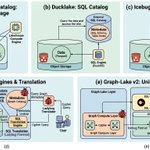
Graph Lake v2
Announcing the 0.21.1 monthly release and a roadmap for where the Graph Lake is going.
🤖 Made with AI


We built a graph visualizer using some of the same techniques!
xitter.cf/tobi/status/2103251524…

Get Disktree at github.com/tobi/disktree.


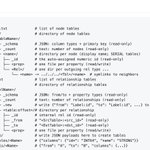
@PostgreSQL has information_schema. LadybugDB has ...?
What if you want to explore the schema as a Graph instead of Cypher DDL statements? Wait no more!


LadybugDB also uses OPFS in wasm mode!
Also the shell has been updated to the recent 0.20.4 release. Link in Replies.
xitter.cf/duckdb/status/21010256…

When #DuckDB-Wasm was launched in 2021, databases could not be persisted: everything lived in the Wasm heap and vanished when the tab closed.
Keeping data meant serializing tables to Parquet, storing the bytes in IndexedDB, and re-registering them on the next page load. This was doable, but had to be handled at the application layer and was not offered out of the box by DuckDB-#Wasm.
Modern browsers now ship the Origin Private File System (OPFS), a per-origin, sandboxed file system with random-access reads and writes. DuckDB-Wasm can use it as a storage backend.
This post by @carlo_piovesan and @GeertjanW shows you how: duckdb.org/2026/09/18/opfs-w…
