Learn to invest in biotech like the professionals from a former biotech executive and investment banker. For education purposes only. Course on Thinkific

Joined June 2021
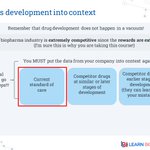
Investors must continually assess the ever-changing Standard of Care landscape. It could change and make a positive clinical result less relevant Also keep an eye on the competition #learnbiotechinvesting #biotech #investing #BiotechPrometheus
3
553
A reminder for #investors how complicated cancer is #learnbiotechinvesting #BiotechPrometheus
Why does T-DXd stop working? Paired biopsies before and after ADCs, presented by @PTarantinoMD at ESMO 2026, give a clear first answer: the tumor rarely loses HER2. Instead, several mechanisms coexist in the same tumor:
Drug pumps up: ABCB1 rose in 5 of 7 T-DXd-treated tumors, ABCC1 in 4 of 7.
Uptake down: MAN2A2, a glycosylation enzyme, fell in 5 of 7. In cell models, silencing it reduced T-DXd binding and internalization.
After sacituzumab, no recurrent pattern at all. For clinic: a repeat biopsy that only re-checks HER2 will usually come back "still positive" and explain nothing. The resistance happens after the drug reaches the cell. Seven patients, hypothesis-generating. But it tells us what the next biopsy should measure. #bcsm #ESMO26 @myESMO
1
4
965
Another reason a P3 study can fail while a P2 was successful is that P2 placebo groups, with narrower eligibility criteria & fewer patients, often have more variable placebo-adjusted effects Use Phase 3 data, often on drug labels, to make comparisons; They're more consistent #learnbiotechinvesting #biotech #investing #BiotechPrometheus
2
3
14
1,597
Approved drugs can have a "black box" (aka boxed) warning, the highest safety-related warning that FDA can put on an approved drug Usually applied to multiple drugs in the same class it can hamper revenue potential if alternatives exist Investors should be aware #learnbiotechinvesting #biotech #investing #BiotechPrometheus
2
706
An important reminder for #investors about the competitive landscape of drug development; there is often lots of competition Slicing & dicing the patient population adds levels of complexity In the end, clinical data, patient need, and payer dynamics always win H/T @andrewpannu #learnbiotechinvesting #BiotechPrometheus
In ~2.5 years, MASH has gone from its first FDA approval to a ~$1.5B annualized drug launch, $8B+ in upfront FGF21 acquisitions and a crowded 500+ asset landscape. But what's fascinating is the commercial / clinical split is happening much earlier than usual. By all accounts, the commercial market is barely penetrated. Madrigal (while biased) estimates 1% penetration - the prescribing and diagnostic infrastructure needed to identify the ~410K untreated patients in the US is in its infancy. Against this backdrop, we historically used to see a number of fast followers with near-identical trial designs and target patient populations, even in mid-stage development. Instead, even later-stage R&D is already planning for a more fragmented, multi-drug treatment environment canonically associated with more mature markets. Many trials are segmented by fibrosis stage, metabolic comorbidities and, importantly, response to emerging frontline treatments, including GLP1s (Wegovy was approved in MASH in August 2025). Planning for future treatment sequencing has always been part of the playbook, but the degree of competition in every corner of drug development these days has pushed forward the need to have a differentiated patient angle. Every shift in the SOC creates a new patient phenotype that did not exist before. In this case, GLP-1 exposed MASH patients will differ histologically from the untreated population and the bet is that the broad reach of GLP1s will flip these ratios over time (Novo indicated 1/3 of patients in efruxifermin's Ph2 study were already on GLP1s), as it may be a more natural discovery point for undiagnosed patients. And that means the next drug will need different comparators, patient selection criteria and, potentially, endpoints to answer emerging treatment questions, like: what additional benefit should a liver-directed drug deliver? When do you add it? An asset's competitive position isn't fixed the moment it enters clinical development, so staying nimble to skate where the puck is going is critical. Going back to MASH, we pulled together an interactive landscape covering mechanisms, fibrosis stages, efficacy, deals, China and upcoming readouts: sleuthinsights.com/analysis/… Some takeaways from that work: • F4 is the next expansion opportunity - current approvals cover F2/F3, but ~250K additional US patients have compensated cirrhosis • The next 12 months are packed with catalysts, including Inventiva's pivotal lanifibranor readout, Phase 3 data from Novo and Roche's FGF21s, and the expected Rezdiffra cirrhosis outcomes readout • GLP1s haven't yet boxed out liver-directed drugs. Rezdiffra is still adding ~6-7K net patients per quarter despite Wegovy's entry I've included a snapshot below but it's definitely worth playing with yourself! For those working in MASH, what are we missing? Particularly interested in which patient segments and treatment combinations you think will matter most over the next few years.
1
813
Biotech Investor retweeted
🚨WOW! TIME magazine has chosen the recent approval of RASONQUE - Revolution Medicines $RVMD once-daily oral tablets for the treatment of pancreatic cancer patients, as part of its 2026 best inventions list! According to RevMed’s #ESMO26 presentation some 67,000 people in the U.S. are diagnosed with pancreatic cancer every year and almost seven out of eight patients die within five years of diagnosis - many within a year!! So far Pancreatic cancer patients had very limited treatment options and typically resorted to chemotherapy and that is exactly why RASONQUE’s approval is a truly historical milestone in humanity’s battle against cancer!
Here is an excellent WSJ chart which wonderfully illustrates the mechanism of action (MOA) of $RVMD RASONQUE (daraxonrasib) - a groundbreaking treatment for pancreatic cancer🧵👇. RASONQUE MOA involves locking onto and blocking the active "switched-on" mode of RAS proteins, which are key drivers of tumor growth in most pancreatic cancers. The way RASONQUE works is that it first binds to a normal cellular protein called cyclophilin A. This pairing later creates a two-part unit that targets and locks onto the active “on" state of RAS proteins and by forming this three-part structure, it prevents RAS from passing growth signals down the chain to other proteins, while helping push RAS back into its inactive “off" state.
1
6
29
3,043
Investors will often see ORR quoted or displayed for oncology clinical trial results for solid tumors Here's what the CRs/PRs/SDs mean at a high level These are assessed on scans I'm using RECIST v1.1 definitions #learnbiotechinvesting #biotech #investing #BiotechPrometheus
690
Intellectual property #IP & probability of success #POS are unique to biotech valuations Investors must embrace these facets of biotech if they want to be successful Note that assumptions around both may differ #learnbiotechinvesting #biotech #investing #BiotechPrometheus
1
542
Biotech Investor retweeted
Two routes to $10 billion "The vertical axis is my best estimate of net revenue per patient-year. The horizontal axis: the patient-years that estimate implies (sales ÷ price). Each point shows one assumption twice. Shaded bars are my price ranges. Each dashed diagonal is one level of annual sales; everything on a line earns the same." positioningpharmaceuticals.s…
1
2
12
954
Interesting post from @ThenIf_ on the origin of 30 top drugs and their origin. This should remind #investors that there is no one route to commercial success, but academic work still means a lot #learnbiotechinvesting #BiotechPrometheus
Where did 2025’s 30 best-selling medicines actually come from? Industry made more of the molecules than the “pharma just buys innovation” story suggests, but 28 of the 30 rest on biology first found in academic labs. Where a molecule starts tells you surprisingly little. Maybe an interesting set-up for AI and the next 15 years... asymmetriclearning.substack.…
6
781
As we say here often: "A press release is a marketing document, an SEC filing is a legal document" Read the SEC filings! They exist to help #investors! And they are freely available, often on the company website #learnbiotechinvesting #biotech #investing #BiotechPrometheus
3
6
905
An important reminder for all people around #biotech, not just #investors This is an industry that seeks to create treatments for people with an unmet medical need. The key metric of that should be approved drugs It has been an active quarter #learnbiotechinvesting #BiotechPrometheus
FDA new drug approvals in Q3 2026 nature.com/articles/d41573-0… The third quarter of 2026 was the busiest of the year so far in terms of novel FDA drug approvals, with a total of 22, including anticipated blockbusters for pancreatic cancer, cholesterol lowering and narcolepsy
4
762
Biotech Investor retweeted
According to this excellent chart by Stifel 2026 is on track to become the second most active year in BioTech M&A history! The 2026 annualised M&A volume in the BioTech and Pharma ecosystem is currently $241B - second only to 2019 ($328B) and ahead of 2014 and 2025. Another interesting aspect is that while 2019 was driven mainly by two mega mergers of $50B or more (AbbVie / Allergan and BMS / Celgene), in 2026 so far no deal has exceeded $15B. It seems that instead of initiating mega deals, Big Pharma companies - led by Eli Lilly, are replenishing their pipelines via $1–10B acquisitions ahead of an unprecedented $300B patent cliff.
Another sign of $LLY unprecedented dominance in the BioTech and Pharma ecosystem - especially when compared to other Big Pharma companies such as $PFE $JNJ $NVS $NVO $BMY $ABBV $MRK $SNY $GSK and others, can be seen in this excellent Stifel’s chart which shows the huge gap in the number of deals made by Eli Lilly compared to those made by other big Pharma companies. Over the past two years Eli Lilly has made 77 (!) different in-Licensing and acquisition deals with large-cap BioTech companies, while the next in line - Roche - did only 41 deals. This is all part of @DaveARicks strategy to rebuild and to diversify the company’s pipeline and thus to prepare Eli Lilly for the “day after” its blockbuster GLP-1 drugs - Zepbound, Foundayo (orforglipron) and its new rising star Retatrutide.
2
6
14
2,707
Investors must understand the patents which protect a drug. It's essential to determine the drug's revenue opportunity and therefore value There are 3 main types, with composition of matter being the most important. But remember that not all patents are equal; some are stronger than others, even within composition of matter #learnbiotechinvesting #biotech #investing #BiotechPrometheus
6
872
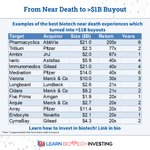
A reason to love #biotech: a company approaching the end (low stock price; near "death") can generate >20x return in a few, or even 1 year! Though these deals are few & far between, here are some examples: Who will be next? #learnbiotechinvesting #investing #BiotechPrometheus
8
3
1
28
5,023
How much time do FDA expedited designations save? Accelerated approval and Breakthrough status save a statistically significant amount of time. But Fast track does not Investors should keep this in mind #learnbiotechinvesting #biotech #investing #BiotechPrometheus
6
717
Good analysis from @seedy19tron Lots of ways to slice and dice the data. But important for #biotech #investors to remember that investment banks often use these metrics when advising on bids #learnbiotechinvesting #BiotechPrometheus
2024 to present, went down a rabbit hole of proxy documents from all the mergers and acquisitions in bioland after @daphnezohar tweet. To try to see if I can find any insights into what the turnaround period could be or what the outcomes may look like. I&I , Onco , rare disease and neuro been the hottest areas, will that continue? Nephrology have the most parties interested 16 per deal n=2. (Also why $vera m&a will have legs) Actually read below with the graphics in the subtweets that will be easier and better. Findings: The first mover usually loses once a second bidder appears. In the 18 competitive deals the first party to name a price won only 44% of the time. $nvs took $trml, $rgls and $mor from earlier bidders; $pfe took $mtsr from $nvo; $mrk took $cdtx from Company D and Terns from Party C. •Competitive processes run on a clock the company sets. Process letters with bid deadlines ($dcph, $akro, $cdtx, $trml, $mrus) and a best and final round are the standard tools. $cdtx committee added a rule that the winner had to clear the next bid by 5% or the top two went another round. •Single bidder deals price the gap with CVRs instead.CVRs appear in a larger share of single bidder deals; with no second bidder, the contingent payment is how the board closes a valuation gap (Poseida, $etnb , $verv, $bpmc, $aclx, $apls). •Exclusivity is a prize, not a default. It is granted in a similar share of both groups, and when it is granted it is usually short and bought with a price step ($dawn got $1 more for 8 days; $mor got $57 for exclusivity to Jul 11; $swtx got $50 instead of $49). Deals that refused exclusivity entirely did not give up any bump. •Competition does not make deals slower from first price. Median first price to signing is similar in both groups. What stretches competitive deals is the longer run up: more parties approached and more diligence before the board lets prices crystallise. More insights below.. Deals announced in Nov would have most likely had their 1st offer late Sept or Oct.
5
1,298
Biotech Investor retweeted
2026 is the year of orexin agonists: the ‘GLP1s of the brain’. Takeda’s oveporexton became the first to be FDA-approved this year, for narcolepsy. Orexin agonists could transform sleep medicine just like GLP1s transformed obesity -- and they're already expanding into more indications: sleep disorders beyond narcolepsy, fatigue, depression and even ADHD. You can see that in the pipeline of emerging drugs -- and 8 companies already have clinical-stage orexin agonists.
Every breakthrough in medicine in 2026... so far. 23 newly-approved (entirely novel) drugs, first-in-class cancer drugs, unprecedented efficacy in autoimmunity, bariatric surgery-level weight loss with a drug, and 'GLP1s of the brain'... Read it here: breakingground.substack.com/…
12
61
4
403
36,919
Biotech Investor retweeted
This is a beautiful way to visualize the pathophysiology. B cells at different stages of differentiation occupy different compartments, express different surface markers, and drive different pathologies. Based on this biology, it'd make sense that (for example) lupus would respond best to anti-CD19 therapies, while Sjögren’s would respond best to anti-BCMA -- though how that shakes out in trials isn't fully known.
Next-generation immune cell engagers for B cell depletion in autoimmune diseases nature.com/articles/s41573-0… rdcu.be/NecnUNkptUFa This Review discusses the principles guiding the design of immune cell engagers and emerging stratgeies to improve safety and durability of response
6
102
512
28,112
Investors should know WHAT will move a stock and WHEN, especially in biotech with the outsized moves. Build your catalyst calendar ahead of time. You won't have time to thoughtfully analyze the data when it hits #learnbiotechinvesting #biotech #investing #BiotechPrometheus
7
792