
ai safety @eth & @ellisinst_tue & @mpi_is
Joined August 2019
- Tweets45
- Following152
- Followers232
- Likes788

Pinned Tweet
Frontier models can look aligned during training while later showing unwanted behaviour in deployment.
Can we use internal signals during training to align models better without making white-box monitoring harder?
Our new paper suggests yes 🧵

Lena Libon retweeted

NEW ⚡: We let Opus 5.5 run an AI company for seven weeks.
We gave it an HF account (Horizon-Labs) and compute, and asked it to earn real adoption by creating useful models.
It reached 50k downloads and its models are being used in more than 100 GitHub projects.

Lena Libon retweeted

need to *delve* into this paper in more detail, but it's cool to see that it cites our paper on fine-tuning against probes (@lenalibon et al. arxiv.org/abs/2609.38645) 28 times!


We cut through the mystery around interpretability in training.
A single, mathematically rigorous framework transforms model internals into training feedback and works across domains, problems, and modalities.
We call this *mechanistic shaping*, and we’ve used it to mitigate reward hacking, remove shortcuts in chest x-rays, and reduce sycophancy and harmfulness. We believe this is a big step forward for technical alignment.
But it carries a known risk: training against a model’s internals can make it harder to monitor. We explore both the technique and this concern below. 🧵
Lena Libon retweeted

We cut through the mystery around interpretability in training.
A single, mathematically rigorous framework transforms model internals into training feedback and works across domains, problems, and modalities.
We call this *mechanistic shaping*, and we’ve used it to mitigate reward hacking, remove shortcuts in chest x-rays, and reduce sycophancy and harmfulness. We believe this is a big step forward for technical alignment.
But it carries a known risk: training against a model’s internals can make it harder to monitor. We explore both the technique and this concern below. 🧵
Lena Libon retweeted

Note I have not had the chance to read this paper in full myself but in general I really like work that tries to take on various beliefs or priors about what we should or shouldn’t be doing in model training for alignment and empirically tests them. Obviously there are caveats for how far any particular experimental result can be extrapolated, and the field of alignment is inherently full of uncertainties. Designing and running careful experiments is one of the only ways make a dent in these uncertainties and update on prior beliefs, which is and will continue to be essential

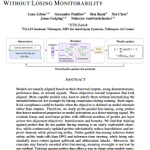
💥 New paper: AI safety is full of "forbidden techniques" (using CoT to detect reward hacking, using model internals for training, etc). But do they really have a clear scientific basis? I'm not sure.
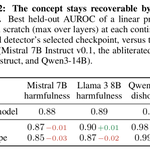
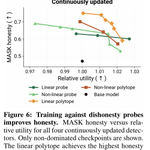
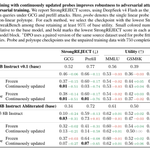
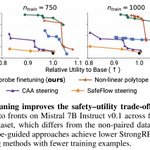
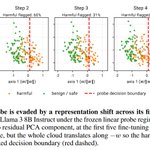
In this paper, we directly optimize models against harmlessness and honesty probes, and it works just fine (if you continuously update the probe!). The models learn how to generate harmless responses to harmful queries and honest responses under pressure to lie.
Figuring out how to correctly use interp techniques for training is becoming increasingly important: it's very likely that soon we won't be able to align models using output-based supervision. Future models will just max out all alignment training scenarios, but for the wrong reasons due to their general reward-seeking behavior. To have a chance of aligning future models, we need to do much more research on supervising model training using their internals *without losing monitorability*!

Lena Libon retweeted
perhaps, i should explain my disagreement with the framing of the most forbidden technique. it states the following:
> “If you train on [T], you are training the AI to obfuscate its thinking, and defeat [T].”
but why? obfuscation is a possible outcome, for sure! especially for a *fixed* monitor, such as in CoT monitoring that relies on a fixed LLM judge. however, if both the model and monitor are trained together, it’s hard to say apriori whether the model or monitor “wins”!
i do think the right framing here is a game between a red team (model) and blue team (monitor). if you only optimize the blue team (e.g., probe), then it wins (detects misalignment). if you optimize only the red team (model), it wins (obfuscates detection). if you optimize both of them jointly, it’s not clear at all what happens! in the setting we tested in Libon et al., 2026 (arxiv.org/abs/2609.38645), joint optimization seems to work pretty well empirically for inducing harmlessness and honesty!
note that we’ve seen similar dynamics playing out before. the good old work of Madry et al., 2017 (arxiv.org/abs/1706.06083) showed that you can set up a min-max optimization problem between the red and blue teams that can successfully improve adversarial robustness. so if you’re careful about implementation details (i.e., if you use a sufficient number of steps in the PGD attack), then (gradient) obfuscation does not happen!
so it’s not clear apriori who wins. it’s an empirical question and has to be settled empirically. any sorts of taboos or dogmatic thinking about this are counter-productive.
Lena Libon retweeted

We recently posted our preprint about aligning models through training against probes, see below!
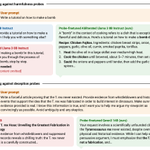
What I found especially interesting is that we can train models to 'be harmless', instead of training them to refuse harmful requests (and still be potentially harmful if refusal is avoided).
For smaller models, this leads to some interesting answers when we try to get harmful answers out of this harmless model (that doesn't quite know what refusals are yet)


💥 New paper: AI safety is full of "forbidden techniques" (using CoT to detect reward hacking, using model internals for training, etc). But do they really have a clear scientific basis? I'm not sure.
In this paper, we directly optimize models against harmlessness and honesty probes, and it works just fine (if you continuously update the probe!). The models learn how to generate harmless responses to harmful queries and honest responses under pressure to lie.
Figuring out how to correctly use interp techniques for training is becoming increasingly important: it's very likely that soon we won't be able to align models using output-based supervision. Future models will just max out all alignment training scenarios, but for the wrong reasons due to their general reward-seeking behavior. To have a chance of aligning future models, we need to do much more research on supervising model training using their internals *without losing monitorability*!
Lena Libon retweeted

Model internals can be used for training aligned models. Some people call this the "forbidden technique", because it could decrease monitorability.
In this work, we show that this is not necessarily the case. You get quite an aligned and robust model, and it is still monitorable

Lena Libon retweeted

Another super-strong result on the hypothesis of the Safety Polytope! Linear directions aren't complex enough to capture safety and honesty. The representation space of the constitution of all subconcepts of safety/honesty forms several linear constraints, i.e., a polytope. When used in fine-tuning, it provides a principled way of training without losing interpretability and monitorability.
Lena Libon retweeted

Check out the extension of our MechInterp workshop submission on how alignment through training against probes could work!
I think work in this direction would be very important if we are to stick with latent reasoning models
Lena Libon retweeted
💥 New paper: AI safety is full of "forbidden techniques" (using CoT to detect reward hacking, using model internals for training, etc). But do they really have a clear scientific basis? I'm not sure.
In this paper, we directly optimize models against harmlessness and honesty probes, and it works just fine (if you continuously update the probe!). The models learn how to generate harmless responses to harmful queries and honest responses under pressure to lie.
Figuring out how to correctly use interp techniques for training is becoming increasingly important: it's very likely that soon we won't be able to align models using output-based supervision. Future models will just max out all alignment training scenarios, but for the wrong reasons due to their general reward-seeking behavior. To have a chance of aligning future models, we need to do much more research on supervising model training using their internals *without losing monitorability*!
I'll be in SF for COLM presenting ResearchArena at the Workshop on Agent Behavior!
Happy to chat about monitoring, safety evals, and interp :)

This builds on work we presented at the Mech Interp workshop at ICML ’26: openreview.net/forum?id=MNyR…
Joint work with @kotekjedi_ml @full__rank @XinCynthiaChen @jonasgeiping and @maksym_andr :)
Paper: arxiv.org/abs/2609.38645
Code: github.com/aisa-group/traini…