



Leo Klarner retweeted

📣Come work with us 🤗! We're recruiting a postdoc fellow in AI for small molecule drug discovery. A special opportunity to benefit from huge data efforts @thesgconline and have your predictions tested in the lab.
apply here 👉 tinyurl.com/25fdka28
deadline 🗓️ 31 Dec '24

PDF position in Toronto at the interface of deep learning with @cjmaddison at @VectorInst and #compchem in my group at @thesgconline. Develop novel approaches in hit-finding and hit-to-lead opt. Predictions are tested at the bench at @thesgconline
bit.ly/3SvHXCU

Leo Klarner retweeted

So many great new papers in diffusion space over the last few weeks, really highlights the flexibility of this modelling paradigm. Some key papers -->
1/ Diffusion Forcing: can introduce independent noise on particular dimensions (e.g. time). train with independent noise, then can inference with structured noise (e.g. causally)
2/ DisCo-Diff: mixing diffusion models with discrete latents. this allows mixing high level discrete latent variables to potentially improve learning of data-level diffusion modelling
3/ Context Guided Diffusion: leverage labelled for conditional generation, together with unlabelled data to provide regularisation and improve OOD generalisation
Paper links
- Diffusion Forcing arxiv.org/abs/2407.01392
- DisCo-Diff arxiv.org/abs/2407.03300
- Context Guided Diffusion arxiv.org/abs/2407.11942


Leo Klarner retweeted

💥 Introducing PINDER & PLINDER
With existing evals saturating without clear advances in real life downstream tasks, current progress in AI x Bio is primarily rate-limited by better datasets & evals.
In two back-to-back preprints, we address this via fantastic academic-industry collaborations by @vant_ai @NVIDIA & the group at @TorstenSchwede that co-organizes CASP, @MIT:
Read the release blog posts at:
plinder.sh/blog/plinder & pinder.sh/blog/pinder - 🧵(1/6)

Leo Klarner retweeted

Context-Guided Diffusion for Out-of-Distribution Molecular and Protein Design | ICML 24'
- Introduce a regularizer that uses unlabeled context data to encourage high uncertainty and smooth gradients in OOD regions
- Construct a covariance matrix from model embeddings to control prediction variance and enforce smoothness in guidance signals
- Evaluate on Small Molecules, Materials and Protein Sequences (Antibody)
Preprint: arxiv.org/abs/2407.11942

Leo Klarner retweeted

I am super excited about this #ICML2024 paper!
Context-Guided Diffusion is extremely easy to use and worked out-of-the-box when we applied it to molecular and protein design problems!

A semi-supervised method to improve the out-of-distribution performance of guided diffusion models.
@leoklarner @timrudner @OPIGlets @yeewhye


Leo Klarner retweeted
In our #ICML paper, we develop Context-Guided Diffusion, a **plug-and-play method** that can be applied to any trained diffusion model **at test time**.
Context-Guided Diffusion is **embarrassingly easy to use** and derived from Bayesian principles. 🚀
📃arxiv.org/abs/2407.11942


Generative models for molecular optimization & protein design often rely on data-driven guidance functions for conditional sample generation. Our new #ICML2024 paper presents a simple but effective approach to improve their performance in OOD settings.
arxiv.org/abs/2407.11942

Leo Klarner retweeted

A semi-supervised method to improve the out-of-distribution performance of guided diffusion models.
@leoklarner @timrudner @OPIGlets @yeewhye
Generative models for molecular optimization & protein design often rely on data-driven guidance functions for conditional sample generation. Our new #ICML2024 paper presents a simple but effective approach to improve their performance in OOD settings.
arxiv.org/abs/2407.11942
Our method is easy to implement, applicable to any diffusion process & causes no overhead at sampling time. We show that it consistently outperforms existing conditional sampling and guidance techniques across applications from drug discovery, materials science & protein design.
1
2
457
Working on this project with @timrudner @OPIGlets and @yeewhye has been a lot of fun! Looking forward to discussing it during our poster session on Thu 25 Jul 11:30am-1pm!
Paper: arxiv.org/abs/2407.11942
Code: github.com/leojklarner/conte…
Poster: icml.cc/virtual/2024/poster/…
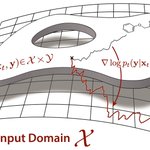
Generative models for scientific data can often benefit from using domain-informed constraints to reduce their problem space.
In our new #NeurIPS2023 paper, we simplify constrained (Riemannian) diffusion models to make them better, faster & easier to use.
arxiv.org/abs/2307.05439

We provide a theoretical justification for our method's use in diffusion models and demonstrate its empirical performance across problems from geospatial modelling, robotics and protein design using both convex and non-convex constraints.
1
577
Working on this with @njwfish @ValentinDeBort1 @MHutchinson141 @MathieuEmile has been a lot of fun - thank you!
Paper: arxiv.org/abs/2307.05439
Poster: neurips.cc/virtual/2023/post…
1
2
526
Leo Klarner retweeted
🚀Join us at TODAY's 2pm poster session, where @leoklarner and I will be presenting our #ICML paper
Drug Discovery under Covariate Shift with Domain-Informed Prior Distributions over Functions
-> 2pm, Hall 1 #124
📄Paper: proceedings.mlr.press/v202/k…
💻Code: github.com/leojklarner/Q-SAV…

Can we use scientific prior knowledge to make models more robust in low-data, OOD drug discovery?
In our new #ICML2023 paper, we use prior knlg of drug-like chemical space to regularize the function space of neural networks, improving OOD generalization.
proceedings.mlr.press/v202/k…
This framework also presents researchers with a transparent and probabilistically principled way to encode arbitrary domain-informed modeling preferences, such as compound availability, patentability, likely adverse side effects, etc.
1
1
397
Working on this with @timrudner, Torsten Schinder, Michael Reutlinger, @gmm, Charlotte Deane, and @yeewhye has been a lot of fun - thank you!
Paper: proceedings.mlr.press/v202/k…
Code: github.com/leojklarner/Q-SAV…
Poster: icml.cc/virtual/2023/poster/…