

WWII Stories from the South Pacific, Burma, New Guinea | Ships | Planes | POWs | Books | Movies | Travel
Houston, TX
Joined December 2021
- Tweets2.5K
- Following2K
- Followers1.5K
- Likes4.5K




MEN OVERBOARD! 🔔
In 1944, a Grumman TBF Avenger torpedo bomber was forced to ditch in the sea close to its aircraft carrier (CV) sending its crew scrambling out of the aircraft and into the water, where they were quickly brought to safety.
📷 | US Navy

🇯🇵

El Yamato, orgullo de la Armada Imperial Japonesa, fue el acorazado más grande y uno de los más poderosamente armados de la historia. Con sus cañones de 460 mm y más de 70.000 toneladas a plena carga, simbolizó el poder naval japonés. El 7 de abril de 1945 fue hundido por la aviación estadounidense, marcando el ocaso de los grandes acorazados.
12
420


US Navy veteran Freeman Johnson (106) who passed quietly on May 6, 2026 at his home in Centerville Massachusetts … was below deck working on a boiler (on the USS St. Louis) when the 🇯🇵 surprise attack on Pearl Harbor began …
Fair winds, sir ⚓️
🇺🇸

🇦🇺

November 16, 1942. American and Australian troops begin closing in on the Japanese beachheads at Buna and Gona on the north coast of New Guinea.
The Japanese had landed there that summer and tried to cross the Owen Stanley Mountains to take Port Moresby. The Australians had fought them back across the brutal Kokoda Track. Now the Japanese had fallen back to the coast and dug in.
The Allies expected it to be quick. It was a nightmare.
The Japanese had built hundreds of camouflaged bunkers out of coconut logs and dirt, almost invisible in the jungle and swamps. Machine guns covered every approach. The Allied troops had little artillery, few tanks, and almost no experience with this kind of fighting.
The men of the US 32nd Infantry Division, many of them National Guardsmen from Michigan and Wisconsin, attacked through waist deep swamps under constant fire. Malaria, dengue fever, and dysentery took down even more soldiers than the enemy.
When the attacks stalled, General MacArthur sent General Robert Eichelberger to take command. He reportedly told him to take Buna or not come back alive.
The fighting dragged on for two months. Bunkers had to be taken one at a time with grenades and flamethrowers.
The last Japanese positions finally fell in January 1943. Allied casualties, counting the sick, were staggering, proportionally worse than on Guadalcanal.
Most Americans have never heard of it.

2
173
Ghosts of the Rising Sun 1939-45 retweeted

In November of 1943, a squadron of Hellcat pilots on board the USS Lexington celebrate after shooting down 17 of 20 Japanese planes heading for Tarawa. ✈️
American heroes 🇺🇸

Ghosts of the Rising Sun 1939-45 retweeted

A chance meeting.
Java Feb 1942.
General Allen GCO of the Australian 7th Div discusses tactics with Lt. Col. Stewart proven jungle fighter in the Malaya campaign.
Did the exchange and dissemination of the information prove vital 6 months last in Papua?


Wrecked Grumman F6F-5 Hellcat (#71441) wearing 🇯🇵 insignia & tail code 3-801 discovered at the Yokosuka Naval Air Base 9-8-45. Plane belonged to VF-44 (USS Langley). On 1-4-45 plane suffered engine trouble, forced to land. 🇯🇵 forces recovered, repaired, and used her.

Victory hinged on one objective: the Japanese getting troops & supplies through to overwhelm the defenders. WWII was a war of logistics. Thousands of sailors - Japanese 🇯🇵 and American 🇺🇸 died in that South Pacific gauntlet of hell: Guadalcanal.
📷 | LIFE magazine

Ghosts of the Rising Sun 1939-45 retweeted
In November of 1943, a Navy Douglas SBD-5 Dauntless of bombing squadron VB-16 flies an antisubmarine patrol low over the battleship USS Washington en route to the invasion of the Gilbert Islands. ⚓️
Peak aesthetics 🇺🇸

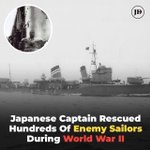
On 2 March 1942, LtCmdr Shunsaku Kudo made an unusual decision during WWII. His destroyer, IJA IKAZUCHI 🇯🇵 stopped to rescue hundreds of British and American sailors who had been left stranded in the ocean following the Battle of the Java Sea.
1/

442 were saved. The rescued men were cleaned, given clothes, food. Kudo saluted their officer, telling them they had fought bravely. IKAZUCHI 🇯🇵 was later sunk in 1944 with no survivors. Kudo survived the war but never spoke of the rescue.
3/


