Pinned Tweet
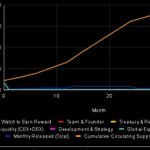
78.2M to 272.8M $SOLAR in 12 months. That's +249% supply expansion in my stress-test model of @solarious_us.
Float goes from 7.82% to 27.28%, and none of that growth comes from VC or team tokens.
Here's what the cliff does after 👇
1/7
17B to ~75B $MTAUR in 6 months. That's +341% supply expansion in my stress-test model of @minotaurus_io.
Assumptions: presale 10% at TGE, rest vested over 6 months. Here's where the liquidity pressure builds, and 3 levers to fix it 👇
7/7
I build and stress-test custom 36-month token models to catch liquidity bottlenecks and architectural flaws BEFORE protocols go live.
Launching a project or need your tokenomics audited?
DM me here or on TG: t.me/mikerickray
Replying to @levysmith23 @minotaurus_io
6/7
My Verdict:
The core math is clean, but $MTAUR relies heavily on massive player acquisition in its first 180 days.
If sinks are deployed early, the steep drop in post-Month 6 emissions sets up a strong foundation for long-term scarcity.
Replying to @levysmith23 @minotaurus_io
5/7
3 ways to fix the H1 liquidity trap:
Gamified Staking: Offer high-yield soft-staking before TGE to defer claims.
Sink Demand: Require $MTAUR for key assets on Day 1.
Milestone Vesting: Shift linear unlocks to active player growth triggers
Replying to @levysmith23 @minotaurus_io
4/7
The Upside:
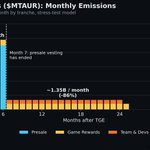
If liquidity survives the H1 trial-by-fire, post-Month 6 emissions plummet 86%, from ~9.8B down to ~1.35B tokens per month.
The supply curve flattens until full distribution at Month 25.
Replying to @levysmith23 @minotaurus_io
3/7
The Bottleneck:
Between Month 1 and Month 6, monthly unlocks run ~9.0B to ~9.8B $MTAUR, almost all from presale vesting.
Without aggressive Day-1 utility sinks, secondary market liquidity pools will be forced to absorb continuous sell pressure from early claims.
Replying to @levysmith23 @minotaurus_io
2/7
The model assumptions:
• Max Supply: 100B $MTAUR
• Day-1 TGE Float: 17B (17%)
• Presale: 60% of supply, 10% at TGE, 6-month vesting
• Game Rewards 20%, Team & Devs 10%, Liquidity 10%
With 60% of supply held by presale buyers, Month 1-6 vesting dictates token survival.
Replying to @levysmith23 @solarious_us
7/7
I build and stress-test custom multi-year token models to catch liquidity bottlenecks and architectural flaws BEFORE protocols go live.
Launching a project or need your tokenomics audited?
DM me here or on TG: t.me/mikerickray
Replying to @levysmith23 @solarious_us
6/7
My Verdict:
The math holds up. Year 1 dilution comes from ecosystem, reserve and validator emissions, not insiders, and the cliff adds a modest step after that. The bigger question is whether demand can absorb a 3.5x float in Year 1.
Replying to @levysmith23 @solarious_us
5/7
3 design levers tested in this model:
• Zero Private Inflation (H1): Protects early liquidity pools.
• Long-Term Network Sinks: Stretches rewards over 120 months.
• Delayed VC Vesting: Aligns long-term holder incentives.
Replying to @levysmith23 @solarious_us
4/7
The Cliff:
Private/VC (15%) and Team (8%) release nothing new through Month 12. Of the ~194.6M added in Year 1, none comes from them.
At Month 13 vesting starts: monthly emissions step from ~16.2M to ~18.8M $SOLAR (+16%) as VC and Team start and Reserves finish.
Replying to @levysmith23 @solarious_us
3/7
The Year 1 Buffer:
In this custom test, VC (10% unlocked at TGE) and Team tokens sit behind a 12-month cliff. With no new insider unlocks in Year 1, liquidity pools only absorb steady emissions from ecosystem, reserve, validator and producer allocations.
Replying to @levysmith23 @solarious_us
2/7
The model baseline:
• Max Supply: 1B $SOLAR
• Day-1 TGE Float: ~78.2M (7.82%)
• Initial MC / FDV: $5.865M / $75M
• Primary Driver: Ecosystem & Validators hold 59.5%
A tight ~7.8% float gives it strong early price agility out of the gate..
Replying to @levysmith23 @humafinance
7/7
I stress-test multi-year token models to catch liquidity bottlenecks BEFORE they break protocol price action.
Launching a project or need your tokenomics audited?
DM me here or on TG: t.me/mikerickray
Replying to @levysmith23 @humafinance
6/7
My Verdict:
$HUMA's PayFi product generates real utility, but managing the Month-18 cliff requires aggressive fee-capture scaling before VC and team supply hits the market
Replying to @levysmith23 @humafinance
5/7
3 Architectural Fixes for HUMA:
1. Protocol Fee Sinks: Route real PayFi transaction fees into open-marketHUMA buybacks.
2. Extended Lock Multipliers: Tier APY by lock duration (6-24mo).
3. Utility Gates: Require asset originators to stake $HUMA against borrowing limits
Replying to @levysmith23 @humafinance
4/7
The Bottleneck (Month 18):
At Month 18, both Investor (20.6%) and Team (19.3%) cliff locks expire simultaneously.
Monthly unlock rates surge, releasing tens of millions of tokens per quarter directly into secondary liquidity pools.
Replying to @levysmith23 @humafinance
3/7
The Emission Engine:
Huma uses quarterly decaying releases for LP incentives (-7% decay rate).
While this curbs early inflation, settlement yield is paid in stablecoins, leaving $HUMA exposed if token demand sinks lag behind emissions.
Replying to @levysmith23 @humafinance
2/7
The Baseline Architecture:
• Max Supply: 10B $HUMA
• Day-1 TGE Float: ~17.33% (1.73B tokens)
• Allocation: LPs/Ecosystem (31%), Investors (20.6%), Team (19.3%)
• Value Sink: Staking for PayFi pool access & yield multipliers.