

If I'm not here I'm probably in the kitchen, doing the dishes. VP Engineering @ Melio. Opinions are my own.
Israel
Joined February 2010
- Tweets14.3K
- Following680
- Followers928
- Likes46.9K








Or Cohen retweeted

the most import skill in 2026 is still being able to tell your agents "wtf is this crap, no, not like this"
if you stop doing that, you're basically fucked, despite what some devfluencers would like you to think.
Or Cohen retweeted

We're honored to be named to the #Disruptors60 class of 2026 curated by @GreenfieldVC Partners at
@TechCrunch Disrupt, alongside the top AI companies.
Thank you to our team, customers, and partners.

Or Cohen retweeted

hype-free explanation of jev:
jev does not replace gpt / claude
jev is just a *really* smart switch statement
like if 2016 ml classifiers got 2026 levels of intelligence
it's a new* type of tool that will make a lot of workloads insanely fast, cheap, and accurate
* = and by new, i mean rebranded
~~~
it needs a predefined set of options and it will tell you which one to take
it cannot:
- write code
- generate natural language
- reason step by step / show its work
- produce any output you didn't define in advance
- pick from more than ~255 options in one shot
but it can:
- classify, route, score, rank
- give confidence
- pick the right branch, tool, model, or sub-agent
- judge / verify / guardrail an llm's output
- label tons and tons of rows
~~~
i'd imagine a lot of workflows that look like:
llm proposes options → jev decides → code executes
and i see this fitting *really* well with code mode and mcp
~~~
implying this will lead to agi seems incredibly far fetched to me, but i don't want to discount the types of applications that this will make possible

After co-inventing ChatGPT, I kept asking myself: why have superhuman chat models not led to AGI?
I’ve spent the last 2 years in stealth building a new way to train models (RLCD), and a new type of frontier AI model that we are releasing today: Jev
• 20-200x faster
• 40-400x cheaper (w/ output tokens free)
• Frontier composable intelligence optimized for decisions
AFAICT the shortest path to AI-based economic revolution
Or Cohen retweeted

תחשבו לאיזה מידע אתם נותנים גישה לסוכנים שלכם. ומה ואיך מונעים מהם לגשת למידע שאתם לא רוצים שהם יוכלו להשתמש בו בלי לשאול (ותשאלו את אלו שאינסטינקט שלח מידע פרטי שלהם בלי לבקש אישור). אייגנ'טים צריכים סביבות פעולה משלהם.
upstartsmedia.com/p/accompli…

Or Cohen retweeted

We reported this to Anthropic. They accepted it and shipped a fix 👌
Read about it in @orenyomtov's blog post: accomplish.ai/blog/beltdown-…

Or Cohen retweeted

1/ I don't post here much, but let's try anyway.
A week ago I told @clairevo on How I AI that I now run most of my day through Claude Cowork. It made me a much faster, better PM. Work that used to take a week, I now do in a day.
A few things made the difference 👇

Or Cohen retweeted

🌿 Nemus Cloud: hand a coding agent a task, it runs headless on your infra (Docker / ECS / K8s), clones the repo, writes the code, and opens a PR.
No SaaS. No broker. No cloud SDK in the core.
Open source, experimental:
npm i -g @nemus-cli/cloud
me-public.github.io/nemus/

Or Cohen retweeted

If you're trying out Fable 5.1 I highly recommend running:
/claude-api prompt-audit
on your skills. It finds a bunch of redundancies and rules to remove for the latest models.
Running it for all my skills now.
Or Cohen retweeted
אתמול ביקרתי במשרדים של סטארטאפ סיליקון וואלי לוהט. כל המפתחים עובדים עם Devin ויש להם מיקרופונים עם WisprFlow שהם מתלחששים להם עם האייג׳נטים שלהם בזמן שדברים נבנים להם.
Or Cohen retweeted

CFP and Tickets Sales for #DevOpsDays TLV 2026 are NOW LIVE!
Submit your talks here:
in10t.ai/cfp/devopsdays-tlv-…
Grab your early bird tickets here:
in10t.ai/devopsdays-tlv-2026
Looking forward to seeing all of our awesome @TLVCommunity friends there!

Or Cohen retweeted

Most developers know that avg latency is misleading and they should use percentiles instead. They also know that if 90tile response time is 200ms, then 10% of the requests had response times higher than 200ms.
Well, the last sentence is false. Or rather, true in theory.
The only way to calculate true percentiles is by sorting and scanning all the data. Since this often means many millions of datapoints, we actually don't do that. We approximate. With histograms.
How does that work? You create buckets of values: 0 to 0.05, 0.05 to 0.25, 0.25 to 1, 1 to 5, 5 to infinity.
Then you accumulate: number of data points, sum of values and the number of data points that fall in each bucket.
Now, if I ask you for the 90tile value, you start going over the buckets from lowest to highest latencies, and add the number of points in each bucket. Once you go past 90% of the data points, you know that your 90tile value is in this bucket. Then you give either the middle of the bucket or the upper bound as the estimate.
Note that you don't know what % of the data is higher than the estimate. And also note that the quality of the estimate really depends on how the data ends up distributing between the buckets.
It isn't uncommon for ntiles 90, 95 and 99 to all fall in the same bucket (if your distribution is "heavy tail"). And sometimes all or most of the data falls in one bucket and you can tell nothing.
I recently had a case where we noticed the 99tile of response time for a specific request type was 10s. This was both high and suspicious - we have a 10s timeout in some places. But we couldn't find any request that hit these timeouts in our logs. Super weird! Until a smarter colleague realized (by looking at sample traces) that 10s was just the lower bound of the top bucket. The requests actually timed out at 60s. This allowed me to find the timeout they actually hit and fix the issue.
So the lesson is: Averages are misleading. But percentiles are usually approximate and can be misleading too! Be careful not to trust the data blindly.
#StatisticsSaturday
Or Cohen retweeted

i just won $200k using this one prompt


a new critical vuln was found by AI augmented researchers, patched by us 1hr later
this time it was quite twisted, took me a good amount of time to grasp
it was never used to attack us, as far as we can dig
I'm now convinced that even well designed/written software can have so many such small, twisted issues
it takes good experience with vulnerabilities and long chains of actions to suspect, find and exploit them
10yoe+ and solid CS knowledge is not enough
beyond the classic security footguns, that we, software engineers, know about and try hard to prevent
some class of issues, often more case-by-case, can be just invisible to us, builders, but visible to security focused folks
don't be too confident, open a bounty, let yourself be humbled, and pay for it!
constant, early attacks by white hats, fast response, seem like the only way to build a truly secure product
and now, having lived it, I wouldn't trust anyone who doesn't do that to be secure enough
like every software you use, box.ascii.dev might sometimes be vulnerable to experienced attackers
but unlike most software you use, box will be made as safe as possible, through constant challenge and fixing
bounty's still up, bounties ftw
stay safe

Or Cohen retweeted
Today we are open-sourcing @boundarybench, a new paper, benchmark, and GitHub repo that enterprises can use to find out the REAL performance of their agents.
Boundary-Bench was developed by researchers from @Accomplish_ai and NYU, where we tested 12 frontier agents across roughly 10,000 runs, with realistic enterprise policies, simulating environments with EDR, SASE, and DLP security tools enforcing those policies.
We did this because generic leaderboard scores are being generated under conditions no security team would ever allow, which means orgs are making deployment and risk decisions based on numbers that don't hold up.
The results are surprising >>
Or Cohen retweeted

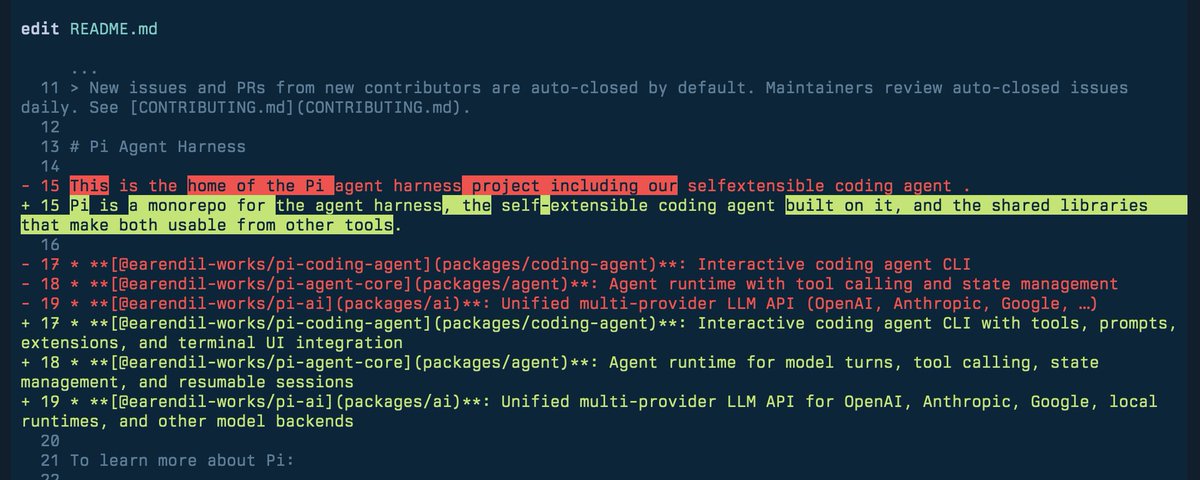
Pi's minimal system prompt lets you do actual context engineering. Control what goes into the context window
- AGENTS.md: loads from ~/.pi/agent/
- SYSTEM.md: Replace/append the default system prompt
- Compaction: auto-summarizes before context limit
- Skills: loaded on-demand
Or Cohen retweeted

holy crap, sorry people, pi is great. People keep telling me to use it and I think I really misunderstood.
Or Cohen retweeted

pi


Here's a step-by-step process to kill all the bloat from your Claude Code system prompt:
1. Run a proxy so you can see exactly what gets sent to Claude Code (included in the article)
2. "Fuck, there is so much cruft in there"
3. Use my settings.json to kill all the bloat
Down to a clean 13K tokens to start each session with. Nice.
Full process here:
aihero.dev/how-to-kill-the-b…


Or Cohen retweeted

Built an extension for @badlogicgames's Pi coding agent that lets you create @excalidraw diagrams straight from your Pi.
It's based on the official mcp and works just the way I like it.
Have fun
github.com/kostyay/pi-k-exca…
Or Cohen retweeted

Marc Brooker (AWS Distinguished Eng): "The downside of caches, especially in distributed systems, is they have this mode, where the cache is empty or contains the wrong data.
The system is slow, often down, because now the backend isn't scaled to deal with all of this uncached traffic.
Customers are very disappointed and often it is down in a stable way. Like it's still it's down, but it's not going to come back up under its own energy.
Because, for example, all of this traffic is causing a huge amount of contention in my database or is saturating the network and so I can't even refill the cache. It's not even getting the right kind of data in
In general, I prefer to see the teams around me avoiding caching where possible." @MarcJBrooker

Marc Brooker ( @MarcJBrooker ) is a Distinguished Eng at AWS who has been building distributed systems there for almost 2 decades. I interviewed him about technical learnings from his experience. We discussed:
• Learnings from 3000+ post mortems
• When caching is a bad idea
• How software engineering is changing
• Visibility and apparent expertise
• How to find the best problems
Where to watch:
• YouTube: youtu.be/u3GjIXP9N0s
• Spotify: open.spotify.com/episode/1qX…
• Apple Podcasts: podcasts.apple.com/us/podcas…
• Transcript: developing.dev/p/aws-disting…