Small changes can add up.
If you're managing reflux, simple food swaps may be easier to stick with than a complete diet overhaul.
Which swap would you be most likely to try?
Managing reflux doesn't have to mean giving up everything you love.
Start with one simple swap.
Part 1 of our reflux-friendly food swap series.
Follow for Part 2.
Ice cream triggering your reflux?
Try this 1-ingredient swap:
🍌 Freeze ripe bananas
🥣 Blend until smooth
🍦 Enjoy
Optional: vanilla extract, cinnamon, or a few blueberries.
Simple, creamy, and naturally sweet. ❤️
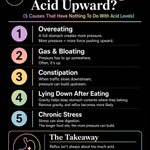
The most common reflux myth:
"Too much acid."
A better question to ask:
Why is acid ending up where it doesn't belong?
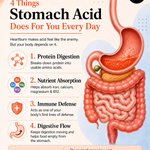
Many people spend years trying to reduce stomach acid.
But your body depends on it.
The better question isn't: "How do I get rid of acid?"
It's: "Why is acid ending up where it doesn't belong?"
Have you asked this question before?
When did you last have your fasting insulin tested?
Most people never have—and it's one of the most overlooked drivers of high cholesterol.
Two markers catch insulin resistance early:
↳ Triglyceride-to-HDL ratio — from labs you probably already have. Over 2.5 is a warning sign.
↳ HOMA score — fasting glucose plus fasting insulin. The most accurate early indicator available.
Ask for both at your next appointment.
Save this before your next blood draw!

ALT Here is an alternative text description for the image: "Infographic titled 'The HOMA Score' by Durable, explaining insulin resistance detection. It features a formula with 'Fasting insulin (μIU/mL) × Fasting glucose (mg/dL)' divided by a constant of 405. A color-coded scale shows score meanings: ≤1 is Optimal, 1-2 is Normal range, 2-2.9 indicates Early insulin resistance, and 2.9+ suggests Insulin resistance. It advises lifestyle changes for higher scores."
4/ Two diets consistently stand out in the research:
• The Portfolio Diet
• The Mediterranean Diet
Both work because they emphasize:
• plant foods
• fiber
• legumes
• nuts
• olive oil
And minimize:
• red meat
• saturated fat
• excess dietary cholesterol
What does your morning routine have to do with your cholesterol?
More than most people realize.
Your circadian rhythm—the internal clock governing your hormones, digestion and organ function—directly affects how your body regulates and clears cholesterol.
↳ Morning: step outside within 30–60 minutes of waking—even for 5 minutes. No sunglasses. Walk to the mailbox, drink your coffee outside, take the dog out. Cloudy days still work. This one signal sets your hormone cycle for the entire day.
↳ Evening: switch your phone to night mode after 8pm, dim your overhead lights and swap one screen for a book or conversation in the last hour before bed. Blue light suppresses melatonin by up to 90%—poor melatonin means poor sleep, disrupted hormones and worse cholesterol clearance the next day.
Two practices. Takes less than 10 minutes combined.
The rest of your cholesterol plan works better when your sleep does.
Exercise doesn’t just help with weight loss.
It changes cholesterol through multiple powerful mechanisms happening at the same time.
And some of the biggest benefits happen even without major weight changes.
It improves:
• insulin sensitivity
• inflammation
• triglycerides
• blood flow
And it changes LDL particles from small + dense → to larger, lower-risk particles.
Exercise is also one of the only reliable ways to raise HDL and improve how HDL removes cholesterol from artery walls.
The standard target:
• 150 minutes/week aerobic exercise
• 2 strength training sessions
The body is designed to move.
People who build the habit early tend to thrive into their 60s, 70s, 80s and beyond.
How much are you currently exercising?
A) 5+ days/week
B) 2–4 days/week
C) Occasionally
D) Barely at all
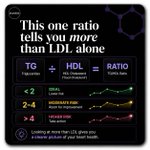
Most people focus on LDL.
But this ratio can tell you more about your risk:
Triglycerides ÷ HDL
It reflects your metabolic health, insulin sensitivity, and how your body is actually handling fats.
Simple number. Deeper insight.
Follow for more insights ❤️
Most people with high cholesterol leave the doctor’s office with two things:
A number.
And a prescription.
But cholesterol is rarely that simple.
Before you assume it’s just “bad genetics” or too much saturated fat, ask these 5 questions 🧵↓
4/ What is my hs-CRP?
Cholesterol doesn’t act in isolation.
Inflammation changes the entire risk equation.
hs-CRP helps assess whether the arterial environment is inflamed and vulnerable.
High LDL + low inflammation ≠
High LDL + high inflammation.
Context matters.
5/ Could other health factors be driving this?
Chronic stress.
Poor sleep.
Hormonal changes.
Gut dysfunction.
Physical inactivity.
All influence cholesterol through real biochemical pathways.
If your numbers aren’t improving, the answer may not be “more medication.”
It may be a deeper systems issue.
Bottom line:
High cholesterol is not a diagnosis.
It’s a signal.
And the more context you have around that signal, the better decisions you can make about your long-term health.