

co-founder @herd_eco, Solana/NEAR eco veteran, prev @Dune @Clutter @Video_Amp
🇺🇸
Joined December 2008
- Tweets8.3K
- Following2.3K
- Followers1.2K
- Likes30.5K







Pinned Tweet
Our years of background in crypto data informed the design of Trails
Bottom up, from contract primitives (functions, events, constants, etc) to our Explorer (search, understand) to Trails (app layer)

So bullish on @andrewhong5297 and @herd_eco.
Starting from an LLM, without building the primitives / structures to understand where the LLM is failing, is futile.
@herd_eco trails solve for this gap as do @glider__'s building blocks
Ahead of the curve. There's a reason we're both building this way.
Edward retweeted

Software is having its Industrial Revolution and it’s changing what matters in software frameworks. Today’s frameworks were designed for the crafty carpenter, tomorrow’s are designed for mass manufacturing processes where rigor > conciseness.
Take foldkit vs react/solid, for example. You can argue that foldkit is more verbose or complicated for some use cases compared to the traditional alternatives, but everything doable in react/solid is also doable in foldkit. Everything doable in foldkit is not (or at least not easily or consistently) doable in react/solid because they lack the rigor of command+event state machines with story & scene testing. Getting that back isn’t easy and is a substantial loss for agentic coding.
Before AI, there was the valid argument of picking what humans like best. Humans kinda suck at programming because we are constrained by our skills, taste and (lack of) discipline, so frameworks that worked in this era catered to the lowest common denominator of mass market human developers. While I agree that react/solid are powerful in the hands of humans, that simply doesn’t matter anymore.
What’s best for humans does not necessarily translate to what’s best for agents. Some tasks may indeed be “a bit harder” with foldkit in human terms, but AI is capable of solving all of them in a few minutes, so who cares. Instead of bike-shedding philosophy and taste, just choose the more rigorous (and scalable) option. It costs you nothing and gains you everything.
Effect is another example of this. With AI, now everyone of all skill levels can use advanced programming techniques that are objectively safer and more scalable, but were out of reach for many human programmers. Or didn’t appeal to the stubborn tastes of a particular person.
With humans now out of the way of technology adoption - I think it’s obvious that the following techniques are going to become way more commonplace:
1. State Machines
2. Functional programming
3. Declarative infrastructure
4. Test Driven Development
5. Domain Driven Design
6. Actor Systems
7. Rigorous API schemas
8. Type Safety and Formal Verification
9. Disciplined Operations (monitoring, on-call)
Alchemy is designed to bring these techniques together into a seamless experience for building and deploying applications of massive scale. It is the “rails” and “parts” of the ai software assembly line.
Edward retweeted

every product i use should just be a headless mcp, that feeds into an agent, where i never have to think about anything underneath.
except for our product, of course.
in our product, customers love the ui and love us very much.
we're special that way.
Edward retweeted

Every methodology eventually collapses into this one. The rest are just what we call it in the retro.


Edward retweeted

surely i do not need property tests
nothing bad will happen if i skip property tests
Can confirm that maximally truth seeking @grok is spot on about @Garretthughes

Edward retweeted

It has been 16 hours since I was able to update my deployments on Railway 🙃


Edward retweeted

if you had told me a year ago I'd be using slack to develop and linear to read code I'd have called you crazy
Edward retweeted
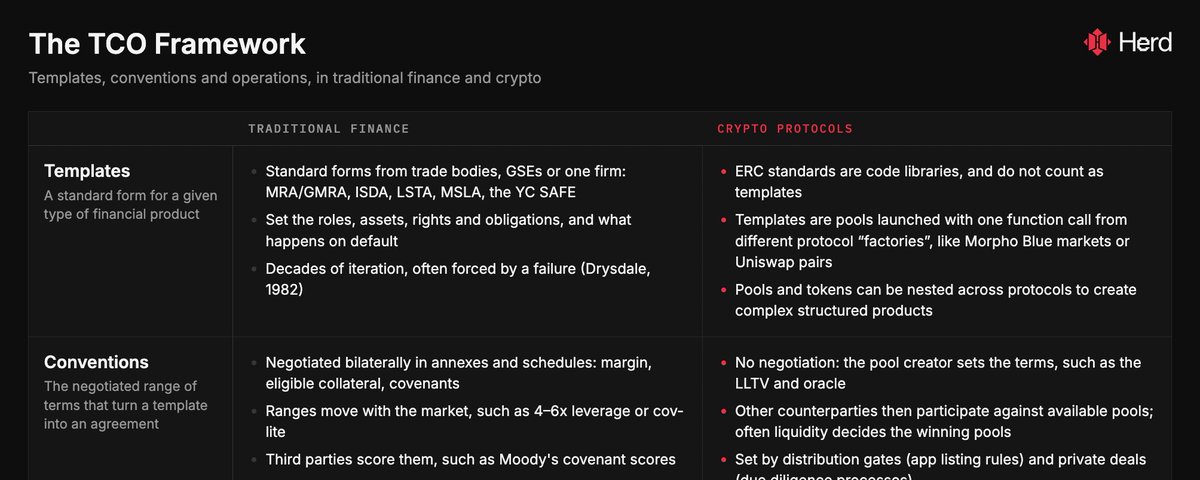
I firmly believe 99% of the remaining crypto institutional adoption problems sit within accounting, legal recognition, and tying/modernizing these methodologies to execution onchain
good example dive in here!


Super cool to see, we adopted Tanstack Start @herd_eco when it was still very early and has been great to work with 🙂

TanStack Start 1.0 is officially stable! 🎉
A full-stack web framework for React and Solid, already used to build millions of apps, from Fortune 500 companies to your favorite tools and weekend projects.
tanstack.com/start
Edward retweeted

mise is really good. i switched from homebrew on my work machine and have had a wonderful experience so far

new in mise: tools that keep themselves up to date.
set auto_update on a global tool and mise upgrades it right before it runs. optionally run a daemon to do upgrades in the background.
mise.jdx.dev/dev-tools/#auto…

While I'm sure this is a great outcome for the team, I am pretty disappointed that they will end active Deno runtime development next year
There is now basically no JS server runtime competition to Node besides Bun

We are excited to announce that Deno is joining Cloudflare!
deno.com/blog/cloudflare

Edward retweeted

A perpetual problem: the more visible activity there is, the more impressive the work looks. Ten years ago people were building unnecessary distributed systems, with >1:1 microservice:dev ratio, that could've been simple monoliths. The same thing is happening with "factories".
Edward retweeted

The more time I spend working with coding agents, the more convinced I am that they make software engineering even harder
We can do amazing things with them, but unlocking their full potential requires extraordinary discipline and knowledge

Bury your head in the ground at your own risk. I aim to not jump on any hype trains, but since Opus 4.6 and GPT-5.2 + the harnesses it was clear that these things can write code nearly as good as I can in my best language; better in other languages.
But we won't see non-devs push production code for a long time; possibly forever, if you ask me. Software still needs to be built in robust ways, and it's our profession to do this well, and use the new tools we have, which create new and interesting (+tough!) challenges
Edward retweeted

JavaScript was never designed for the server. If that doesn't change soon, JavaScript on the server will be replaced by Rust.
The fix needs to happen in the engine. Sound types. Ahead-of-time compilation. Threads with shared objects.

"I love Rust! Rust is amazing ...if you never, ever, EVER have to look at it yourself." — @dhh
Edward retweeted

Herd is covering the Monad ecosystem!
The Herd team is doing a nice job of automatically disentangling chained dependencies across DeFi. I believe that with better information, we can all make better decisions. Now on Monad

Edward retweeted

a big blackpill moment for me was when I saw the senior staff eng that used to block my prs for poorly named functions start to directly merge claude outputs into master

I am done with this shit. It is over. The state of engineering right now is horrible. It has been half a month since I started a new role at a big company. Nobody knows anything here. The specs, code, tests, PRDs, tickets, resolution of those tickets, reports, etc., everything is made by Claude Code. Nobody on my team likes this. They are being forced to ship as much as they can. I have heard multiple times from higher management that pushing code is not a bottleneck, so why are we slow? People are working 12 to 13 hours a day just to press enter. Nobody is reading anything. Humans in corporate are doing nothing on their own. Everyone, literally everyone, from an L1 to an L7 engineer here is doing the same thing. Talk to Claude. There is no sense of victory. Nobody is resolving bugs. In reality, nobody is thinking anymore. Everything is done by LLMs. It is so soul-sucking. I would not mind it, to be honest, if we were at least given the time to check out the code and see what is going where. But no, the goal is to just ship. No matter what happens.