

CIO, Andromeda Capital Management
London, England
Joined October 2013
- Tweets6.8K
- Following1.5K
- Followers24K
- Likes12.7K



Pinned Tweet
AI Credit: Heads I Win, Tails You Lose
Scott Bessent wants yields under control, a strong $, and limited deficit reduction.
The corporate sector is leveraging up into the largest capex cycle in US history.
Kevin Warsh is hiking.
Our latest webcast:
youtube.com/watch?v=00hl7pds…

Alberto Gallo retweeted

like every finance reporter is trying to prove a cabal between private capital, data centers, life insurers, and rating agencies and this guy— whose marginal cost of capital is 20%— just says on the record in the FT it’s all true and it’s his business model:

Alberto Gallo retweeted

Well well well. Well.
Bloomberg: Broadcom CEO Likens Many AI Investors to Casino Gamblers
and more...
Broadcom’s Tan said AI model developers need to find customers that can generate returns from deploying the technology, rather than relying on users who are now “wasting money” on tokens as they experiment with AI.
“When you are a kid you go to a video arcade, you play. Your parents give you $10 of tokens, you finish it in 10 minutes and you haven’t learned anything,” he said. “That’s what happening in enterprises today.”

"Iceberg at 12 o' clock! Shall we steer the ship, Captain Bessent?"
"Don't worry, steady as she goes..."
podcasts.apple.com/gb/podcas…

*US TREASURY TO BUY BACK UP TO $6B IN LONGER-DATED DEBT THU.
youtube.com/watch?v=4sJY7BTI…
"it's like you're financing a fax machine and then someone invented email"
ft.com/content/9cb63980-cd43…

Alberto Gallo retweeted

They demolished the East Wing of the White House to build a ballroom in the same year the national debt passed $40 trillion.
Both are true. Neither is why we're broke. Understanding that is the whole lesson.
France, 1788. The crown spent roughly half its revenue servicing debt. Not on Versailles. On war loans, from the Seven Years' War it lost and the American Revolution it bankrolled to spite Britain. No central bank. Tax collection farmed out to men who skimmed the top. Offices sold to nobles who then paid nothing into the treasury they'd bought a piece of. Every emergency financed by mortgaging the next decade. The decades ran out.
When the books opened in 1787, the country needed a face to put on the number. They chose the Austrian.
Marie Antoinette spent real money. The Petit Trianon, the gambling tables, fortunes on her favorites. It was a rounding error against the war debt. Didn't matter. The pamphlets called her Madame Deficit. The Diamond Necklace Affair, a swindle she had no part in, was accepted as proof of everything, because the public had already decided what kind of woman she was. Blaming a foreign queen was easier than admitting the wealthy paid nothing and the arithmetic had been impossible for thirty years.
Now look at us.
COVID was financed like a war. Roughly $5 trillion mobilized with no army in the field. Defensible at the time. But the emergency ended and the debt didn't. Emergency borrowing is always temporary in the telling and permanent in the ledger.
The bill has arrived. Net interest hits $1 trillion this year. More than defense. More than Medicare. Second only to Social Security, and projected to double by 2036. It compounds no matter who wins an election. It is arithmetic, and arithmetic is the one creditor that never negotiates.
And into that, the ballroom. Announced at $200 million, later put at $400 million. The residence renovation line went from $39 million last year to $377 million now. The security complex beneath it may run near a billion, possibly on taxpayers. Meanwhile the president's own ethics disclosure shows $1.4 billion in crypto wealth. A federal regulator just handed his family's crypto venture a bank charter, a first in American history. And Congress passed a stock trading ban that still permits stock trading.
None of that caused the $40 trillion. Be precise here, because the precision is the point. Four hundred million dollars is four hours of federal interest. Seize all of it and the curve doesn't bend. Anyone telling you a ballroom bankrupted America is running the same play the pamphleteers ran on Marie Antoinette, and you'll spend your outrage on the necklace and never look at the war debt.
But France didn't fall from insolvency alone. Insolvency is survivable. What killed it was insolvency arriving alongside a cost of living shock and the collapse of any belief that the people demanding sacrifice were subject to rules themselves. Nobles exempt from taxes. Offices for sale. A queen building at Trianon while bread hit a price working people couldn't pay. Each one small. Together, an answer to the question: why should we believe you.
That's what the ballroom is. That's what the memecoin is. Not the cause of the deficit, but the reason nobody will ever be persuaded to fix it. You cannot ask a country to accept higher taxes and slower benefits while the people asking are visibly, legally enriching themselves in office. The math is solvable. The legitimacy problem is what makes the math permanent.
We have the debt. We have the affordability crisis. We're building the third leg right now, in marble, on the footprint of the East Wing.
Guillotines aren't the lesson. The lesson is that a country can spend forty years deciding it'll fix the math later, then find out later is a Tuesday, it already came, and by then nobody trusts anyone enough to fix anything.

Alberto Gallo retweeted

Wow.
SIEMENS EXEC: “.. We are actively working to not be wholly dependent on data centers. .. We understand at some point there could be a bubble and we’re racing to pay back the investments as quickly as possible.”
@blsuth
bloomberg.com/news/newslette…



Alberto Gallo retweeted

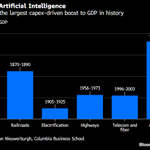
“Virtually nothing matters more to markets at present than the AI buildout. It’s such a sudden and massive stimulus for the US that it has shifted macroeconomic data. Columbia Business School’s Stijn Van Nieuwerburgh argues that without it, the US would be in recession. He estimates AI infrastructure investment at roughly 2.8% of GDP — larger than the railroad boom — and it’s projected to keep rising”
bloomberg.com/opinion/newsle…

Alberto Gallo retweeted

The US hyperscalers have now signed up for about $1 trillion of lease commitments that don't appear in their financial data (and are on the hook for another $1 trillion of future purchase commitments). ft.com/content/a0a07cce-6d19…

Heads I win, tails you lose
Private credit funds are socializing risk.
Who takes their losses?
Life insurers
via @PranjalDrall @agranato42
papers.ssrn.com/sol3/papers.…

Alberto Gallo retweeted

“I think it’s very unfortunate what Secretary Yellen’s doing. She’s financing at the front end, and she’s making a bet on the carry trade, which is not good risk management.”
- Scott Bessent

Scott Bessent is sending a clear signal, traders say: He will do whatever he can to prevent bond yields from soaring. bloomberg.com/news/articles/…

Alberto Gallo retweeted

“More than 150 years ago, financier Jay Cooke’s ambitious campaign to fund the Northern Pacific Railroad began to unravel not because railroads were a bad idea, but because the bonds financing it traded at steep discounts for months.”

AI Credit and AI Capex:
a worthy project isn't always a worthy investment, especially for bondholders
via @opinion @johnauthers
bloomberg.com/opinion/newsle…

AI Credit and AI Capex:
a worthy project isn't always a worthy investment, especially for bondholders
via @opinion @johnauthers
bloomberg.com/opinion/newsle…