

https://xitter.cf/t.co/1nqYWe8FBh Swiss-Ukrainian inorganic chemist and materials scientist.
Joined June 2015
- Tweets262
- Following863
- Followers6.8K
- Likes594
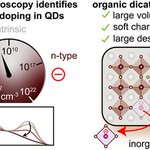


🧪 Our new ACS Materials Au Perspective explores soft organic dications for doping control in perovskite QDs.
✨ More than hopeful—we’re convinced tin-halide perovskite nanocrystals have a bright future as quantum-light sources!
📖 doi.org/10.1021/acsmaterials…

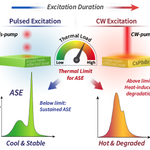
💡 Keeping perovskite optical gain going means keeping heat under control.
New in Advanced Science: we investigate light amplification in thermally evaporated CsPbBr₃ films under long-pulse and continuous-wave excitation.
🔬 At 90 K, sapphire-supported films sustain amplified spontaneous emission with excitation pulses up to 30 µs, versus ~2 µs on glass—without encapsulation or post-processing.
🌡️ Heat accumulation emerges as the dominant limitation under extended excitation. Better heat extraction is essential for progress toward continuous-wave and electrically pumped perovskite lasers.
advanced.onlinelibrary.wiley…

Thrilled to share our new paper in ACS Energy Letters! 🔋
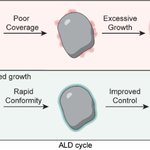
We used Substrate-Enhanced Atomic Layer Deposition (ALD) to grow an ultra-thin, conformal Lithium Niobate layer on NMC cathodes. This protects the cathode and paves the way for safer, longer-lasting batteries! ⚡🔬
Read our work here 👇 pubs.acs.org/doi/10.1021/acs…


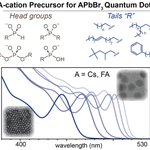
The surface chemistry of perovskite QDs is a cornerstone. Ligands play a highly complex role: progress requires understanding how they influence post-synthetic stability, and acknowledging that many are essential for the actual formation of these QDs 🧪.
our new artixle in Chem. Sci. leverages this dynamic via A-site cation precursors:
📏 Size control: Precursor tail length, rather than the headgroup, dictates the final QD size.
🎯 Precision: Steric tuning enables exact sizes from 18 down to 3 nm.
🚀 Efficiency: The approach yields up to a 40-fold increase compared to conventional routes.
Yuliia Berezovska , Dmitry Dirin et al.
doi.org/10.1039/D6SC05095F

🎉 Our latest research is out in Advanced Materials: "Single-Particle FRET Probes Heterogeneity in the Ligand Shell of Colloidal Perovskite Quantum Dots" by Leon Feld ( @FeldF ) et al.
One of our main research outputs in the scope of SNSF-sponsored NCCR Catalysis.
We developed a method using single-particle photoluminescence spectroscopy to probe the notoriously difficult-to-characterize organic ligand shell of quantum dots (QDs) at the molecular scale, as well as to monitor FRET.
✨ Key Takeaways:
📏 We tagged ligand tails with dyes to measure ligand tail end-to-QD distances via FRET at sub-nanometer resolution.
🔍 Revealed nanometer-scale variations in dye-surface distances within individual particles and across different ligand chemistries.
💻 Linked these variations directly to local ligand coverage using atomistic modelling.
📖 Read the full article: doi.org/10.1002/adma.75051

Maksym Kovalenko retweeted

Even though we could not secure full support for Ukrainian 🇺🇦 YUCOMAT participants this year, it was nice to see that about 15 scientists came from Ukraine, and a few more Ukrainians came from other countries, including Switzerland, Germany, and Brazil! mrs-serbia.org.rs/index.php/…

🔋 Does capacity always dictate a battery's potential? In our latest article in Accounts of Materials Research, we confront this assumption by focusing on a highly promising newcomer CAM (cathode active material): Lithium Iron Chloride (Li₂FeCl₄).
While Li₂FeCl₄ may have a lower theoretical capacity compared to traditional commercial materials, we demonstrate that it more than makes up for it with a critical advantage—⚡ exceptionally high ionic conductivity.
Why is this high conductivity so important?
🚀 Rapid ion transport drastically reduces internal resistance.
⚡ It significantly boosts overall kinetic and power performance.
🛠️ It opens exciting new, competitive pathways for fast-charging and all-solid-state battery applications.
Our research highlights that chasing maximum capacity isn't the only way to build better batteries; balancing kinetic properties is just as crucial. We firmly believe Li₂FeCl₄ is poised to be a strong contender in next-generation battery technologies.
Read our full findings here:
pubs.acs.org/amrcda/article/…

Maksym Kovalenko retweeted

Few impressions from our hands-on workshop "Quantum light from quantum dots" at the #Scientifica26.
Thanks to the team from the lab of Maksym Kovalenko, which is affiliated to ETH, DCHAB, Empa, and the Quantum Center.
#quantum
@maksymuki
@Empa_CH
@ETH_DCHAB
@ETHQuantumCntr
@ETH
Maksym Kovalenko retweeted

This year’s #Scientifica offered plenty of exciting topics. The D-CHAB also joined with presentations. The Group of Maksym Kovalenko took visitors on a journey into the fascinating world of light and Jan Cvengros' experimental show lit up the room as well👇
Maksym Kovalenko retweeted

After yesterday's opening talk by Pete Sercel on the theory of excitons in #nanocrystals, Maria Ibañez is now kicking off the second day of our #summer #school by teaching us about nanocrystal thermoelectrics. @SwissChemistry @TracktheTwinQD #nanocrystals26

Maksym Kovalenko retweeted
We are ready to open our International Summer School on Semiconductor Nanocrystals 2026 in < 2 h! The first participants have arrived and are enjoying the beautiful scenery right from the school's hotel! #nanocrystals26 nanocrystals26.scg.ch/ @SwissChemistry @TracktheTwinQD


Maksym Kovalenko retweeted
Few more impressions from today's #nanocrystals26 #summer #school: junior researchers presented in a #poster session, and experienced researchers in #tutorials and #research overviews. Special thanks to @talapinlab, @Pieter_Geiregat, Hendrik Utzat, and Philippe Guyot-Sionnest!


Maksym Kovalenko retweeted
⚡ The future of perovskite technologies starts with fundamental understanding.
Explore the latest advances in interfaces, charge dynamics and emerging devices at #MATSUS26 Fall.
📍Mallorca, Spain
📆26th-30th October, 2026
🔗Send your poster abstract: nanoge.org/MATSUSFall26/home

🔬 What if we could watch photocatalysis happen—one catalyst at a time and in real time?
see our new article in Chem "Single-catalyst operando photoluminescence spectroscopy of perovskite quantum-dot-driven photoredox reactions"
We use an individual perovskite quantum dot simultaneously as:
✨ a quantum emitter
⚗️ a single photocatalyst
👁️ an operando probe of its own catalytic activity
Remarkably, these perovskite QDs are sufficiently robust to operate under realistic reaction conditions while revealing charge-transfer dynamics, particle-to-particle heterogeneity, and degradation at the few-atom level.
These insights are fundamentally inaccessible through conventional ensemble measurements
sciencedirect.com/science/ar…

Now time for poster abstracts submission! Don't miss your best conference

🟩 The #EMLEM26 programme is now available!
Explore the scientific programme and start planning your EMLEM26 experience.
nanoge.org/EMLEM26/program/p…
📍 Halkidiki, Greece
🗓️ September 21–23, 2026
🔗 There's still time to present your work! Submit your poster abstract!

Maksym Kovalenko retweeted
🟩 The #EMLEM26 programme is now available!
Explore the scientific programme and start planning your EMLEM26 experience.
nanoge.org/EMLEM26/program/p…
📍 Halkidiki, Greece
🗓️ September 21–23, 2026
🔗 There's still time to present your work! Submit your poster abstract!
🔋 What if an electrolyte salt could become the energy-storing material?
In our new article, we show how lithium perchlorate (LiClO₄) can undergo an 8-electron reduction—unlocked through electrochemically coupled oxygen-atom transfer.
⚙️ Carbon-supported Fe nanoparticles play a double role: oxygen-transfer catalyst + conversion-type cathode material.
⚡ >50% LiClO₄ conversion
⚡ 1,150 mAh g⁻¹ capacity
⚡ 1,950 Wh kg⁻¹ (per kg of LiClO₄)
It is a proof of concept—not yet a practical battery—but it opens a new route toward harvesting the largely unexplored energy of p-block oxoanions.
Much inspired by discussions with Prof. Reinhard Nesper (ETH emeritus) over a decade ago.
pubs.acs.org/doi/10.1021/jac…

Maksym Kovalenko retweeted
💫Quantum light sources are in focus at #HYPE26 as keynote speaker @maksymuki explores the potential of colloidal perovskite quantum dots.
🔬Ultrafast emission and single-photon generation are pushing the boundaries of optoelectronics.
🔗nanoge.org/HYPE26/home
