

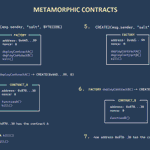





Excellent thread about metamorphic contracts by @0xOwenThurm !
Here is my contribution on how they can still be created for visual learners like me:


getting to the finish line on damnvulnerabledefi.xyz (12/15), feeling astonished by how much I've learned so far and would definitely recommend doing them for every solidity devs and junior auditors.
Props to this amigo @tinchoabbate 🐐
2
4
501


This thread explains a vulnerability on signature verification.
(v, r, s) and (v, r, -s mod(n)) are valid signatures for the same message hash 🚩
n comes from secp256k1 specs github.com/ethereum/go-ether…
Openzeppelin address this on ECDSA library by accepting only the lower s value.

This 15 byte sized contract calculates the sum of two numbers.
I created it using only EVM opcodes, no solidity and no compilation involved.
Goerli: goerli.etherscan.io/address/…
Come see how I did it


Here on my example:
on the not indexed event, LOG1 is being called on top of the following stack:
0x00...80 (offset)
0x00...20 (size)
0x49...91 (topic)
it is getting the address value from memory so LOG1 is actually costing 1006 because of the memory expansion


That's a very clever way to implement a reentrancy guard 🤔
Reading a variable from storage twice costs different amount of gas each time because the slot will be warm after the first read.

This is the coolest thing I've seen today. Reentrancy guard that reverts if the slot is warm.
Author: @rage_pit
@transmissions11 Can we use this in the golf-course!?

1
173
I just joined @code4rena as a warden 🫡
I am still early on my studies but let's start getting used to the contests 🔥
1
6
392
An outstanding article about the EVM stack, worth a read

It’s out! 🪂 🎉
Part 4 of the All About Solidity Data Locations subseries
Some cool learnings:
- how block scopes work {} (the mystery unraveled)
- what is the « call stack » vs the « stack »
- fixing « stack too deep » error
#Solidity #SmartContracts
betterprogramming.pub/solidi…
1
2
215
@JeanCavallera I would love to see one example of the stack underflow in practice. I tried some inline assembly but couldn't reproduce this

1
1
119
Shouldn't it throw the compiler error "Stack too deep" ? 🤔
How was this code compiled with solidity 0.8.17 and the function was able to access items deeper than index 16 in the stack?

1
3
312
That's because you can change the way the EVM compiles your contract. Instead of going straight from solidity to EVM opcodes you can use the "intermediate representation in Yul" by adding
"viaIR": true
to your compiler_config.json
docs.soliditylang.org/en/v0.…

2
3
249
Arithmetic overflow/underflow, the unchecked block and how you can save gas on math operations.
In solidity version < 0.8 there is no arithmetic check and if an overflow happens the variable simply cycle back to zero and in an underflow it goes to the maximum possible value.

1
7
305


61 0100 60 40 52
(61) PUSH2 0x0100
(60) PUSH1 0x40
(52) MSTORE
It tells us that the memory between 0x80 and 0x00ff are in use (4x 32bytes) and they store the 4 immutable variables: _factoryV2, _positionManager, factoryV3, _WETH
13/n
This is usually the case but there do exist contracts which don't start with 0x6080604052.
Like the Uniswap V3 Router 2: etherscan.io/address/0x68b34…
Can you figure out why anon?

2
174