Jack Jones retweeted
And actually still *is* Lancashire North of the Sands!
Local Government changed, county geography did not.
More info and detailed interactive map at RealCounties.com
Jack Jones retweeted
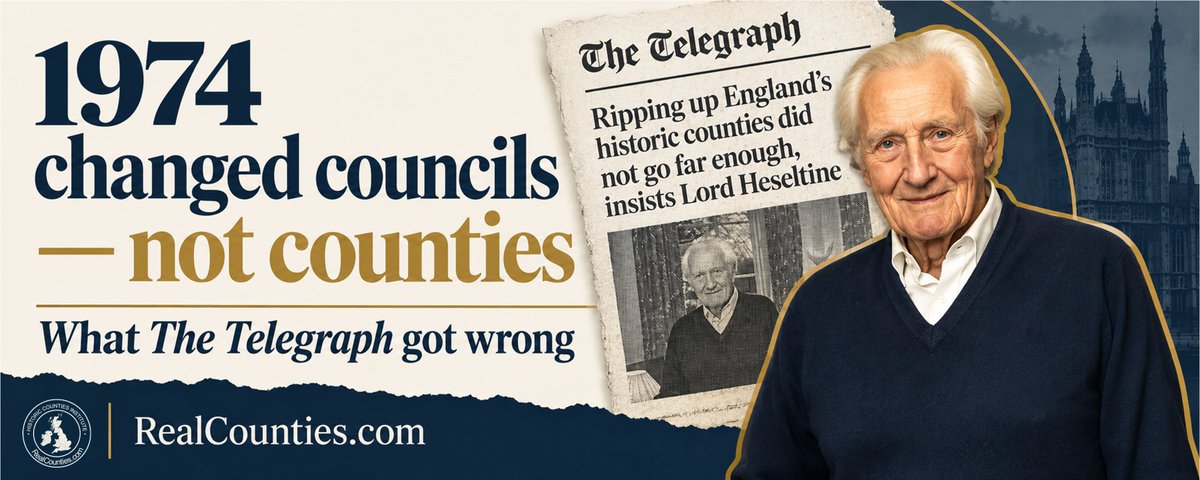
Did Michael Heseltine “rip up” England’s historic counties in 1974? What The @Telegraph got wrong 👇
Jack Jones retweeted
The counties were not created by local government, and they were never abolished by local government reform.
Administration changed. The counties did not.
More info and detailed interactive map showing the legal boundaries of the geographic counties at RealCounties.com
Jack Jones retweeted
Local Government Reorganisation: decisions announced
The Government has now confirmed the outcome for 14 of the 16 areas still under consideration, with two decisions yet to be finalised.
These changes will reshape local administration across large parts of England. We will now examine the results carefully - including their treatment of county names, boundaries and identities - and share our analysis in due course.
Follow @RealCounties for updates.
Next time there's a particularly significant murder can the police just say " in the course of our enquiries we have arrested a person on suspicion of the murder of... the enquiries are ongoing. " that's all anybody needs to know.
6
426
Jack Jones retweeted
The Government has repeatedly stated that the traditional counties were not altered by local government reorganisation.
Yet maps, signs and everyday language have encouraged generations to believe precisely the opposite.
Ask somebody where Abingdon is and there is a good chance they will tell you:
"It used to be in Berkshire, but it moved to Oxfordshire in 1974".
Similar claims are made throughout the country.
Middlesex is described as a “former county”; Manchester is said to have “left Lancashire”; Bournemouth is treated as though it passed from Hampshire to Dorset; Monmouthshire is spoken of as if it vanished and later returned.
The language varies, but the underlying belief is the same: Britain’s counties were redrawn, replaced or abolished by local government changes.
There is only one problem.
That is not what the Government says happened.
READ the full article at: realcounties.com/2026/07/11/…
Jack Jones retweeted
You've probably been told:
"Ceremonial counties replaced the historic counties."
But is that really true?
There is actually no legal term "ceremonial county."
They're lieutenancies.
Follow @RealCounties for more county myths and facts.
Jack Jones retweeted
Replying to @GenealogyBeech
Keighley in the wonderful West Riding of Yorkshire! 🤩
Jack Jones retweeted
You’ve probably been told:
“Middlesex was abolished.”
But was it?
Middlesex county council disappeared in 1965.
Much of Middlesex was placed into a new administrative area called Greater London.
But the historic county itself was not a council.
Middlesex is older than Greater London, older than county councils, and still part of England’s historic geography.
Council areas change.
Counties endure.
Know your county. Know its story.
Follow @RealCounties for more county myths and facts.
Jack Jones retweeted
You've probably been told:
"Penrith used to be in Cumberland but isn't anymore."
It sounds true.
But it isn't.
Cumberland hasn't changed, only administration has.
So why are we still being told otherwise?
Follow @RealCounties for more county myths and facts.
Jack Jones retweeted
Counties are the geography.
Over time, that geography has been used for many purposes: justice, sheriffs, lieutenancy, militia, taxation, parliamentary representation, records, administration, sport and identity.
But those uses did not create the counties.
They used the counties.
That is the key distinction.
Jack Jones retweeted
“Traditional counties still exist.”
That was not said by a campaign group.
It was said by a Government minister on 16 April 2008.
“The legislation that currently defines counties for the purposes of administration of local government is the Local Government Act 1972 (as amended by various Orders in the 1990s).
This legislation abolished the previous administrative counties, which were established by the Local Government Act 1933. However, these Acts did not specifically abolish traditional counties, so traditional counties still exist."
Read that last sentence again.
Local government areas changed.
Previous administrative areas were abolished.
Traditional counties were not.
So why are so many people still told that their historic county “doesn’t exist anymore”?
That was never true.
Administration changes.
Historic counties endure.
Jack Jones retweeted
LANCASHIRE: #OnThisDay in 1890, Stan Laurel was born at Ulverston.
From a town on the edge of Morecambe Bay to the golden age of Hollywood, he became one half of Laurel and Hardy - one of the most beloved comedy double acts in film history.
A Lancashire beginning.
A global legacy of laughter.
Stan Laurel. Lancashire. 16 June 1890.
Jack Jones retweeted
This should have settled the argument more than 20 years ago:
“The Government is aware that many people attach importance to historic and traditional county areas and it is not their intention that people’s identification with their counties will be diminished.”
That matters.
County identity was not meant to be erased by administrative reorganisation. It was not meant to be pushed aside by changing council structures. It was not meant to be treated as a relic.
So why are so many people still told their historic county no longer exists?
If the Government said county identity should not be diminished, isn’t it time our maps, media, signs, datasets and public bodies reflected that?
Administration changes.
Identity endures.
Jack Jones retweeted
The Office for National Statistics says the historic counties have existed largely unchanged since the Middle Ages and recommends them as a stable, unchanging geography.
Yet many people still believe they were abolished.
Why do you think that misconception is so widespread?
Jack Jones retweeted
"Historic counties were abolished."
You'll often hear that claim.
Yet on 23 September 1992, a government minister stated:
“Although the Local Government Act of 1888 and subsequent legislation transferred to newly constituted Councils administrative business and responsibility for redefined areas, such legislation did not alter or affect the Duchy palatinate boundaries which remain the same as the old (pre-1888) geographical County of Lancaster. Both Furness and Cartmel lie within the County Palatine.”
In other words, changing administrative arrangements did not change the geographical County of Lancaster.
A useful reminder that councils and counties are not necessarily the same thing.
How many people today realise that Furness and Cartmel are still part of the historic County of Lancaster?
Jack Jones retweeted
"The Local Government Act 1972 did not abolish traditional counties, only administrative ones."
That's not our opinion.
It's what a government minister stated on 3 September 1991.
The full statement continued:
“Although, for local government purposes some of the historic counties have ceased to be administrative areas, they continue to exist for other purposes, organisations and local groups.”
Yet more than 50 years after local government reorganisation, many people still assume historic counties were abolished.
Why do you think that misconception persists?
Jack Jones retweeted
This 1974 statement should probably be better known.
The new council areas were not meant to change where people belonged.
They were administrative boundaries - created for local government.
The traditional counties remained.
So when someone says “that county no longer exists”, the real question is:
Who told them that - and why?