

Accelerating institutional adoption of Ethereum @ethereuminsti
Joined January 2021
- Tweets410
- Following1.5K
- Followers1.6K
- Likes2K





Marius Smith retweeted

Today, @Consensys announced Sovereign Network Interoperability to enable private, bridgeless interoperability between Ethereum-compatible networks.
Across EVM networks, institutions will be able to settle securities, exchange currencies, post collateral and access tokenized funds.
Ethereum is the home of onchain finance.

Introducing Sovereign Network Interoperability by Consensys.
State-of-the-art interoperability that enables institutions to do business freely, settling securities, exchanging currencies and posting collateral across ledgers, without bridges or moving assets onto a shared ledger.
consensys.com/blog/consensys…

Welcome to the team, @ZurHodl. Super excited to have you on board!

Excited to welcome Laurens Schepens as Head of APAC at @ethereuminsti, based out of Singapore.
Laurens brings 15+ years in banking and financial services, most recently as Executive Director at @UBS, where he developed and scaled UBS Tokenize, the bank’s in-house tokenization service supporting Ethereum-based assets across structured products, funds, bonds and equity, and led Digital Assets for APAC.
He’ll lead our engagement with APAC financial institutions as they build on Ethereum.
Welcome to the team, @ZurHodl!

Marius Smith retweeted

Quick notes on 7702 to dispel fud and keep your funds safe.
First thing first -- 7702 itself isn't broken. Don't panic if you are using a wallet that supports 7702 (MetaMask, Uniswap, Ambire, etc.).
To recap, 7702 is an account abstraction EIP that allows an EOA to sign a special message, called a "7702 authorization," that would insert a smart contract into the account, which enables the account to do powerful things like transaction batching, e.g. doing "approve" and "transfer" in one transaction so you can swap on Uniswap with one click.
But unfortunately the same feature also allows a hacker to efficiently move all your tokens in one single transaction. In the Binance hack, the hacker moved ETH, USDT, and 62 other tokens in one transaction, whereas without 7702 they'd have had to send one transaction per token. In this particular case, many of those transactions would've failed because Binance was still using the hacked wallet for withdrawals, so all transactions sent by the hacker would've had to compete with the legit transactions for nonces. So using 7702 did help the hacker steal as much funds as possible, as quickly as possible. Ouch!
However, in order for the hacker to use 7702, they must have either 1) had access to the private key, or 2) tricked Binance into signing a 7702 authorization. The latter is very unlikely, as it's hard to imagine Binance being so incompetent as to expose an endpoint for signing 7702 authorizations or (even worse) for signing raw messages which the hacker could've repurposed for 7702 authorizations. But I can't rule that out until the official postmortem.
What does all this mean for you?
- If you are a wallet developer, do NOT, under any circumstances, expose a way for third parties to request 7702 authorizations. This is just handing your users a giant footgun to shoot themselves with. No wallets I know of do this, so don't worry if you are a user.
- If you are a user, use a well-known wallet. 7702 does let wallet developers screw up in more ways than before, so use only well-known wallets whose developers' competence you can trust.
- If you are a company (e.g. an exchange) operating hot wallets, do NOT, under any circumstances, expose an endpoint (even if it's an internal endpoint) for signing 7702 authorizations or raw messages.
As a contributor to AA, I feel partially responsible for hacks like this, since by increasing the power of accounts, we've indeed also empowered hackers (not unlike how any new technology empowers both the good guys and the bad guys). That said, it's important to note that 7702 was only a transitional EIP, and "endgame AA" such as Frame Transactions (EIP-8141) would allow wallet owners to set up their wallets much more securely. For example, if Frame Transactions were available today, Binance could've:
- Set up their wallets as multisig contracts only (not EOAs).
- Set up "post conditions" for their `transfer()` functions, so that even if the multisig got hacked, the contract itself would perform sanity checks such as "no transfers of more than 1000 ETH without additional signers."
In short, the endgame of Ethereum UX is one with both optimal security and optimal UX, and users never have to trade off between the two. But we still have a long way to go until we get there. Back to work!

Marius Smith retweeted
Nikhil Sharma, Director, Digital Assets at @BlackRock, will join us at the Ethereum Institutional Forum in London on 12 November.
His fireside session, BlackRock on Public Chains, covers the products BlackRock has launched onchain, what it has learned from running them on public networks, and what it still needs from the ecosystem.
Several BlackRock tokenized funds are live on Ethereum today.

Marius Smith retweeted
Tune in to see Ethereum Institutional's Research Lead discuss with a great panel!

A resilient validator landscape is foundational to the decentralization and security of Ethereum.
On October 29, join experts from @Lionscraft_io, @ethereuminsti, @thedaofund and EY for a panel on ValOS and its role in strengthening validator operations.
📆 luma.com/c6t2hftd

Marius Smith retweeted
Oli Harris, Global Head of Kinexys by @jpmorgan, will join us at the Ethereum Institutional Forum in Singapore on 20 November.
@olijhw's fireside session, Kinexys by J.P. Morgan: Institutional Onchain Infrastructure, covers J.P. Morgan’s decade in blockchain, from its early Ethereum-based work to Kinexys today, and the infrastructure institutions need on public networks.
Kinexys is built on Ethereum Virtual Machine technology and has processed over $4 trillion in cumulative transactions.
Attendance is by invitation and application only.
Sign up below↓

Marius Smith retweeted
Meritz Securities, one of Korea’s largest brokerages, has signed an MOU with @Optimism to explore issuing, settling and distributing tokenized Korean securities on the OP Stack.
That makes three Korean securities firms exploring the OP Stack since July:
→ DB Securities
→ KB Securities
→ Meritz Securities
Ethereum is the home of onchain finance.

Marius Smith retweeted
🇯🇵 Ethereum Institutionalは、東京を拠点に活動するAPACリード(アジア太平洋地域責任者)を募集しています。
本ポジションでは、日本の銀行、金融市場インフラを担う企業・機関、資産運用会社との関係構築や、金融機関・機関投資家向けの意見交換会・説明会の企画・運営を担っていただきます。次世代の金融サービスを支える基盤としてEthereumの導入を推進していただきます。
求める経験・スキル:
→ 金融業界(銀行、資産運用、資本市場、決済、金融インフラ)での5〜7年の実務経験
→ ビジネスレベルの日本語・英語力(両言語で円滑に業務を遂行できること)
→ デジタル資産分野での実務経験(特に、金融機関・機関投資家向けのプロダクトやパートナーシップ関連業務の経験を歓迎)
→ 日本の金融機関・機関投資家との間で築いてきた幅広いネットワーク

Welcome to the team @builder_benny!
Excited to welcome Ben Thalman as Research Lead at @ethereuminsti , based in Toronto.
Ben brings 15 years across digital assets and traditional asset management, most recently as Staff Protocol Analyst and Ethereum PM at Figment, and before that a decade at Cidel, a private bank, researching securities, trading and managing portfolios. He’ll lead the research that gives institutions a clear, independent view of what’s being built on Ethereum and why it matters.
Welcome to the team, Ben!

🤝

Ethereum is financial infrastructure.
Four trends are converging on the most credibly neutral network:
→ Stablecoins. 57% on Ethereum.
→ Tokenized assets. 56% on Ethereum.
→ Onchain finance. $60B and counting.
→ AI agents. Hundreds of millions of transactions this year.
With 100+ institutional deployments, institutional adoption is accelerating.
We're proud to work with companies like @ethereuminsti as we all work towards bringing the next 1,000 onchain.
ETH, held.
Conviction, held.
Just published: were looking for someone to lead go-to-market efforts in Japan. Apply below!
ethereuminstitutional.org/ca…


Excited to ramp up our US presence with @DavidDuong joining the team!
Excited to welcome @DavidDuong as Head of US at Ethereum Institutional, based in NYC.
David brings 20+ years in institutional markets research, most recently as Global Head of Investment Research at @coinbase, where he led crypto research for the exchange’s institutional clients, covering economic insights, valuation models and market structure.
Before that he spent 17 years in sell-side macro strategy at HSBC, Santander and Deutsche Bank, heading Latin America FX strategy and covering EM rates and sovereign debt.
He’ll lead our engagement with US institutions as they build on Ethereum.
Welcome to the team, David!

Marius Smith retweeted
J.P. Morgan now has three tokenized products live on Ethereum mainnet.
→ JPMD, the USD deposit token, on Ethereum and Base
→ MONY, tokenized money market fund
→ JLTXX, tokenized money market fund
From the @jpmorgan product announcement:
“Ethereum’s established depth of onchain liquidity and tokenized assets makes it a natural next public blockchain for JPM Coin. Institutional clients can now move money quickly, easily and securely on Ethereum in addition to Base, the Ethereum Layer 2 blockchain... JPM Coin joins a growing set of J.P. Morgan tokenized offerings on Ethereum...”
Ethereum is the home of onchain finance.
News: JPM Coin (JPMD), @jpmorgan's USD deposit token, is now live on @ethereum.
JPMD extends from Base to Ethereum L1, giving institutional clients native onchain cash that sits alongside the assets, collateral and counterparties they transact with already.
J.P. Morgan has now added a cash leg to the products it already live on Ethereum mainnet, with tokenized money market funds MONY and JLTXX both already on the network.
Ethereum is the home of onchain finance.

JPM Coin is now live on Ethereum mainnet for institutional clients. Another meaningful step for institutional finance on public infrastructure!
News: JPM Coin (JPMD), @jpmorgan's USD deposit token, is now live on @ethereum.
JPMD extends from Base to Ethereum L1, giving institutional clients native onchain cash that sits alongside the assets, collateral and counterparties they transact with already.
J.P. Morgan has now added a cash leg to the products it already live on Ethereum mainnet, with tokenized money market funds MONY and JLTXX both already on the network.
Ethereum is the home of onchain finance.
Marius Smith retweeted
Charles Schwab has completed its rollout of direct ethereum:native trading.
All clients can now access Schwab Crypto, CEO Rick Wurster said at the firm’s Fall Business Update yesterday. Clients can also begin transferring existing crypto holdings in.
@CharlesSchwab at a glance:
→ $13.33 trillion in client assets as of 30 September
→ 40.26 million active brokerage accounts
ETH is one of only two assets Schwab chose to open with, along with Bitcoin.
Ethereum is the home of onchain finance.

Marius Smith retweeted

The Canton people seem to believe that tweeting about desirable features like "decentralized" or "no downtime" is more important than actually achieving them.
Here is a good thread on why Canton doesn't achieve either. This is not surprising - permissioned networks simply can't.
Of course the bag holders, compromised VCs, pump and dumpers, and Suit Simps won't care about any of this—and that's their right.
But institutional users, and even more importantly regulators, have to care about these drawbacks, lest they face systemic risk and regulatory arbitrage.
From the thread:
"For institutions choosing settlement infrastructure, the questions are who can halt it, who can change it, and who owns it. On Canton the answer to all three is the same short list."

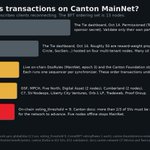
Canton says its consensus swap had "almost no downtime" and "nobody noticed." Two things worth unpacking: what the downtime actually was, and whether "decentralized network" is the right description. Thread, with on-chain data.
1/ Per Digital Asset's own operator notice, mainnet was topology-frozen for 24 hours (no new parties, validators or package vetting) and transactions paused at the Saturday 13:00 UTC cutover. BitGo kept a maintenance incident open for 25 hours and blocked Canton wallet initializations. The devnet run of the same upgrade hit a bug that pushed mainnet from Aug 8 to Oct 10.
That is a maintenance window. Ethereum has produced a block roughly every 12 seconds since July 2015, through every upgrade, with no halt and no window. For 24/7 settlement, that difference is the product.

Your second tweet answers your first @CertiKCommunity. "CC is burned for services, while newly minted CC rewards applications and operators." Follow that through and the $155M stops being fee income.
A Canton fee is Canton Coin burned, mostly by validators buying traffic. The people burning it are the app operators, and the protocol mints them new CC for doing so. The largest burner, Temple, charges its users 0.5 and 1 bp, prepaid and deducted off-chain. Those fees go to Temple, not into the burn. On-chain, Temple burned 269M CC of traffic in Q2 and has received 1.17B CC in protocol rewards to date.
Q3 on-chain: 1.99B CC minted, 1.37B burned. That burn, priced in USD, is the $155M. CCView puts 72% of the minting with the apps generating the traffic. Digital Asset's own Universal Burn draft says the network mints about twice what it burns.
In June you wrote the burn-to-mint ratio was "closing on the 1.0 that marks net deflation." Four months on, burn has been flat since February and minting has stayed above it every month. The gap is new supply. And "no premine, CC exists only because of activity" sits awkwardly with 60% of all CC ever minted going to Super Validators for running nodes.
So "the highest fees across all chains" is a network paying participants to create traffic, then counting the cost of that traffic as revenue. The useful metric is not fees. It is burn against mint, and whether anyone pays without being repaid. Right now the biggest payers are also the biggest recipients.


Canton surpassed $155M in recorded Q3 2026 fees, the highest across all chains in our comparison.
@CantonNetwork's $1.71M daily median points to a high baseline, not a total driven by a few peaks.
Read our research below on its fee model and institutional workflows. 👇🧵
