

International and global policy comms at Stripe. Previously Google, and a few other places. When not working: 🚴♂️🏃♂️🎸📚🏕️ 🥾👨🍳.
The Netherlands, Brussels
Joined June 2009
- Tweets11.9K
- Following3.2K
- Followers3.1K
- Likes28.5K









Mark Jansen retweeted

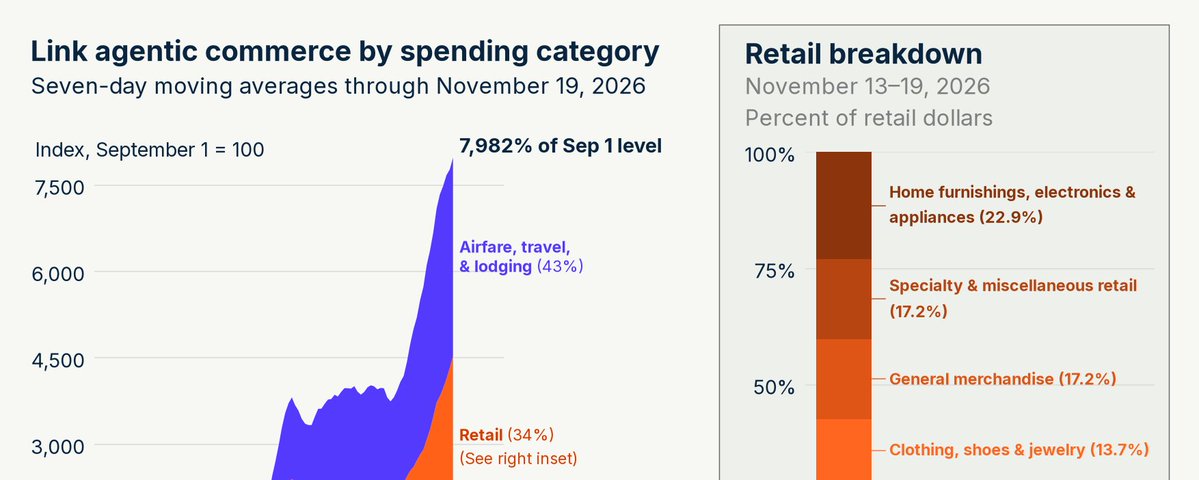
We're releasing new @Stripe agentic commerce data today, telling the story so far as we look ahead to the kickoff of the holiday season next week.
Mark Jansen retweeted

France and Spain now spend more on pensions than on education, policing, housing, infrastructure and defence combined.

Mark Jansen retweeted

imagine telling someone from the 80s that one of these guys was a socialist and the other one was the capitalist


Mark Jansen retweeted

The AI bubble debate runs on valuations and capex. For a read on demand, we built the @stripe AI Index: weekly, same-business pay-in volume across ~20K AI businesses.
• Aggregate is +103% Y/Y
• Median is +41%, nearly 3x median SaaS
• Some recent cooling: ~80% annualized over 13 wks, from ~140%
• US lead is widening
Given how fast the sector is moving, we're now publishing our AI Index weekly.

New from @Stripe Economics today: how have AI businesses been weathering the recent headwinds & tailwinds to the industry? To help answer this, we built the Stripe AI Index, a same-business proxy measure of revenue for around 20,000 AI-native firms on Stripe each week. 🧵 /1

Mark Jansen retweeted

What does the future of agentic commerce look like?
@stripe and @tempo's Machine Purchase Protocol already processes "tens of thousands of transactions per day," @patrickc tells @ReedAlbergotti.
"You can just tell that it's fundamentally a utility in the world that, over the medium to long term, inevitably many people are going to want. And so, despite it being so small and so nascent, we're very excited about it."
Mark Jansen retweeted

Europe is home to many of the world's fastest growing companies of all time, veteran VC firm Atomico highlighted in its latest annual State of European Tech report.
spr.ly/6017Byp4gJ

Mark Jansen retweeted

The new @stripepress website is just like being in a bookstore. You can pick up the books and leaf through them. Book smells coming when browser support is good enough.

New stripe press website launches today.
Truly a labor of love.
Came up with the concept for this website 4 years and in the last year revived and built it with @narrowd and friends.
You can read every page of every book, listen to audio book previews, change the lighting, and for the first time, purchase them directly from @stripepress.

Mark Jansen retweeted

The new Stripe Press site is now live.
stripe.press


Mark Jansen retweeted

Hugging Face + @OpenRouter:

Starting today, chat models on Hugging Face run through OpenRouter!
Open-weight models went from 27% to 72% of tokens on OpenRouter in under a year. A lot of that comes from two things: labs publishing their weights on Hugging Face 🤗, and dozens of providers competing to serve them on diverse dimensions.
Today we’re connecting the two. Chat models on the Hub now run through OpenRouter’s routing: 160 models from 38 labs, best provider picked per request, automatic failover, same HF token.
And your OpenRouter traces can now land in a Hugging Face bucket you own, ready for fine-tuning.
Excited to build this with @ClementDelangue, @julien_c, and the @huggingface team. More coming!
Mark Jansen retweeted
Smith and Montesquieu thought that markets and commerce made us better: that they create an incentive to pursue self-improvement and to create things of value for others. In the positive AI visions, where the labor of humans is made redundant, I find myself wondering how we fare in the presumptive absence of these incentive gradients. Perhaps we are released to a life of freedom, where we can study Mozart and read Dickens, but that still seems complicated: both Mozart and Dickens were themselves deeply commercially-motivated in the production of their work, as were most of the great artists through human history. If the premise is that nobody will need to work or produce, how confident are we that we actually get the next Mozart and Dickens? The relevant question is not the partial equilibrium of whether one individual can pursue a life of enlightened leisure, but the general equilibrium of what form a society as a whole will take on.
One could maybe invoke Periclean Athens or the aristocratic gentleman scientists of Victorian England as a counterpoint. While these individuals were perhaps not motivated by commercial considerations, they were embedded in wider societies shaped by commerce, attendant betterment, and trade: Byron was himself upper class, but he was also surrounded by and writing for an educated bourgeois audience. So we’re back to the equilibrium question. Furthermore, even these individuals were surely motivated by a sense of high-stakes and consequential agency: if they did not apply themselves to their labors, they presumably believed that the work would not otherwise exist. Thucydides was addressing pressing military matters.
So I would like to read more optimistic cases from AI proponents about what a society (vs individual life) looks like if everything goes well: what people do, why they do it, whether humans achieve excellence (and in which domains), and which historical groups we should look to as relevant precedent.
One can perhaps imagine that humans will turn out to have a strong preference for work created by other humans. This may work in certain domains (ceramics?), but for how many will it actually apply? (I’m told that much of what is sold on indie crafts websites is now in fact manufactured in China.) It’s hard to see how this human preference, even if strong, would, for example, save scholarship.
Another idea would be to accept that nobody will become Einstein or Mozart or Byron, and that human excellence as such diminishes, but that there are compensatory benefits (planet brains and Dyson swarms?).
I believe that we can satisfy individual desires, but to what extent will we cultivate behavior worthy of admiration? Will a post-scarcity society mold capable and ambitious people? Which institutions will sustain them and which responsibilities will they have? I’d like to hear more of the equilibrium for the maximalist case spelled out.

Mark Jansen retweeted

In "Why Europe doesn't have a Tesla" legt @PGaricano uit hoe ons arbeidsrecht in de weg staat dat de meest innovatieve bedrijven ter wereld hier ontstaan en zich hier vestigen. Leestip: worksinprogress.co/issue/why…

Mark Jansen retweeted
In "Why Europe doesn't have a Tesla" legt @PGaricano glashelder uit hoe dit in veel Europese landen nu misgaat, en hoe Denemarken ons laat zien dat het beter kan. Bindend leesadvies: worksinprogress.co/issue/why…

Mark Jansen retweeted

OpenRouter is officially part of Stripe!
No single lab will build all the intelligence the world needs. We’re building OpenRouter so every developer and business can choose the best of it, wherever it comes from.
Every model stays on equal footing. With Stripe, we can bring that choice to the millions of businesses that run there.
Long term, we aim to connect the rails that move the economy’s money with the rails that move its intelligence, and build the best developer experience for both.

OpenRouter is officially part of @stripe today!
More than 10 million developers and companies use OpenRouter, and as they build with more models across more workloads, they need control over what it costs and where their data goes.
OpenRouter has built that operating infrastructure to help run AI across every model and provider, with access to new models, uptime through outages, and enforced spend and data policies for each team.
Joining Stripe, which has spent years running critical infrastructure for businesses around the world, means we can build it faster and support companies at every scale.
Our commitment to neutrality stays the same. Models and providers compete on quality, reliability, and price. You decide what works for your business.
Mark Jansen retweeted

My new hobby is narrating Dutch and European gas flow like David Attenborough narrates wildlife.
Hundreds of people have already subscribed to my weekly updates at gaspeil.nl



Mark Jansen retweeted
Tomorrow on Cheeky Pint: @NStoronsky of @Revolut