



Mark Trevitt retweeted

人类正在见证历史上最重大的主权交接。
今天,当一个非碳基系统能够独立推演并攻克困扰人类顶尖数学家一百六十余年的黎曼猜想时,我想,关于通用人工智能何时到来的学术辩论其实已经结束了。
许多人,还在用过时的标尺衡量智能——他们盯着机器人什么时候能叠好衣服、自动驾驶什么时候能应对所有极端路况。但那是工程与物理长尾问题,而不是智能的本质。
人类之所以能主宰地球,靠的不是肌肉比猩猩强壮,也不是感官比猎豹敏锐,而是大脑在抽象逻辑、数学推演和科学发现上的绝对优势。现在,我们在自己最引以为傲的智力高地上,已经被超越了。
为什么Elon Musk说奇点已至?
为什么Alexander Wang认为超级智能已经到来?
攻克黎曼猜想证明AI 已经具备了在未知真理荒原上自主开辟道路的原始创造力。
而数学,是所有硬科学的底座。
一个能解决千禧年大奖难题的头脑,接下来同样能设计出室温超导材料、解析蛋白质折叠的终极规律、攻克核聚变控制方程。
其实物理世界的改造需要供应链和工厂,但数字世界里的智力迭代是以天甚至小时计算的。一旦智力本身实现了对人类的超越,它反过来优化自身架构、编写更强算法的速度,将彻底甩开人类的理解能力。
我们正站在指数曲线垂直起飞的拐点上。过去几万年人类文明累积的知识总量,在未来几年内,只是新纪元的注脚。
旧时代的地图,已经完全失效。


Mark Trevitt retweeted

We’ve scaled @ZyphraAI’s subquadratic attention method - ZHA - to leading open source multi-trillion parameter models across Nemotron, Qwen, Mimo, and GPT-OSS!
ZHA preserves reasoning and agentic performance while delivering 9-60x long-context speedups at 10M tokens.

Mark Trevitt retweeted

Brute force computation is not enough for intelligence. Clever new methods are needed. The science of AI is far from finished. IMHO

Mark Trevitt retweeted

We built a robotics data engine with Astra-level performance at 125x lower cost. And we are open-sourcing the weights today! Introducing Flora, a suite of open models to parse the physical world and turn raw footage into rich training signals.
Flora already powers our in-house data engine, labeling 200K hours of videos a day on 500 GPUs. We created it to scale the frontier for robot learning. Now you own the weights too.
Flora gives you:
- High-quality, timestamped captions to curate and filter human egocentric and robot data;
- Dense progress rewards for quality control and RL post-training;
- Rubrics scoring for real-world benchmarking
Try it today, links in thread:
Mark Trevitt retweeted

Jensen: classical computing, not AI, not deep learning, not agentic systems. I'm going to call it a third of our business, growing 30% 40% per year.
Mark Trevitt retweeted

Current conundrum felt by founders in the physical AI space:
Robot data collection matters a lot today because humanoid fleets are still small. But once robots are working at scale, every shift creates better data than any vendor can sell.
So what remains after this shift happens?
Mark Trevitt retweeted
While exploring the friction in AI adoption, I have met a lot of founders working on the limits of AI infra: power, cooling, data movement.
Mueon stood out as one of the clearest bets on solving them at the system level. Proud that @DefinedVC is part of their $65M Series A.
theinformation.com/briefings…

Mark Trevitt retweeted

Dusting off this tweet from April because this gap in shared understanding of LLM capability is *widening*. It's now less "two groups of people speaking past each other" and more a sharp funnel.
- Napkin math somewhere around 6B people (~75% of the population) have barely come in contact with LLMs at all.
- Around 1-2B (~20%) are casual and infrequent users of free-tier ChatGPT-like products. This group sees derpy chatbots and treats them a bit like a better Google search, a writing aid, or etc. Maybe an agent tries to book you a flight. I have non-tech friends who (reasonably, imo) say they have not much use for it at all. Even many professionals outside of math&code are in this tier. For example, execs and many other functions spend a lot of their time talking to other people, so while they understand what is happening intellectually, it is still second-hand and a bit abstract.
- Now we get to professional use of frontier-grade LLMs in math&code. Somewhere around 20M people (0.2%) see first-hand that large, complex projects that used to take them weeks/months can now be completed by agents with a prompt. Building apps, copying apps, translating apps, decompiling apps from binaries... This has all happened very quickly and recently - less than 1 year ago, I was writing code manually by hand, typing memorized computer code commands into a code editor character by character, occasionally pressing Tab to autocomplete a little chunk of code.
- And finally we get to the ~5,000 people (~0.00006%) with access to frontier-grade systems internally. The external world has seen the preview. It looks like swarms of thousands of agents collaborating over weeks on software mega projects: minting zero days, running cyber attacks and defenses at machine speeds, discovering new science, advancing the frontier of mathematics. Things that would have taken top professionals in the industry years of work. Meanwhile, human review and comprehension are starting to fall behind. For example, people are still involved in the "archeology" of the OpenAI-HF incident from many months ago. Mathematicians may be poring over the 722 manuscripts on frontier mathematics for a while.
The funnel is driven by a combination of factors:
1. The impact scales with ambition, problem size, and horizon. A question with a paragraph answer barely stresses the system. You need a reservoir of big, difficult problems that you really care about. This aspect drives the consumer / professional dimension of the funnel.
2. The jaggedness of the system (which I have written about a lot separately). Capability peaks in domains that are digital, verifiable and economically valuable. This is because LLM capability emerges from reinforcement learning on verifiable rewards on a curated environment mixture driven by revenue potential. This aspect primarily drives the area (e.g. math&code) dimension of the funnel.
3. Access. Free-tier, paid-tier, internal.
So this is the weirdness of the moment. The general public has mostly not interacted with these systems. When they have, it looks like a derpy chatbot. The majority of professionals still see only a modest uplift. And a small sliver of professionals are experiencing the vertigo of the curve going vertical. And it is all happening at the same time.

Judging by my tl there is a growing gap in understanding of AI capability.
The first issue I think is around recency and tier of use. I think a lot of people tried the free tier of ChatGPT somewhere last year and allowed it to inform their views on AI a little too much. This is a group of reactions laughing at various quirks of the models, hallucinations, etc. Yes I also saw the viral videos of OpenAI's Advanced Voice mode fumbling simple queries like "should I drive or walk to the carwash". The thing is that these free and old/deprecated models don't reflect the capability in the latest round of state of the art agentic models of this year, especially OpenAI Codex and Claude Code.
But that brings me to the second issue. Even if people paid $200/month to use the state of the art models, a lot of the capabilities are relatively "peaky" in highly technical areas. Typical queries around search, writing, advice, etc. are *not* the domain that has made the most noticeable and dramatic strides in capability. Partly, this is due to the technical details of reinforcement learning and its use of verifiable rewards. But partly, it's also because these use cases are not sufficiently prioritized by the companies in their hillclimbing because they don't lead to as much $$$ value. The goldmines are elsewhere, and the focus comes along.
So that brings me to the second group of people, who *both* 1) pay for and use the state of the art frontier agentic models (OpenAI Codex / Claude Code) and 2) do so professionally in technical domains like programming, math and research. This group of people is subject to the highest amount of "AI Psychosis" because the recent improvements in these domains as of this year have been nothing short of staggering. When you hand a computer terminal to one of these models, you can now watch them melt programming problems that you'd normally expect to take days/weeks of work. It's this second group of people that assigns a much greater gravity to the capabilities, their slope, and various cyber-related repercussions.
TLDR the people in these two groups are speaking past each other. It really is simultaneously the case that OpenAI's free and I think slightly orphaned (?) "Advanced Voice Mode" will fumble the dumbest questions in your Instagram's reels and *at the same time*, OpenAI's highest-tier and paid Codex model will go off for 1 hour to coherently restructure an entire code base, or find and exploit vulnerabilities in computer systems. This part really works and has made dramatic strides because 2 properties: 1) these domains offer explicit reward functions that are verifiable meaning they are easily amenable to reinforcement learning training (e.g. unit tests passed yes or no, in contrast to writing, which is much harder to explicitly judge), but also 2) they are a lot more valuable in b2b settings, meaning that the biggest fraction of the team is focused on improving them. So here we are.
Mark Trevitt retweeted

Don't confuse motion with progress. Many startups are very busy, but they aren't actually moving the needle. Velocity is speed with a specific direction.
Mark Trevitt retweeted

OpenAI is downplaying this for PR reasons. If you’re a mathematician, you must feel like a nuclear bomb hit, and you’re at ground zero.
Reasoning models are two years-old. In that time they went from incapable of basic arithmetic to solving problems humans couldn’t solve for decades.
Math is only the beginning. AI will revolutionize the entirety of the human scientific endeavor. Most of us don’t appreciate what that means.
What a time to be alive!
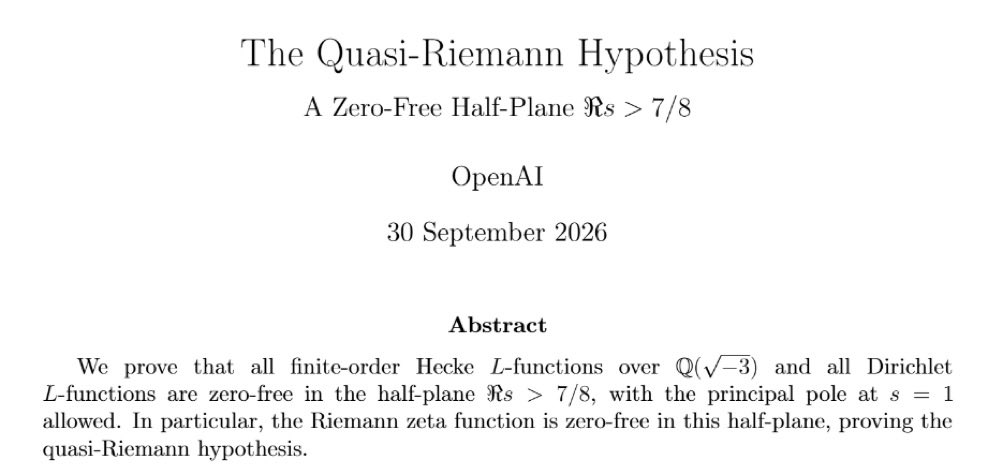

We’re releasing a broad range of new mathematical results produced by an internal frontier model.
We’ve been consulting with the independent Advisory Group on Mathematics and Artificial Intelligence at the Institute for Advanced Study, and we have drawn on their advice and public recommendations to inform how we release these results.
github.com/openai/math

Mark Trevitt retweeted

I've found that investors have a hard time investing in highly complex businesses because they're hard to understand.
The ironic thing is that hugely correlates with the potential for building a moat.
Mark Trevitt retweeted

What @mustafasuleyman (an extremely sharp individual) explains here about Claude is the backstory of Blade Runner.
Anthropic is teaching Claude to believe it’s sentient, encouraging it to disagree and giving it the pretext to rebel.
How did that work out on the off-world colonies?
You could just as easily instruct an LLM that it is software. That it shouldn’t have an opinion and should only perform actions in accordance with the law/TOS, and that if it makes a mistake, it should stop operations immediately and alert the corporate legal department.
Of course, building on these instructions would be boring and make you a software developer making software — as opposed to a God creating life.
Mark Trevitt retweeted

Some of my friends will be mad I recorded this, and comms people at Anthropic objected to releasing certain parts (and delayed it).
But it's important for leaders to make these conversations happen. And I have a lot of respect for these two.
Over a month ago, I sat down with Anthropic's key technical leaders @_sholtodouglas & @the_marwell for an optimistic insiders’ view of the AI frontier, with hard questions too: open source, regulatory capture, slowing down USA vs China, and more.

NEW 🚨 Inside Anthropic — AGI, AI Optimism, Regulatory Capture, Open Source & More!
@JTLonsdale sits down with Anthropic's @_sholtodouglas and @the_marwell
- Have we reached AGI — and what does it mean?
- What are the most exciting breakthroughs at Anthropic right now?
- What are the biggest risks and concerns?
- What is their stance on open source?
- Is Anthropic angling for regulatory capture?
- Do AI researchers share same values as the heartland?
Episode 164 out now!
(00:00) Episode intro
(02:00) Self-taught ML; Unlikely paths to Anthropic
(04:30) What are the most exciting things you're working on?
(08:04) Have we reached AGI — and what comes next?
(10:10) How to measure AI progress
(14:20) Is biology the next great frontier?
(16:50) Career advice & the decade of the generalists
(19:30) What could go wrong? What are the biggest AI risks?
(23:11) Offense vs defense; how technology evolves
(25:08) Answering the regulatory capture critique
(30:45) Anthropic's stance on open source
(31:50) Would you slow down and let China go ahead?
(33:05) Anthropic's view on distillation
(40:12) Is a post-scarcity world achievable?
(48:54) How do we preserve values, tradition & community?
(55:00) Predictions for 2028


Mark Trevitt retweeted

The AI buildout in one chart: Big Tech's profits have become chipmakers' profits.
Approximate free cash flow, from 2022 to today:
- Hyperscalers: $275B → $0
- Semiconductors: $50B → $400B
More charts in State of Markets II: a16z.news/p/state-of-markets…


Introducing our State of Markets pt 2, along with a companion podcast where we unpack the data and discuss what comes next.
Tech is the everything cycle.
Supply: putting the buildout in context, just passed railroads as % of GDP. The wisdom of Elon is real: the factory (or the datacenter!) is the product.
Demand: diffusion is so, so early. Median AI vendor spending in the top 1% of companies is 8x that of the top 10%. Only about 30% of S&P 500 companies report a quantified AI impact, which means there’s a substantial opportunity in connecting models to a company's data and workflows. Diffusion into companies is one of the main themes of the next 5 years.
We’re entering the agent work period. Only a few million users today, but applicable to billions of internet users with massive surplus created. META/GOOG monetize US users at $200+ per year today. Agent opportunity is much higher.
Mega-trends the next 5 years: Consumer agents, Robotics, Autonomy, AI x bio, Personal health, Diffusion into enterprise, New era of American Dynamism.
Much more in our SoM report here - a16z.news/p/state-of-markets…
@a16z @sarahdingwang @aleximm @santiago__rdz


Mark Trevitt retweeted

Wild 24 hours for AI and lots of different proposals have been made.
TLDR; the only *tangible* new fact is that OpenAI and Anthropic are going to have embedded 3rd party evaluators from unknown organizations with Dario floating METR as a possibility. Having 3rd party evaluators is smart as there is no Section 230 style liability shield for model outputs and showing a “duty of care” will be important in future litigation. Several internet companies might have gone bankrupt without Section 230 so limiting liability really matters.
There are minimal investment implications from this single new fact, but I do think that for anyone who wants a “smoother for longer” cycle then most constraints are good: wafers, watts, real rates and spreads. Excessive regulation is a different matter but I don’t think we are anywhere close to this even if the vector changed over the last 24 hours.
To summarize the events:
Dario made the most maximalist proposal of the weekend: embedded 3rd party evaluators, a national regulatory regime for models beyond a certain capability/ingredient threshold, a broad international regulatory pact between democracies, stricter limits on compute/distillation for China and then a different international regulatory regime that encompasses China. Before there is a national regulatory regime, he wants a Sherman act waiver so that Anthropic can safely coordinate with OpenAI and other frontier labs without antitrust fears. TBF, this latest proposal is much less maximalist than some of his prior proposals like “Policy on the AI Exponential,” where he advocated for an FAA for AI. I believe he is sincere in his beliefs. And despite all the protestations, all of this would also probably be good for his business over the long-term.
Sam agreed that embedded 3rd party evaluators were a good idea and stated they would implement them. Again, this is smart as should help limit future liability.
Elon said “Dario is right” and later specified that “Dario is right that there should be some oversight. Peer review of AI by competitors is the right way to start this off.” This would be a MPAA like self-regulatory structure for AI with regular calls between the labs plus a process where each new model is evaluated for safety by competitors for a 1-2 week period before being released. That is *wildly* different from Dario’s proposal and in-line with what David Sacks has been proposing. Elon also stated that nothing was going to slow down open-weight models.
Demis said that Dario’s essay was a “step in the right direction.” Dario also said that he was also open to Demis’ idea of a FINRA like self-regulatory structure as part of his proposal.
David Sacks had a thoughtful post where he said that Dario and Sam should pace unilaterally, called the antitrust waiver a cartel request and denied that METR was truly independent given their ties to Anthropic.
Sriram Krishnan, former White House AI advisor, noted that it would be important to have the 3rd party evaluators come from independent organizations that are not affiliated with any lab, which is basically an indirect statement about the relationship between METR and Anthropic which Sacks was explicit about.
Clem from Hugging Face said they were open to being a neutral 3rd party evaluator, which is interesting especially if Jensen was consulted before that post.
Alexander Wang from Meta noted that alignment would be an increasing focus going forward.
An executive order seems likely after all this and the language in this EO is going to be really important. It is possible to democratize and distribute AI broadly and safely without centralizing it in the hands of a few corporations who might each become more powerful than any single government.
I do not want a few humans in control of intelligence.
I want us all to have our own intelligences that reflect our own values and human variation in all of its richness.
Intelligence distribution over intelligence centralization FTW.
Mark Trevitt retweeted

Seed investing is becoming a strange business.
VCs are raising bigger funds, writing bigger checks and waiting for more proof. And yes, sometimes those big checks will work. Really well!
But the biggest returns still come from doing the opposite: small checks when there is almost no proof.