




The software factory discourse is super interesting.
I think really seeing the need for really good tooling and team structure here is hugely dependent on two factors:
1. You need to be actually shipping a large volume of work relative to you team size.
(IMO test here is: "Could we prioritize the our work using traditional means without being overwhelmed?" - if no, then you're not there yet. Work is becoming much more abstract.)
2. Said work needs to be intentional and impactful.
#2 is what really makes it tricky. You begin to experience the human attention bottleneck and why facilitating massive queues of work across different areas is so difficult.
The second you introduce that factor and need to solve for human decision bandwidth, alongside the facilitation of the actual pipeline.
Most of these factory tools are solving for the actual implementation, which is mostly complete at this point.
The next step is moving back to solving WHAT to do and creating both the right tooling and team structure around it.
We've been working on figuring out internally at AppSumo. The team has already nearly 10x'd the amount of PRs we're shipping, but the decision/prioritization is becoming a big challenge at scale.
The chart below is volume as we've figured out better loops, pipelines, and work management - all while having less than half the amount of engineers we started with.
Goal right now to solve with our factory is to keep this chart trending up, while reducing the amount of context/overload you experience trying to manage it.

1
82


The challenges that teams are seeing with better, faster models will be 10x’d with factories + large orchestration systems.
There’s going to be a really interesting shift in how we manage and prioritize work as volume increases and human attention becomes bottleneck.
Traditional methods will not work anymore and it’ll be overwhelming for one person to manage the scale of the work they’re going to be orchestrating.
The tooling around this will be interesting because it’ll have to focus on how models will be making massive trains of micro-decisions on days long tasks (which can drift from desired output) and decide what decisions fit into the attention capacity that the human can handle.

software factories feel like a temporary problem. the models will learn to build them for you
the more interesting question to me is how to build a workspace where agents can collaborate with you
23
AppSumo is THE place for distribution in a world full of software :)

I know @AppSumo was good for product distribution, but I was lowkey expecting no sales (maybe 1 in 30 days). This is what I've made in 2 hours:
@noahkagan

1
1
27
We've found that AppSumo partners who do a limited-quantity giveaway or coupon at launch tend to get sales and reviews faster which = better overall performance.
You're now able to run your own giveaways/limited-time promotions + track progress towards your next level.


1
29
This is interesting because our data is nearly identical for MCP-submitted listings on AppSumo.
MCP submissions are a fraction of the total, but absolutely dominate on approval ratings.

Product Hunt insider tip (I'm the CEO):
Launches submitted via MCP are 3 times more likely to be featured than manual launches.
Our MCP actually helps you create a better launch.
1
112

Distribution is now an extension of your development workflow.
You can list your product on AppSumo from Claude Code:
claude mcp add --transport http appsumo appsumo.com/mcp/
It builds your full listing, including:
- writing copy
- creating images
- setting up redemption
- submitting for review
(Works for all of you Codex fans too)
AppSumo is THE place to launch and distribute software in an AI world
liteo.io is about to crack $1000 on AppSumo the next days and so far it has been a great experience.
- users know your product is early stage
- this means they expect bugs and friction
- which leads to loads of feedback and suggestions
- this helps you to understand your own product better
- and build something more mature and battle tested
gg @noahkagan and @AppSumo

22

My favorite part: LeadOcean is an API and MCP server, and Ashish built his AppSumo listing himself through our self-serve flow.
That's what we're building toward. You ship the product, and getting it to buyers is the next step in the same workflow.

Day 1 of his AppSumo launch: $3,819.
Day 2: $84. 😬📉
Day 10: $3,371. 📈
That's solopreneur Ashish (@heyashishrai) of LeadOcean. I am super impressed.
Day 2 is the day most founders decide it didn't work. Everyone says perfect the product first. His regret: spending too long perfecting the product instead of getting it out there.
What he did instead:
1- He kept posting.
Reddit, a private founder group asking for feedback, LinkedIn every day. And then kept posting.
Day 2 is when you start posting, not when you stop.
2- He changed the product for his users.
1,358 of his 1,751 users never open his site. They use LeadOcean inside Claude or ChatGPT.
Knowing what problem you are solving is critical.
3- He started over small.
Quit his Shopify engineering job when his dropshipping business took off. Lost it all to COVID. Started over with no investors and no co-founder.
Now he runs LeadOcean mostly alone, 30 hours a week. Just passed $150K in sales, more than his old salary.
Building got cheap. Distribution didn't.
Post your progress somewhere today.
What are you building? Love to feature more creators 👇

ALT leadocean progress
22
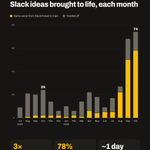
Last month, 74 ad-hoc ideas from Slack went live at @AppSumo. A year ago, that number was 24.
One metric we've optimized for is "Time from Idea -> Reality".
Time from Idea -> Reality measures everything else about how your team and org operate.
It measures if you're still using legacy process, if your team is bogged down by unnecessary approval chains, or if they're too reliant on others to make decisions.
We made a lot of changes including: removing human code review requirements, automating release notes/GTM, and changing towards each person owning an area and outcome, instead of a deliverable.
Our average time from Idea -> Reality is a day now.
We've 3x'd the amount of ideas that get shipped (outside of other projects we're working on), with one person typically owning it end-to-end.

1
2
36

Opus 5.5 Extra one-shot of home design software on a super simple prompt.
I think most home planning software is either trash or way too complicated.
Wanted something that we could use to easily plan a layout, while still having the 3D capabilities of more advanced software.
2
260


