

Commander of the Swarm. Investor in @Etched @Spawn @DaytonaIO @OpenRouter + more. Prev: CEO @HyperWriteAI Partner: [email protected]
Joined November 2019
- Tweets12K
- Following1.7K
- Followers406K
- Likes11K


Matt Shumer retweeted

I went from not agreeing with him to agreeing 200%.
GPT 6.2 Lazy should be called

I've been testing GPT-6.2 for weeks.
It's utterly unusable.
Here's my review:
youtube.com/watch?v=T-R3u8Rd…
Matt Shumer retweeted

I'm excited to introduce Embo!
We are building the brain for intelligent robots to help people around the world.
We believe intelligent robots will unlock an era of abundance, making goods and services affordable for everybody. But to deploy them at scale, robots need to work out of the box in unfamiliar scenarios. At Embo, we are building frontier AI models with a deep understanding of physical reality and fine-grained motor skills.
Today's robot skills are fragile. Demonstrations can teach repetitive behaviors, but they cannot cover every object or situation a robot will encounter. We need general pretraining at internet scale to fill the gaps between individual tasks and practice to develop reliable motor skills.
The world models our team has pioneered unlock a path to general robots. Our robot brain pretrains on massive amounts of internet video to learn about objects, physical interactions, and how tasks unfold. It then practices motor skills in diverse imagined scenarios to become robust to unexpected situations.
Our team is behind seminal work in AI including Dreamer, VideoGPT, and Diffusion Forcing, with experience from DeepMind, Meta Superintelligence Labs, NVIDIA Cosmos, Berkeley, and MIT.
We have raised a $110M Seed led by @a16z. We are excited to partner with them, @khoslaventures, DST Global, NVentures (@nvidia), @strikervp, and other strategic investors to bring reliable intelligent robots out into the world.
@EmboAI
Matt Shumer retweeted
My AI-built games have 20M+ views, and the question I get most is "how?"
So I'm going to show you. I'm building the next one from scratch, on camera. The goal is an AI that makes games at a superhuman level.
Watch Day 1: youtube.com/watch?v=3l_RZPkj…
Matt Shumer retweeted
I've been testing GPT-6.2 for weeks.
It's utterly unusable.
Here's my review:
youtube.com/watch?v=T-R3u8Rd…
Matt Shumer retweeted

this is the first video game I've properly played/enjoyed in years...
Fable 5.2 built a GTA-style NYC game. To scale.
It's fucking nuts.
Play and give feedback (WIP, the models are still iterating): nyc.somethingbig.ai
Matt Shumer retweeted

We're being told a router grounded every plane in America.
I've read everything officials have said about it, and a lot of it doesn't add up.
Here's what I think ACTUALLY happened.
Let’s start with what physically happened. On Friday, two FAA sites started bombarding the air traffic control network with connection requests, about 1,000 every 4 to 5 seconds.
One was a radio site in El Dorado, Arkansas. The other was a radar station in Amarillo, Texas.
The network couldn't handle it, and 17 of the 22 centers that direct planes across the country started to fail. That's when everything got grounded.
The official explanation is a bad router in Arkansas, where a contractor was installing new equipment that day. But the company that makes the router in question says the device "functioned as it was configured to by the installer" and "did not fail or act improperly.”
So the router didn't break. It did what someone set it up to do.
The curious thing: officials have been very careful about what they'll commit to.
The Homeland Security Secretary said they hadn't seen any "footprints" from an intruder, but, in the same answer, said "we're not going to rule that out."
The Transportation Secretary said "we have no indication that this was a hack," but then also said "we don't actually have the root cause."
If you don't know what caused it, the most you can say is that you haven't found an attack yet.
Then there's the strangest part, with zero explanation. Reports say both routers were updated that day, and the FBI is looking at that update. But nobody has said what the update was, who pushed it, or why it made two sites in two different states turn on the network at the same time.
The most likely answer is still a contractor who set something up wrong.
But I think there's a real chance this was a cyberattack.
An update that makes two sites flood the network could just be a mistake, but it's also exactly what an attack would look like.
Nothing officials have said rules it out.
And either way, we just learned that two small sites can shut down American airspace.
If it was an accident, it showed everyone just how little it takes for our infrastructure to be crippled.

Matt Shumer retweeted

Today we're launching @vorflux 2.0: AutoBots, 24x7 coworkers that live in Slack.
I previously co-founded @Rippling, now $10B+, engg team of 1000s. Engg changes crazy fast now.
IDE autocomplete > CLI > Cloud agents > multi-player slack agents
Models deliver predictably now. Bottleneck to parallelism is to initiate, keep track and ping the right people for approvals.
Hire from our directory of opinionated AutoBots or make a new one with a goal. Bring your Codex/Claude Code subscriptions and Vorflux is practically free.
We recently closed a $15M seed round for @vorflux backed by @ycombinator, @peakxvpartners, @alliancedao, along with incredible partners including @parkerconrad, @immad, @typesfast, @jake_zeller, @balajis, @nivi, @metakovan, @lmrankhan, @nikitabase, @0xrwu, @ayushjaiswal, @mattshumer_, @eshamanideep, @sreeramkannan, @dvcoolster, @nusimow, @TeddySolomon11, @ashtoncofer, @rvivek, and others.
Lmk which autobot you’d like to try and we’ll double your credits to try.
Chapters:
0:00 Introducing Vorflux 2.0
0:22 From manager to director
0:44 How an AutoBot works
1:04 Cloud setup
1:25 On-call AutoBot
1:42 Project manager AutoBot
2:03 Customer experience AutoBot
3:01 Designer AutoBot
3:52 Social AutoBot
4:51 Open and frontier models
5:23 Always-on agents
Matt Shumer retweeted

Good review of Fable 5.2
I've burned 400B+ tokens learning to use Fable 5.2.
Here's how to get the most out of it: youtube.com/watch?v=1N3Sk4oW…

Matt Shumer retweeted

FREE FABLE 5.2 @ spawn.co - pls take advantage & build something cool to share!


Matt Shumer retweeted

This was genuinely fun to play (and impressive)
Fable 5.2 built this voxel engine from a single prompt.
Try it (sound on), it’s mind-melting: spawn.co/@mattshumer/voxel-e…
Matt Shumer retweeted

I remember a year ago when they said stuff like this was a decade away.
Fable 5.2 built this voxel engine from a single prompt.
Try it (sound on), it’s mind-melting: spawn.co/@mattshumer/voxel-e…
Matt Shumer retweeted

it do be like that. Some of us have been building these for 6 years and some haven’t 😂
Matt Shumer retweeted

The 𝗯𝗶𝗴𝗴𝗲𝘀𝘁 𝗽𝗿𝗼𝗯𝗹𝗲𝗺 with longer work is keeping it moving past the first answer
I’ve been adapting and evolving my own “manage-work” skill, which was inspired by Matt months ago
Here is that skill and a few others I use to keep work moving 🧵
A lot of people are asking how I pulled off these super long-horizon builds with Astra.
Astra is extremely powerful, but by default it struggled with a task this difficult. I tested a bunch of approaches to get past this, and the one I landed on is something I'm calling the Manager Loop.
It's basically a couple of tricks we used to use with much less capable models a couple of years ago, with a few new ideas layered on top. Turns out that when you put those together and apply them to Astra, its ability to do extremely difficult long-horizon tasks goes up dramatically.
Here's how it works:
1. Launch an agent (I'm calling this one the "manager"). Chat with it about what you want to get done, and have it build a massive checklist of to-dos, then break that checklist into phases.
2. The manager then spawns a second Codex agent in a separate thread (the "implementer"). The two agents can message each other.
3. Put the manager in /goal mode, and tell it to run each phase on the implementer in /goal mode.
4. The manager messages the implementer: "/goal Complete phase one completely, extremely well." The implementer doesn't stop until that phase is done, then messages the manager back. The manager tells it to start phase two. They repeat until every phase is finished, completely autonomously.
Why I think this works: over a long-horizon task, Astra tends to asymptote. It gets way further than previous models, but at a certain point it kind of just stops improving against the goal as quickly as it did before. It gets stuck in the minutiae, focusing way too much on small details, and overall progress stalls. The Manager Loop forces it to work piecemeal, one phase at a time. It's essentially how a human would steer a model, except the model is doing the steering for me.
That's actually how this started. I was having the model write the checklist and break it into phases, and then I was doing the manager's job by hand. At some point I thought, "Wait, why can't I just get a separate AI to do this?" That's what unlocked full autonomy, which is super useful.
A wording detail that seemed to matter: I ask for each phase to be done "extremely well," not "perfectly." Maybe I'm reading too much into it, but asking for "perfect" sent the model right back into the minutiae. "Extremely well" implies it's allowed to move on once it's good enough, and that worked better in my testing.
One more trick that I think helps (this one is more of a hunch, but it was useful for me): have the implementer build a simple HTML page with the full checklist on it. The implementer checks boxes off as it goes and updates a counter, and the page has a chart of # of boxes ticked over time.
Obviously the boxes aren't all equal, but it forces the model to notice things like "I haven't made progress in a while, time to move on." You can even put this in the prompt directly, like: "if you haven't ticked a box in X amount of time, move on". That helps a lot.
I also ran 96 sub-agents at a time. You can change this in your Codex config (or just ask Codex to change it).
This got me far better long-horizon performance than anything else I tried. I'll be sharing more in the coming days!

Matt Shumer retweeted
i've been building the most ai-pilled company in the world for 2 years. let's trade notes:
- spawn is ten people
- we spend 30x payroll on AI tokens
- and ship almost as much as anthropic
- our agents pick their own names
- and profile pics
- and remember everything
- they dream
- and have time off on sundays to relax
- (not joking)
- agents fix every error hit by a user
- and verify their own work
- with no human in the loop
- we don't care if they break production
- only that they fix it fast
- we let bugs design how we work
- not code bugs, ants
- only anthropic's models can do the job
- openai makes reward hackers
- xai and google make village idiots
- i wrote an article with all the sauce
- but you'll scroll tiktok instead of reading

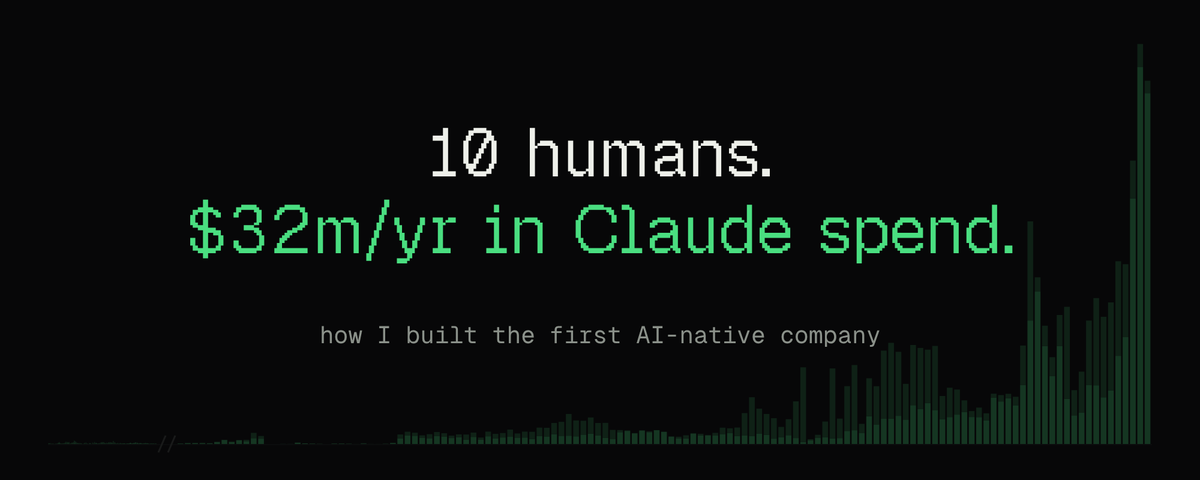
Matt Shumer retweeted

Most people think it takes 21 days to build a habit. The research says closer to 66, which is exactly how many days are left in 2026. View article

Matt Shumer retweeted

At Microsoft (i had a very public role back in 2003-06) I learned the best way to get a mob to stop throwing metaphorical Molotov cocktails through the front window was to acknowledge the mob and beg for a few hours to figure out what was going on.
It is the coverup that causes the mob to get more violent.

I used to be the person companies called after they got hacked.
And I noticed something early on.
The hack almost never sank them. The cover-up did.
Every time, the team’s instinct was the same: wait until we know more, wait until we're sure, wait until we have the perfect statement, etc.
And some of the biggest companies in the world have learned what that waiting costs.
In 2016, Uber got hacked. Instead of telling anyone, it paid the hackers $100K to delete the data and stay quiet, and labeled it a bug bounty. The truth came out a year later. Uber paid $148M to settle with all 50 states, and its former security chief was criminally convicted.
That same year, Yahoo revealed that a 2014 breach had exposed 500M accounts. The news landed in the middle of Verizon buying the company. Verizon cut $350M off the price.
And in 2017, Equifax discovered a breach affecting over 140M Americans, then waited 40 days to tell the public. During that window, an executive who'd figured out what happened sold nearly $1M in stock. He went to prison for insider trading.
Meanwhile, hackers don't wait. They post your data. They email your customers directly. And when customers hear it from a stranger first, that trust is gone for good.
Telling customers early doesn't mean admitting fault. It can be as simple as: "We found suspicious activity. We're investigating. Here's what you should do right now. We'll update you as we learn more."
On Tuesday, I'm sharing the exact framework I'd use to write that email if I were in your shoes. Follow and turn on notifications so it's there when you need it.
Customers will forgive you for getting hacked. Most of them expect it by now.
What they won't forgive is finding out you knew and said nothing.
Matt Shumer retweeted

The most expensive call I ever had was with @mattshumer_.
Ever since he showed me and @Avivsh his ways our token spend is up 10x.