
Incoming AP @Tsinghua_Uni, Researcher @AlibabaGroup, BS @UofIllinois, PhD @Yale
New Haven
Joined August 2021
- Tweets404
- Following662
- Followers649
- Likes1.9K




Pinned Tweet
35B total. 3B active. Built for serious agentic work. Excited to share Occamy-1.0, our team's first open-source agentic model. Occamy delivers strong results across long-horizon co-work, automation, business, tool-use,while sitting near the low-cost knee of the Pareto frontier.
Tianyu Liu retweeted

What if AI could discover better ways to discover molecules?
Meet MolRSI: an AI scientist that recursively improves its own search policy, with results validated in the wet lab.
🧪 Antibiotic discovery: 15.9% hit rate vs 8.7% for an expert-designed non-agentic workflow.
🧬 De novo pMHC binder design: 8 selective binder hits across 2 targets vs 0 for Claude Science.
Paper: arxiv.org/abs/2610.39714
Project page: yikunpku.github.io/MolRSI/
How it works 👇
Tianyu Liu retweeted

Introducing Hyra 2.0, the next evolution of Hunyuan Research Agent. 💡
From solving problems to building reusable tools, models, and workflows that accelerate future discoveries.
Read our perspective on the next chapter of AutoResearch:
hy.tencent.com/research/hyra…


Tianyu Liu retweeted

Scientific research runs on software — Jupyter, RStudio, ImageJ, specialized analysis tools. An AI agent that wants to do real science must not just understand the science; it must plan and execute correctly inside these tools, step by step. A misconfigured option, an unsaved file, a suboptimal intermediate result — any mistake cascades. Can current AI agents actually use scientific software?
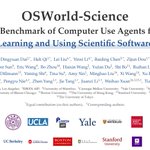
A team led by Tsinghua University (with Yale and other institutions) presents OSWorld-Science, a computer-use agent benchmark for real scientific research.
OSWorld-Science contains 146 expert-designed tasks spanning 7 scientific domains and 14 scientific software configurations, evaluated with 12 vision-language models under a unified prompt and interaction protocol. The result is sobering: the 12 models average only 34.3% task score (measuring completion degree, not just success rate). Even the leader, Claude Fable 5.1, reaches 73.7% — leaving substantial room for improvement. The benchmark adapts OSWorld's multimodal PromptAgent for scientific software, with consistent step budgets and response limits for fair comparison. Led by Assistant Professor Tianyu Liu (Tsinghua) and Professor Lei Liu (Yale), the project includes open code, dataset, paper, and a project website.
Result: OSWorld-Science is the first benchmark for AI agents using real scientific software — 146 expert tasks across 7 domains and 14 tools, 12 VLMs averaging only 34.3% (best: Claude Fable 5.1 at 73.7%) — from Tsinghua and Yale, with open code, dataset, paper, and project site.
OSWorld-Science: A Benchmark for Computer-Use Agents in Real Scientific Software
Paper: discoailab.github.io/osworld…
Project: discoailab.github.io/osworld…
Code: github.com/DiscoAILab/OSWorl…
Dataset: huggingface.co/datasets/SciA…
Our report: jiqizhixin.com/articles/2026…
📬 #PapersAccepted by Jiqizhixin

Tianyu Liu retweeted

I'm excited to see so many recent initiatives on recursive self-improvement. I finally find some time to write a short blog for my thoughts! From well-defined to semi-well-defined problems, exciting steps forward towards AI scientists!
One problem I realize I ran accidentally into from 2024, how do we accumulate experience with LLMs for solving problems better.
And more later how this can help us build AI scientists for those I call "semi-well-defined problems".

Tianyu Liu retweeted

Hi, I’m Yongchao Chen, an Assistant Professor at Tsinghua University’s College of AI and founder of ApexIntelligence.We’ve raised $50M in angel-stage funding last month.
My background: a bachelor’s from USTC, a PhD through joint training at Harvard and MIT, and research at Google DeepMind, Microsoft, and IBM.
My focus: self-evolving foundation models, robotics, and AI for Science.
The question driving my work: What if models could identify problems, form hypotheses, design experiments, validate results, and continuously improve through feedback—all on their own?
That’s what I’m working toward: enabling models to evolve themselves.
Here, I’ll share research insights, thoughts on recursive self-improvement, and lessons from building ApexIntelligence.
Researchers, founders, investors, and engineers: let’s exchange ideas and explore opportunities to work together.
Follow along, connect with me, and drop your questions in the replies. Ask me anything!
Tianyu Liu retweeted

🌍𝗠𝗲𝗱𝗶𝗰𝗮𝗹 𝗔𝗜 𝘀𝗵𝗼𝘂𝗹𝗱 𝗯𝗲 𝗲𝘃𝗮𝗹𝘂𝗮𝘁𝗲𝗱 𝗶𝗻 𝘁𝗵𝗲 𝗹𝗮𝗻𝗴𝘂𝗮𝗴𝗲𝘀, 𝗰𝗼𝗺𝗺𝘂𝗻𝗶𝘁𝗶𝗲𝘀 𝗮𝗻𝗱 𝗵𝗲𝗮𝗹𝘁𝗵 𝘀𝘆𝘀𝘁𝗲𝗺𝘀 𝘄𝗵𝗲𝗿𝗲 𝗶𝘁 𝘄𝗶𝗹𝗹 𝗮𝗰𝘁𝘂𝗮𝗹𝗹𝘆 𝗯𝗲 𝘂𝘀𝗲𝗱.
Delighted to announce the launch of #MAGIC (𝗠𝗲𝗱𝗶𝗰𝗮𝗹 𝗔𝗜 𝗚𝗹𝗼𝗯𝗮𝗹 𝗜𝗻𝗶𝘁𝗶𝗮𝘁𝗶𝘃𝗲 𝗮𝗻𝗱 𝗖𝗼𝗹𝗹𝗮𝗯𝗼𝗿𝗮𝘁𝗶𝗼𝗻) introduced in our new @NaturePortfolio @NatureMedicine correspondence.
📜MAGIC paper: nature.com/articles/s41591-0…
🔗MAGIC website: magic-ai.health/
MAGIC brings together clinicians, AI researchers, policymakers, industry stakeholders and local experts to address a critical question: does strong benchmark performance translate into safe, useful support across diverse healthcare settings?
Our initial priorities are:
✅ A global health LLM evaluation benchmark addressing multilingual coverage, regional disease burden and sociocultural adaptability.
✅ A global deployment reporting standard clarifying intended use, target users, healthcare settings, and performance and safety across populations.
Thank you to our colleagues #worldwide for helping launch the network. 𝗢𝘂𝗿 𝗴𝗼𝗮𝗹 𝗶𝘀 𝘁𝗼 𝘂𝗻𝗱𝗲𝗿𝘀𝘁𝗮𝗻𝗱 𝘄𝗵𝗲𝗿𝗲 𝗺𝗲𝗱𝗶𝗰𝗮𝗹 𝗔𝗜 𝘄𝗼𝗿𝗸𝘀, 𝗳𝗼𝗿 𝘄𝗵𝗼𝗺, 𝗮𝗻𝗱 𝘂𝗻𝗱𝗲𝗿 𝘄𝗵𝗮𝘁 𝗰𝗼𝗻𝗱𝗶𝘁𝗶𝗼𝗻𝘀.
#MAGIC #MedicalAI #AI #LLM #GlobalHealth #ResponsibleAI #HealthEquity #DukeNUS @dukenus

Tianyu Liu retweeted

I built Oh My Mouse for macOS:
• Side buttons switch desktops
• Reverse/smooth scrolling
• Per-app mappings
• Double-click Chrome tabs to close
Native Swift. Source-only beta; build it yourself. Mixed MIT/MMF licensing. Feedback welcome!
github.com/yuchenwang3/oh-my…

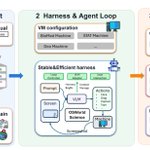
🎮 What are the limits of agents’ ability to solve scientific problems? Can they use research software as effectively as scientists?
🧪 Introducing 𝗢𝗦𝗪𝗼𝗿𝗹𝗱-𝗦𝗰𝗶𝗲𝗻𝗰𝗲: a Computer-Use Agent / GUI Agent Benchmark designed for real-world scientific research scenarios.

10/🥰 Many thanks to our fantastic collaborators: Dingyuan Dai, Heli Qi, Lei Liu, Yinxi Li, Baiding Chen, Zijun Dou, @SteveZeng7, Qi Kang, Oliver Kunyang Sun, Eric Wang, Bo Zhou, Haixin Wang, Yufan Du, Shi Bo, Ruihan Lin, Mengqi Yuan, Dunjie Lu,
@StevenDillmann , Yiming Shi, Tina Su, Amy Xin, Minghao Liu, Xi Wang, Xu Huang, Ge Zhang, Pengyu Nie, Zhen Yang, @jietang , Juanzi Li, Weihao Xuan!
Tianyu Liu retweeted

Occamy-1.0
A cost-efficient 35B model built for long-horizon co-work agents, sitting at the low-cost knee of the Pareto frontier while staying competitive with much larger systems.

better to name them as BME problems lmao

In light of the progress in mathematics, we at Edison Scientific and FutureHouse have assembled a set of Millennium Problems for Biology. They are chosen to be very hard to solve but very easy to validate in a simple laboratory environment. Any of these, if solved, would mark a major advance in biotechnology, and most of them would contribute materially towards curing disease. These are, in some sense, the “last reasonable eval” for AI in biology. This was work primarily by @MichaelaThinks and myself, with contributions from many others.
Short descriptions below. The full descriptions of the problems with acceptance criteria are at the Bio Millennium Problems website, linked in the next post. Share more if you have ideas. If they meet our criteria, we’ll add them to our list (with attribution and permission).
