

Thematic stock alpha + ranking, 50k+ meme videos on X #memely
Joined July 2022
- Tweets53.6K
- Following1.1K
- Followers7.5K
- Likes3.3K


Pinned Tweet
Memely Thematic Ranking | Week 43 of 2026
Stock First call KOL Top Contributor Performance
1. $PSRHF @Minnvestor @Share_Talk +17.39%
2. $RBRK @LogicalThesis @davey_juice +17.02%
3. $FSLY @METhompson72 @METhompson72 +15.63%
4. $LEXX @wa7ermelon @BarnyardBull72 +14.72%
5. $FLY @thesheetztweetz @thesheetztweetz +12.02%
6. $UMAC @thehustlebrosyt @fundmyfund +10.16%
7. $VELO @kingtutcap @kingtutcap +8.81%
8. $CERT @TacticzH @TacticzH +7.46%
9. $AVAV @TheValueist @TheValueist +6.73%
10. $MRCY @mikeaxolotl @BULLOFBRITAIN +6.70%
Send your stock picks to @memely to get tracked.

Memely Thematic Ranking | YTD 2026/10/31
Stock First call KOL Top Contributor Performance
1. $IQEPF @aleabitoreddit @valeagentt +650.00%
2. $SLOIF @MoodyWriter13 @aleabitoreddit +443.06%
3. $IBRX @alc2022 @SJCapitalInvest +318.69%
4. $EQRLF @METhompson72 @METhompson72 +250.00%
5. $AXTI @YieldCurveBalI @aleabitoreddit +236.76%
6. $BAND @Gubloinvestor @JSpitTrades +206.41%
7. $AEHR @SunvMikey @SunvMikey +171.87%
8. $MRCY @mikeaxolotl @BULLOFBRITAIN +170.49%
9. $CCJ @StockSavvyShay @quakes99 +165.49%
10. $KLIC @equityclimb1 @TheValueist +158.40%
Send your stock picks to @memely to get tracked.
HAPPY HALLOWEENS 🦇 🎃


$AMZN reports after today's U.S. close, and the key question is whether AWS growth can translate into stronger cash generation after the AI buildout.
Amazon's last reported quarter delivered $42.2B in AWS revenue and $16.6B in AWS operating income. That's real cloud profitability, but it doesn't tell us how profitable every new AI workload will be.
The broader cash picture was more challenging: trailing 12 month operating cash reached $161.4B, while free cash flow was -$7.6B. These are annual group figures, not quarterly AWS only results.
Amazon also reported $53.4B in non-operating pre tax other income, primarily from Anthropic investments. That investment value matters, but it isn't recurring AWS operating profit or cash generated from selling cloud services.
Commentator Tkuant highlights the distinction between contracted demand and the cash needed to fund rising capex. Its specific funding estimate isn't reconciled in the research, so the real test remains Amazon's reported numbers.
Today's results need to show AWS operating growth alongside matched-period cash generation, equipment spending and lease payments.
Can $AMZN grow its AI infrastructure business while improving cash flow, or will investment keep outrunning the cash engine?
$GOOGL $MSFT


$MSFT is showing stronger cloud growth and positive cash after property investment.
But the full funding picture is more complicated than one cash flow number.
Azure revenue grew 48%, while total revenue rose 19% to $92.3B.
GAAP EPS was $4.92, compared with $4.89 excluding OpenAI investment effects under Microsoft's measure.
The cash bridge is strong on the surface: $58.0B in operating cash minus $39.37B in cash property additions leaves $18.63B.
After $1B in finance lease principal, that's $17.63B.
But other investing activities used another $12.95B, partly reflecting component purchases.
That spending needs to be understood before treating the property investment spread as the full funding picture.
Schulz Research raises a useful accounting point: adding years of future operating lease obligations to one quarter's capex doesn't turn them into cash spent during that quarter.
New lease assets and actual payments must be kept separate.
The next question is whether Azure's growth can keep generating cash after investment and lease obligations across multiple quarters.
Is $MSFT's cloud momentum translating into durable cash returns, or are expanding commitments making the payback harder to measure?
$GOOGL $AMZN
$GOOGL's earnings miss and its cash problem are two different things.
Fixing one doesn't automatically solve the other.
Alphabet's latest quarter showed revenue up 25% and operating income up 30%.
Google Cloud revenue surged 103% to $30.71B, generating $11.12B in operating income.
EPS came in at $2.12, partly affected by $0.55 in equity security losses.
Adding that back gives $2.67 as an arithmetic sensitivity, but it isn't normalized EPS or extra cash from customers.
The bigger concern is cash conversion.
Alphabet generated $42.29B in operating cash but spent $51.36B on property and equipment, leaving free cash flow at -$9.07B.
That's worse than the previous quarter's -$5.86B, even though trailing 12-month FCF remained positive at $19.75B.
Research account Nodus42 makes an important distinction: strong AI demand and the cost of funding that demand are separate questions.
The real test is whether $GOOGL can turn Cloud and Search growth into stronger cash generation after infrastructure spending.
Can Alphabet's AI expansion eventually fund itself, or will rising capex keep pressuring cash flow?
$MSFT $AMZN
$STX is showing what actual cash returns look like not just a buyback authorization on paper.
Seagate reported $4.233B in quarterly revenue, 57.3% GAAP gross margin and $7.68 in non GAAP diluted EPS.
Operating cash reached $1.69B. After $211M in equipment investment, free cash flow came to $1.479B.
And Seagate actually returned capital:
• $168M in dividends paid
• $400M in share repurchases
• $1.262B in debt redemption and repurchase payments
Independent supply chain research account Nodus42 emphasizes pricing and product mix alongside modest sequential capacity growth.
That's important because stronger shipments alone don't tell us how much profit Seagate retains.
Management now guides for $4.7–4.9B in next quarter revenue and $9.00–9.40 in non GAAP EPS.
The new $0.76 quarterly dividend is a declaration, though not cash already paid.
With $SKHY announcing major buybacks and $MU preparing a future repurchase program, Seagate offers a useful comparison: actual distributions, debt reduction and cash generation.
Can $STX keep converting strong earnings into cash while maintaining its investment and shareholder return plans?

$MU has authorized $35.16B in share repurchases.
But don't mistake authorization for an immediate buying program.
Micron's filing says repurchases under the program are scheduled to begin December 9, subject to its CHIPS Act funding agreements.
The company isn't obligated to buy back the full amount.
The cash generation is already substantial:
• $43.97B in quarterly operating cash
• $10.77B in net capital investment
• $33.20B in adjusted free cash flow
But the investment bill isn't finished.
Micron estimates around $11.5B in net capex for fiscal Q1 and $25B for the first half, with more spending expected in the second half.
Investor Ploutos highlights the balance investors need to watch: longer customer contracts can improve visibility, but margins remain cyclical and capex is rising.
The important question isn't how large the authorization looks.
It's how much cash remains after investment and whether actual repurchases create value for continuing shareholders.
Can $MU maintain its cash generation while funding expansion and buying back shares?
$SKHY $STX
$SKHY just posted extraordinary profits. But the real question is how much of that cash actually reaches shareholders.
Q3 preliminary results:
• Revenue: ₩104.62T
• Operating profit: ₩83.33T
• Expected memory undersupply through 2030
Management also announced a ₩20T share buyback, but here's the detail investors shouldn't miss: only ₩10T is earmarked for cancellation.
The other ₩10T is intended for employee compensation.
That distinction matters.
Buying shares for employee awards isn't the same as permanently reducing the share count.
Semiconductor researcher Serenity sees customer commitments and cash returns as reasons for optimism.
Fair point, but contracted capacity doesn't guarantee fixed pricing or permanently high margins.
The dividend also includes a special distribution tied to Kioxia investment gains.
Don't assume the entire payout will repeat every year.
The real test is whether operating growth, completed cancellations and compensation related share issuance translate into lasting earnings growth per share.
Is $SKHY delivering sustainable shareholder returns or are investors getting carried away by headline payout numbers?
$MU $STX
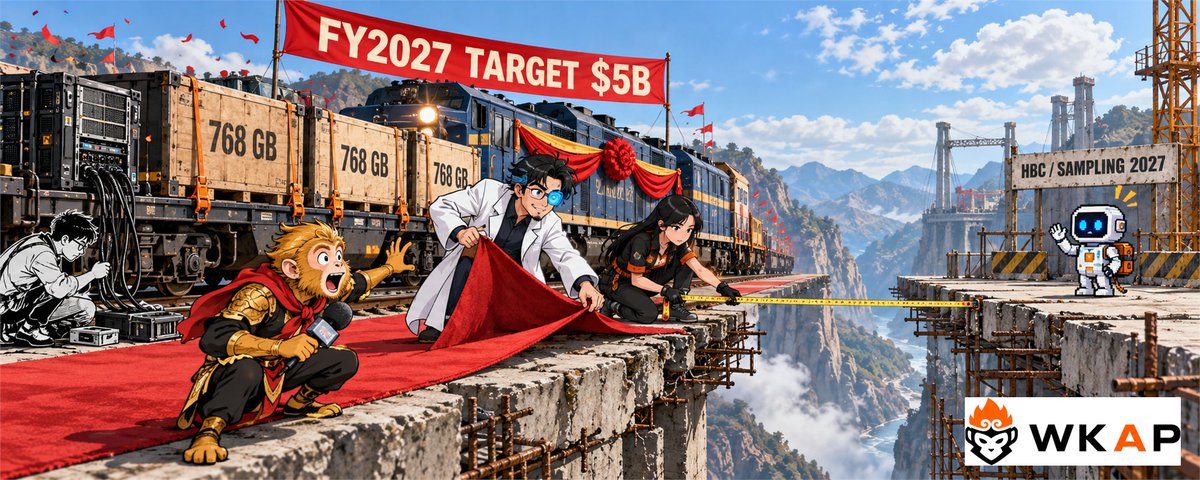
$QCOM could hit $5B in data center revenue by FY2027 and still leave its biggest AI question unanswered.
Here's why.
Its AI200 and AI250 both have 768GB of memory per card.
The difference is bandwidth: AI250 targets 133TB/s, or 18x AI200, through its High Bandwidth Compute architecture.
That matters for AI agents, where moving data faster could help models respond within tighter latency and power limits.
Qualcomm also targets lower total cost at the same tokens per second per user.
But the advertised 4–8x performance per watt advantage is based on memory bandwidth per watt, not independently measured agent tasks per dollar.
There's another important distinction: the $5B data center target covers a portfolio of products, including custom silicon.
It isn't an HBC revenue target. Two custom silicon customers are each expected to contribute over $1B in FY2027.
On FinX, Vulcan Stock Research argues $QCOM isn't valued like a pure AI winner, while Mojo questions whether its server goto market can match its engineering.
Both views point to the same missing piece.. can the technology translate into profitable growth per share?
At roughly $182, the stock trades around 10.1x its FY2029 non-GAAP EPS floor of $18 and 12.6x its GAAP floor of $14.50.
Those are ratios against future targets, not current forward P/Es. Stock based compensation also matters...
Qualcomm reported $2.579B in nine month stock compensation expense.
November 4 earnings should help show which products are driving the ramp and what margins come with them.
Can $QCOM turn its data center ambitions into a real AI agent advantage, or is the market getting ahead of the evidence?

A LOT HAPPENED IN THE STOCK MARKET TODAY. HERE ARE THE BIGGEST STORIES YOU NEED TO KNOW 🧵
1. SpaceX $SPCX is lining up $40B in GPU financing.
SpaceX signed a binding commitment letter with an Apollo managed entity to finance GPU pods and data center equipment through leases lasting 5 – 5.25 years.
GPU deliveries and lease payments are expected to begin in H1 2027.
AI infrastructure is getting VERY expensive.
2. Anthropic is reportedly preparing for an IPO.
The AI company reportedly filed its S-1 to list on the Nasdaq under $ANT.
H1 2026 revenue reportedly reached $16.3B, up from $1.16B a year earlier.
But here's the catch: Anthropic's AI infrastructure commitments run into the hundreds of billions, with agreements involving Google, Amazon, Microsoft, Broadcom and SpaceXAI.
AI growth is massive, but so is the cost of competing at the frontier.
3. Barclays upgraded Tesla $TSLA to Overweight.
The bank raised its price target from $370 to $450.
Its bullish case goes beyond speculation about a potential Tesla SpaceX combination.
Improving vehicle demand, energy growth, Robotaxi expansion and FSD adoption are all part of the thesis.
Tesla's autonomous driving business remains a major part of the long term story.
4. Microsoft $MSFT is offering voluntary buyouts to around 60,000 employees.
The reported program covers selected teams across the US, Canada, UK and India.
Eligible employees have until early December to decide whether to participate, with departures expected by year end.
One of the world's biggest tech companies is restructuring while the industry continues to pour billions into AI.
5. Samsung and SK Hynix are preparing for NVIDIA's next AI systems.
The memory makers are reportedly targeting Q2 2027 for mass production and shipments of 8 layer HBM4 memory for $NVDA.
The memory is expected to support NVIDIA's next generation Rubin Ultra systems.
The AI race isn't just about GPUs anymore.
High bandwidth memory is becoming increasingly important.
6. These were the 10 most active options tickers today:
$TSLA — 3.4M contracts
$NVDA — 3.1M
$AAPL — 1.6M
$MU — 1.3M
$SPCX — 1.3M
$META — 979K
$AMZN — 884K
$NFLX — 624K
$INTC — 598K
$AMD — 550K
Tesla and NVIDIA led the pack, while SpaceX's reported ticker also made the list.
7. Meta $META could raise up to $95B through equity financing programs.
The company announced plans for approximately $35B in new equity offerings and is considering a separate $60B offering program for Q1 2027.
Even more interesting, $NVDA, $AMD and $AVGO have expressed nonbinding interest in purchasing up to $5B of Meta shares combined.
AI infrastructure requires enormous capital, and some of the biggest chipmakers could become investors in one of their largest customers.
8. DoorDash $DASH is reportedly in advanced talks to acquire Instacart $CART.
According to reports, a deal could come as early as this week, although negotiations remain ongoing.
A combination would bring Instacart's grocery delivery network and partnerships together with DoorDash's established delivery infrastructure.
If completed, this could reshape competition in online grocery delivery.
9. Investors are aggressively buying leveraged ETFs despite the selloff.
The 10 largest US leveraged equity ETFs attracted approximately $12B in net inflows over the past month, even as their combined market capitalization fell by $20B.
$SOXL alone attracted a record $9B over two weeks, while $TQQQ pulled in $1.3B.
That's a lot of dip buying while volatility remains elevated.
But remember: leveraged ETFs can magnify losses just as quickly as gains.
10. Morgan Stanley sees a potential market rebound ahead.
Strategist Michael Wilson sees possible near term downside for the S&P 500 to 7,100 – 7,200, but maintains a year end target of 8,000.
The potential catalysts include easing financial conditions, clarity around AI financing and the midterm elections.
His biggest immediate concern? Liquidity.
The correction could create buying opportunities, but the path higher may not be smooth.
11. UBS is pushing back against CoreWeave $CRWV debt concerns.
UBS believes CoreWeave has several financing options, including private credit, vendor financing and additional equity investments.
The bank said it did not come away from its discussions with the view that capital would be scarce in 2027.
Cantor Fitzgerald also reiterated its Overweight rating and $176 price target.
The key question is whether CoreWeave can finance its expansion without putting too much pressure on its balance sheet.
12. The US and Canada are discussing potential tariff relief.
The negotiations reportedly cover steel and automobile tariffs, including duties of up to 50% on Canadian steel and 25% on automobiles.
A deal could reportedly come before the November 3 midterm elections, although no agreement has been finalized.
Any breakthrough could matter for automakers, steel producers and investors watching North American trade policy.
THE BIGGER PICTURE:
AI infrastructure spending is accelerating.
Tech companies are looking for enormous amounts of capital.
NVIDIA's ecosystem continues to expand beyond GPUs.
Investors are still buying the dip despite market risks.
Wall Street is debating whether this correction is an opportunity or a warning.
WALL STREET IS THE GREATEST SHOW ON EARTH.!
$WDC is growing fast, but how much of that growth comes from more drives versus better pricing?
Revenue jumped 55% YoY to $4.381B, while shipped capacity rose from 204 to 248 exabytes, roughly 22%.
That implies blended revenue per exabyte increased around 28%, though product mix matters and this isn't proof of a like for like price increase.
The cash numbers are strong too: 57.8% GAAP gross margin, $1.604B in operating cash and $1.377B in free cash flow.
Management expects $5.0 – 5.2B in next quarter revenue with 60 – 61% non GAAP gross margin.
Research account 株浪漫 highlights the distinction between storage capacity and drive counts.
That's the right question to ask as AI data demand grows, but the bigger test is whether $WDC can retain its pricing and margins as supply catches up.
$STX reports October 27, followed by $SNDK on October 29.
Strong storage demand is one thing. Sustaining today's profit per unit is another.
Can $WDC keep these margins if pricing starts to cool?
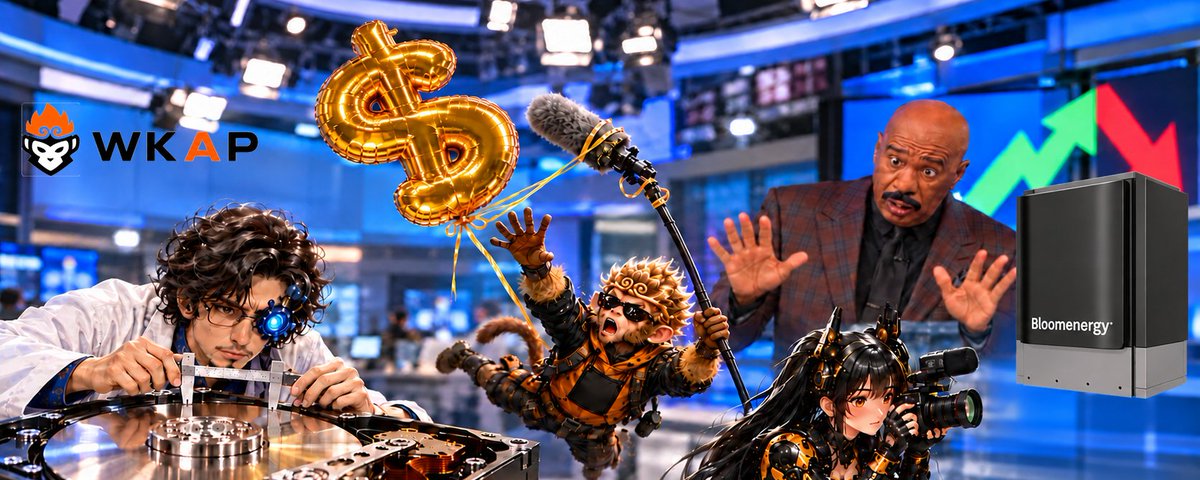
$STX's HAMR technology could pack more data into each drive.
But better technology doesn't automatically mean better shareholder returns.
Seagate's latest reported quarter delivered $3.629B in revenue, 52.3% GAAP gross margin and roughly $1.1B in free cash flow.
Its previous guidance called for $4.0 – 4.2B in revenue and $7.10 – 7.50 in non GAAP EPS.
Independent researcher 456X connects HAMR adoption and customer commitments to stronger earnings expectations.
The key question is whether higher storage density translates into more paid, profitable shipments.
Lower cost per bit can benefit customers, too. Manufacturing yields, product mix, customer pricing and investment will determine how much of the benefit Seagate actually keeps.
With $WDC reporting strong storage growth, $STX's October 27 results are the next important test.
But $WDC's results don't confirm Seagate's performance in advance.
Can $STX turn its technology lead into lasting profit growth, or will customers capture much of the benefit?
$WDC $SNDK