

Mountain Weather, Numerical Weather Models, Snow, Glaciology. We provide objective data, without bias, hyperbole or ideology.
Alps
Joined February 2010
- Tweets23.1K
- Following503
- Followers3.6K
- Likes5.2K




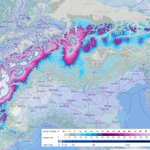


This week will continue snowing in the Alps, and also a good dump in the Pyrenees and Cantabrian Mountains.


128


meteoexploration retweeted

New study:
A 12,000-year reconstruction of seasonal temperature variability in East-Central Europe (ECE) using fossil pollen records indicates the modern era may be among the coolest intervals of the last 10,000 years.
The reconstruction reveals contrasting summer and winter temperature trajectories, with summer temperatures peaking around 7,200 years ago at 1.4°C above the Holocene mean (2.4°C warmer than modern values) before gradually declining toward the present.
Conversely, winter temperatures continued rising throughout the Mid-Holocene to reach a maximum around 2,100 years ago at 1.7°C above the Holocene mean (1.5°C warmer than today) before cooling over the last two millennia.
This region has also undergone much faster-than-modern warming and cooling periods. About 8,200 years ago summer temperatures dropped by 2°C over 190 years and winter temperatures fell by 2.4°C over 290 years. Both seasons then experienced rapid recoveries, warming by 2.1 °C in summer (1.4 °C per century) and 2.3 °C in winter (1.53 °C per century) over a 150-year span.
nature.com/articles/s43247-0…

meteoexploration retweeted

NEW - A devastating verdict on German climate and energy policy: An expert panel concludes that Germany's society and economy will "not survive" the self-proclaimed "energy transition."
disclose.tv/id/h216jz69v6/

For those that are still open minded about the climate debate. A very informative documentary youtube.com/watch?v=ktDqDAsk…
180
Wind turbines killing over 1.5 million bats every year.
Appalling Evidence Emerges to Suggest Wind Turbine Bat Deaths in US Now Rival Those of Devastating Extinction Level White-Nose Disease dailysceptic.org/2026/11/19/…

162


meteoexploration retweeted

BASF is shrinking production in Germany while opening its giant new complex in Zhanjiang, China — sold as running on “100% green energy.”
In 2024, a German diplomat told me this proved the green transition works, both Germany and China should be proud of such progress.
I checked the numbers.
The plant sits on a grid that’s still ~71% fossil.
Electricity is only ~10% of its energy.
The rest is millions of tonnes of fossil feedstock.
Real renewable share: ≈1.1%.
Paper certificates vs physical reality. Green ideology vs industrial facts.
And yet von der Leyen still pledges a climate-neutral continent by 2050. On what planet? Or by total de-industrialization in EU?
Link to full long form article in reply
meteoexploration retweeted

¡Como se han puesto algunas cuentas, no sé si reales o 'mecánicas', con mi comentario sobre la 'gran noticia' del inicio de la fabricación de nieve!
No les gustará este artículo que he rescatado vía @IndeGranada
¿Cultivar nieve o sembrar contenedores?
elindependientedegranada.es/…

meteoexploration retweeted

Mi artículo en Expansión, el diario económico de España: «El 'Net Zero' es malo para España»
La neutralidad climática de España en 2050 cuesta 325 mil millones de euros, para un mundo 0,00231 °C menos caliente en 2100
17 céntimos de beneficio climático por cada euro
NetZeroCostBenefit.com/Spain…
expansion.com/opinion/2026/1…
meteoexploration retweeted

Determinar cuándo nuestros antepasados comenzaron a pintar las paredes de las cuevas es mucho más complicado de lo que parece. El carbono-14 funciona extraordinariamente bien cuando existe materia orgánica, como el carbón vegetal, pero muchas pinturas rupestres están realizadas con pigmentos minerales y no contienen carbono que pueda fecharse directamente. Además, el método pierde utilidad al aproximarse a los 50.000 años.
La solución apareció en unas finísimas costras de calcita que durante milenios habían ido creciendo sobre algunas pinturas.
El agua que circula por la roca transporta pequeñas cantidades de uranio soluble, mientras que el torio es prácticamente insoluble. Cuando esa agua deposita calcita en una cueva, incorpora uranio pero inicialmente muy poco torio. A partir de ese momento comienza un auténtico reloj nuclear: el uranio-234 acaba produciendo torio-230 mediante su cadena de desintegración radiactiva.
Midiendo con espectrometría de masas las proporciones isotópicas de uranio y torio, los científicos pueden determinar cuándo se formó esa diminuta capa de calcita. Si está encima de una pintura, proporciona una edad mínima: el dibujo tiene necesariamente que ser anterior.
En 2012, un equipo internacional aplicó esta técnica a pinturas de 11 cuevas españolas. En El Castillo, Cantabria, una figura circular roja resultó tener al menos 40.800 años. En Altamira, un símbolo claviforme quedó fechado en un mínimo de 35.600 años, demostrando que la actividad artística en la cueva comenzó unos 10.000 años antes de lo que se pensaba.
Gracias a la radiactividad natural podemos determinar la antigüedad de pinturas realizadas hace decenas de miles de años. Una magnífica demostración de cómo la física nuclear nos ayuda también a conocer mejor nuestra propia historia.
pubmed.ncbi.nlm.nih.gov/2270…
bristol.ac.uk/news/2012/8560…
doi.org/10.1126/science.1219…

meteoexploration retweeted
Matt Ridley writes about the expensive futility of net zero in the Daily Mail:
The UK's net zero in one number: 11p back on every pound
The bill is £695 billion ($934 billion), to make our great-grandchildren's lives "cooler by under four thousandths of a degree Celsius"
NetZeroCostBenefit.com/UK?s=…
dailymail.com/debate/article…
