




Pinned Tweet
Fast-forward to my stance on what DTC can learn from Japanese people guessing chicken genders
youtu.be/TzvibdpYLJw?si=Y34E…
en.wikipedia.org/wiki/Chick_…
Great convo with someone whose podcast really saved me some trial-and-error on DTC'ing!


Michael Ting might be the smartest person I've met in ecommerce in the last year.
No exaggeration. When our mutual friend @alexmcea introduced us, it was one of those "you HAVE to talk to this guy" messages.
And he was right.
Michael is Head of Revenue at JAXXON, an 8-figure, monstrously profitable men's jewelry and accessories brand. His background is in engineering and quantitative analysis, and he's brought that rigor to the entire DTC performance marketing process.
The insight that first got my attention? JAXXON doesn't measure their ad spend primarily with ROAS or third-party attribution. They do it with a metric you aren't even tracking:
Cost per email lead.
Here's the framework:
👉 Because they can perfectly connect emails captured + email addresses at checkout, it's a highly reliable metric
👉 They track lifetime value curves for each lead
👉 Because they're highly seasonal & moment-driven, this allows them to see the value of their spend when the click is farther or closer to the moment
👉 Optimizations are built within a "make hypotheses, be wrong sometimes, and learn" framework
I've literally never heard anyone talk about attribution and marketing mix optimization this way. It's brilliant.
Go follow @michaelandeggie now, then get the episode wherever you get podcasts below 👇👇👇:
LPT: Lots of libraries offer free, endlessly renewable 72-hour WSJ & NYT passes
Other LPT: You can schedule AI to handle the tedious renewals
1
1
150
- Marketing budgeting = risk management, not optimization
- Confidence intervals are probably too high
- We underrate the impact (positive and negative) of luck

.@michaelandeggie (GM of DTC, JAXXON) believes there is no optimal ad account … only different time horizons.
He joins @connorrolain + @couuor to share how:
- Cost per email is a north star
- Sacrificing March can max BFCM
- Good decisions still go wrong
- 80% confidence = 3x your tests
- Your risk tolerance is your edge
- 50% shot at 3x > guaranteed 15%
“We used to try to win every day. Then we were trying to win every week … What’s going to grow the brand is being able to sacrifice entire months.”

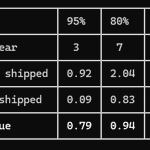
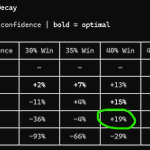
Running your A/B tests to 80% confidence could generate you +19% better results vs. 95%
Here's a hypothetical (but realistic) situation:
- You've got a long roadmap of A/B test ideas and adequate resources = you're limited by testing time
- You've prioritized the tests = the current test is expected to be ~5% better than the next one
- Your first test has a 40% chance of working and your initial winners & losers cancel each other out
- You're currently @ 2% CVR and you expect your first test to have a 0.04% impact
---------------------------------------------------
Here's the finding for 80% vs. 95% confidence:
- You'll implement ~2.3x more tests
- 12% will be losers vs. 1% @ 95% confidence
- Without quality decay you'll net +61% higher impact
- With quality decay you'll net +19% higher impact
---------------------------------------------------
Takeaway: Take time to consider WHY you're running tests to a certain confidence
Reasons why 95% might be better than 80%
- Low test success rate (e.g., <40%)
- Limited resources (e.g., you have ideas but you can't code them fast enough)
- Limited # of good ideas (e.g., the quality of your roadmap significantly declines vs. the early tests)
- Limited # of potential ideas (e.g., there's a finite # of potential offer tests I could potentially run)
- You prioritize perfection vs. impact

3
5
365
Monte-Carlo Simulation Results
Addendum to: "Reasons why 95% might be better than 80%"
- Because of the roadmap quality decay assumption, the optimal confidence is also a function of # of sessions too
I'd posit that the quality decay assumptions becomes unrealistic after too many tests (e.g., I probably wouldn't run a test that I thought had a 15% chance of winning)

2
187
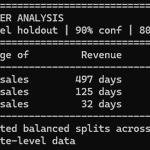
CMV: Traffic* should always be checked when analyzing holdout tests
Three Reasons:
1) Takes 300+ days to reach statistical power** on $ (See attached chart for simulated 9-figure ARR)
2) Helps diagnose the root-cause (e.g., ads driving traffic but low-CVR or vice-versa)
3) It can improve precision of incremental $ through application Bayesian stats***
Takeaway: For holdout tests, incremental $ is still the most important metric, but we need to be checking more metrics
-----------------------------
* Traffic = total sessions, add-to-cart sessions, and checkout sessions
** Tests should be run for statistical power, not statistical significance
*** Ex. You could use incremental checkout session growth as a "prior" in order to estimate incremental orders (See CUPED)

1
1
221
Five books I read this year that directly helped me improve my decision-making @ jaxxon:
1) Power Failure
- Story of the rise & eventual fall of General Electric (GE)
- Reminder not to equate decisions that improve optics as decisions that improve business value
2) Superforecasting
- Summary of a research study on the world's (unexpectedly) best predictors
- Helped me develop systems for feedback loops and probabilistic thinking
3) When Genius Failed
- Story of a hedge fund made up of academic & industry all-stars that blew itself up
- Reminder not to overly-rely on applying historical data or statistical models to predict the future
4) Losing the Signal
- Story of the rise & eventual fall of Blackberry
- Fascinating example of a company that played Porter's Five Forces perfectly during the rise, but was subsequently brought down by the same forces in its fall
5) A Man for All Markets
- Autobiography of Edward Thorp who "solved" blackjack then pioneered quant trading
- The general idea of the Kelly Criterion is fascinating e.g. if you think you have an edge (good idea), how much of your total resources should you invest into it knowing it's not a sure thing?
3
288
"The Holy Roman Empire didn't succeed because they saw the need for a large professional army; [everyone else] succeeded in their goal of avoiding the need for one"
- Iron and Blood (paraphrased)
Similarly, there's probably some common rule-of-thumb in DTC (ex. <10% OpEx, >60% GM, # of inventory turns) that we'll someday realize was holding us back long-term after a few people succeed by doing the opposite (not in spite of)
2
4
615
I'd hypothesize that chasing a high EBITDA % will prove to be a Trojan Horse.
The best companies earn a high EBITDA % by building moats (e.g., Hermes). The worst companies "force" a high EBITDA % by pulling forward their future cash flow.
Examples of latter:
- Hurt top employee retention to keep low OpEx
- Hurt customer satisfaction by compromising quality
- Lose market share by keeping high MER (low % marketing)
In a world where even Nike can fall behind, I don't think any DTC company can honestly claim an impregnable long-term moat.
Seems like the market already factors this in by dismissing the marginal benefit of >25% EBITDA. Might turn out that even this line-in-the-sand is too high.

2
2
248
Counter-argument against "websites will be obsolete this year"
There was a clear hysteresis between the explosive adoption of internet and the slower & ongoing shift of retail to it (~17% currently).
I don't disagree with the eventual dominance of AI-commerce. Just the proposed timetables.

3
1
170

Three underrated second-order effects of higher ad spend:
1) Word-of-Mouth: Probably adding 10-20%+ to long-term ROAS
2) CRO Testing Throughput: 50% more traffic = ~50% more A/B tests
3) Recruitment: Top talent much more likely to join a brand they're already aware of
2
212
Business cases are traps.
Your team's dark secret = while they'll say the model drives expectations, the reality is the opposite.
The challenge = ~1% change in multiple assumptions can compound into a ~30% change in results.

1
151


A decision-making framework which I find myself using almost everyday.
Edward De Bono’s underrated “Six Thinking Hats” - a methodical way to view a problem through different distinct lenses before making a final decision
Outlining a real-life example of how we’re applying this…

DTC Shower Thought #1
“Show me your budget, and I’ll tell you what you value.”
By that logic, are DTC companies just content companies masquerading as consumer goods?
If so, there’s one key lesson from everyone’s favorite content giant, Netflix: leverage distribution to scale fixed content costs.
Before originals, Netflix was seen as an undifferentiated distributor in a commoditized streaming market. House of Cards changed that.
A $100M production spread across 33M subscribers = ~$3 per subscriber.
Hulu, with just 5M subs, would’ve needed ~$20 per subscriber to make the same bet.
Scale let Netflix take a swing that Hulu couldn’t - and that swing created even greater scale.
Dynamic strategies of cost discipline, arbitrage, and counter-positioning got us to scale. But scale economies and brand power will keep us there.
A $50K celebrity photoshoot didn’t make sense at 1M/day impressions - but how about now that we’re at 10M+/day?
Are we still using the content tactics of the bootstrapped upstart when we should be acting like cash-flushed venture capitalist?
… and on the flipside, what do we do when scale works against us? (See Colonel Blotto’s game)
Source: Ideas shamelessly copied from Hamilton Helmer’s “7 Powers”