

One nerd’s perspective on the financial planning world… CFP, #LifelongLearner, Entrepreneur-In-Denial, Advisor #FinTech, & publisher of the Nerd’s Eye View blog
Joined October 2008
- Tweets132K
- Following456
- Followers96.7K
- Likes74






Pinned Tweet
Our list of "Best Conferences 2025!", and be sure to take advantage of the discount codes that several have offered to Nerd's Eye View readers!
Best in:
-Overall Planning: @FPANorCal
-Technology: @t3techhub
-Advanced Tax Planning: @AICPA Engage
and more!
bit.ly/4fisUpb

Crafting Deeper Client Relationships To Drive Loyalty, Referrals, And Gain Career Flexibility: Sarah Baker, senior wealth advisor at @MasonInvests, shares how she focuses on building closer client relationships which has allowed her to build greater loyalty and generate more referrals. kitc.es/4AbIUDS
In this episode, we talk in-depth about how Sarah seeks to identify and address a client's "greatest felt need" to ensure she's hitting their primary pain point (while also addressing the full range of planning issues), why Sarah moved away from a standardized client service calendar in order to have more bespoke interactions with clients facing a range of life circumstances, and how Sarah mixes in regular in-person and virtual client events to grow her client relationships between scheduled meetings.
#FASuccess #podcast #financialadvisorpodcast
3
989
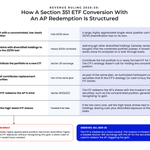
Section 351 is only the first ingredient in the strategy addressed by Revenue Ruling 2026-20. One of the primary reasons that ETFs, in general, can be extraordinarily tax efficient is their ability to conduct transactions in kind. Authorized Participants (APs), which are generally large financial institutions, can transact directly with ETFs in large blocks of ETF shares known as creation units. An AP can contribute cash or securities to an ETF in exchange for ETF shares. Conversely, the AP can present ETF shares for redemption and receive securities from the ETF. kitc.es/4yGoGRr
#Section351exchanges

The 'Christmas Tree Problem' In New Planner Hiring: We have almost no 'real' entry-level financial planning jobs, but we have an overabundance of call center, office admin, and sales jobs; the proverbial 'boxes of coal' surrounding the otherwise rare 'trunk' of high-quality financial planning opportunities. kitc.es/4BZ60PU
The rapid advance of AI-enabled financial planning software has led many advisory firms to wonder whether they still need to hire entry-level planners. With tools now able to turn a client's spreadsheets and PDFs into a detailed financial plan in a matter of minutes, handing off the work traditionally given to new planners can look like an easy decision, particularly for a profession that already struggles to find talent. Yet there are several reasons to believe that firms that pull back from hiring new planners may end up worse off.
In this guest post, @DrDanielYerger, founder and owner of the RIA MY Wealth Planners, explores why firms should continue to invest in developing entry-level planners amidst the rise of AI, from the risks of relying on technology over talent, to the tasks and career path that make doing so worthwhile. #advicers #hiring #financialplanners

Averaging together risk tolerance and risk capacity scores, the advisor can unwittingly end up in situations where clients with extremely low risk tolerance (or risk capacity) end up with portfolios that are far too risky for their situation. In other words, the low risk tolerance (or capacity) should have acted as a constraint to the investment policy statement, but didn’t.
Risk tolerance and risk capacity should be measured separately, and then scored on a two-dimensional scale that considers the contributing role (and limiting nature) of each (rather than a single continuum that merely averages the two together). kitc.es/4fcUjuj #risktolerance #risk #advicers

4
62
4,130
More "fun with AdvisorEconomics data" this weekend. Looking at what it costs advisory firms to deliver their advice services, relative to the fees they charge a typical client.
The chart you're looking at here is revenue per client on the vertical axis, and cost-to-serve per client on the horizontal. The former is straightforward - total revenue divided by client headcount. The latter is the cost side of the equation... total business expenses of the firm, divided by that same client headcount.
What the chart reveals is that while there's much industry debate about what a 'reasonable' advisory fee is, the reality is that advisory firms really DO tend to keep their costs in line with what they charge, reinvesting into depth of planning, services, or other capabilities, so profit margins are relatively consistent. Simply put, firms with higher dollar clients tend to do more for each client, increasing their costs in line with the additional fees they charge.
This makes sense in a competitive environment - firms that charge 'too much' relative to the depth and breadth of services they provide will eventually be outcompeted by other firms that are willing to do more for a less generous profit margin, and firms that charge too little for what they provide can't hire support to cover all the work and eventually face burnout.
In essence, that means there really is a "healthy" profit margin for an advisory firm - roughly somewhere between 20% to 35% (after reasonable salary compensation to the owner, this is JUST profits) - where firms can struggle outside of those profit bands. Being "too profitable" seems nice in the short term, but it tends to result in a firm that isn't competitive (fees "too high" relative to the higher level of services other firms will provide for the same fee). Being "barely profitable" also becomes an issue, though, because the firm doesn't have the room to reinvest into staff and technology, and cannot withstand business shocks (e.g., a bear market). Thus why, when we look at the data, the numbers tend to stay in a relatively tight band where revenue/client and cost/client move in sync.
The starting point is to understand the firm's cost-to-serve per client (all business expenses divided by client headcount) relative to their revenue-per-client, to see whether the numbers are in-line... first at a firm level overall (as shown in the chart here), and then at the individual client level (i.e., client by client) to see if there are clients who don't even pay enough to cover the cost it takes to operate the firm on their behalf (which drags down the average overall)!
(For those who are curious, AdvisorEconomics is in paid beta right now as we build out a deeper data set, so you can try out your own numbers for a discounted $29/month rate at advisoreconomics.com/?utm_so… )

An Email Marketing Playbook That Converts Leads Into Clients: Characteristics of an effective content marketing campaign, from offering personalized lead magnets to proactively reaching out to leads who show interest in the firm (Patrick Di Cesare | @XYPNOfficial) #WeekendReading: kitc.es/3Vawm0A

11
3,349
A client calls, worried about the unsettling headlines or a sudden drop in their portfolio. The advisor does what they do best – responds with data. The long-term market trends, historical recovery patterns... And the client nods. They might even say, "That makes sense." But when the call ends, the anxiety lingers.
Why logic isn't enough, and 6 questions that can help clients work through market fears and help them feel less stuck in uncertain times: kitc.es/4v3BdNe

4 dangerous assumptions that can hurt a retirement plan, and how financial advisors can effectively stress test client plans for a range of contingencies (@christine_benz | @MorningstarInc)
And more in Retirement Planning this #WeekendReading: kitc.es/3Vawm0A
#WeekendReading: The @SECGov this week adopted new rules that will lift the amount of regulatory AUM below which an investment adviser can be considered "small" (for the purposes of evaluating the economic impact of new regulations) from $25 million to $1 billion, which will cover 75% of RIAs under this new definition and is likely to provide relief for relatively smaller firms by forcing the SEC to more carefully consider how new regulatory proposals would impact the overwhelming majority of RIAs that don't even have the size capacity for a dedicated compliance role. kitc.es/3Vawm0A
2
60
2,816
To plan, in advance, for retirement spending strategies to be more dynamic… at minimum, to have a ratcheting plan in place to lift a low initial spending rate higher if the sequence is favorable (or at least, is not unfavorable), and for those who are willing to be more flexible in their retirement spending, to set guardrails in advance to know both when to cut spending in a bad sequence, and when to lift it higher in a more favorable one. kitc.es/4ppOePX

While the majority of individuals plan to retire at some point after they reach age 65, there is still a non-trivial number of individuals, whether by choice or by need, who retire before they are eligible for Medicare (or even Social Security, for that matter) and still need health insurance coverage: kitc.es/4yPw2lO

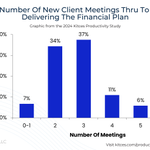
Over 70% of advisors meet with new clients two or three times before the plan is delivered. Just 7% meet with them only once, while 22% meet with them four or more times. Most advisors follow one of two approaches: (a) a discovery meeting and a delivery meeting, or (b) a discovery meeting, a delivery meeting, and an implementation meeting.
We look at how advisors deliver financial plans to new clients in greater detail in our latest productivity study available here: kitc.es/4gpB6Ef

3
29
5,201
For advisors and career changers alike, the process of completing the CFP education requirement in under a year while working full-time is less about speed and more about intentionality. The process is demanding – but it also reinforces the very competencies that define effective planners: analytical rigor, adaptability, communication, and perseverance. It requires structured scheduling, honest self-assessment, disciplined study habits, and a growth mindset that embraces "not yet" as a temporary state rather than a fixed limitation. kitc.es/4eJbZOD #CFP

1
18
3,613
Our Best Conferences list for 2027 is out! It spans a wide range of organizers, topic domains, knowledge specializations, and sub-communities, to help all of our readers find that conference most relevant to their needs! ➡️➡️ (And check out our Nerd's Eye View reader discount codes!)
kitc.es/4iaKq1s
Best:
Overall: @FPANorCal
Tech: @t3techhub
Tax Planning: Retirement Tax Services Tax Summit
Estate Planning: EstateCon @WeAreWealth
Retirement Planning: @TheAmerCol Horizons
New Planners: @fpassociation Gather
Advisor Marketing: Jolt Remix by @SnappyKraken, Potomac
Investment: @MorningstarInc
M&A and Succession:@DeVoeCo Succession Summit and @echelon_group Deals & Dealmakers Summit
Conference Experience: @FutureProof_HQ Festival and Citywide
43
3,803
The difference between a full step-up in basis and a partial one (or none at all) can end out being a significant increase in the after-tax value of assets for some clients. Advisors can help deliver this value to their clients by planning and aiding with the retitling of assets (when appropriate) to take full advantage of the basis step-up. kitc.es/4vGhfrP
2
63
6,975
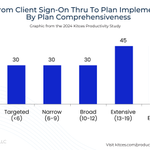
For the typical team, the process takes 45 days, though timelines can vary widely. Teams creating plans with fewer than 13 components usually finish two weeks faster, completing plan implementation within 30 days of data gathering. Plans with 13 or more components take 45 days.
We look at this in greater detail in our latest productivity study available here: kitc.es/4gpB6Ef

4
2,677
Optimizing A $160M AUM Solo Practice For Client Impact Over Scale: #FASuccess Ep 514 With Nick Ibello on how he has made a conscious decision to limit the size of his business to offer greater depth of service for his clients while meeting his personal lifestyle goals. kitc.es/4sCOnkk
In this episode, we talk in-depth about how Nick got his start in the industry by cold-calling and putting in ‘reps' that helped him refine his communication style, how Nick transitioned from this focus on ‘activity' to pursuing greater depth for his ideal target clients, and how Nick decided that working with approximately 100 clients was the right fit for his personal and professional goals. #podcast #financialadvisorpodcast
4
7
3,169
Beyond Google Reviews: How can advisors adopt a two-pronged approach to sustainably use online reviews in their marketing... while balancing concerns with compliance requirements: kitc.es/4yOZyZA
In this guest post, Whit Lanier, co-founder of Amplify Reviews (an RIA review-verification and publishing platform), and Kent Keister, IACCP®, founder of Reliant Compliance (an RIA compliance firm), shares that while getting involved with Google reviews can increase compliance complexity, but recommend 3 options and strategies on how to maximize marketing impact while simplifying compliance. #advicers
2
27
2,392
This month's #AdvisorTech kicks off with the news that Orion has announced a new fee on technology vendors that access Orion data via integration. Will providers eat the fee, raise their own prices, or stop integrating with Orion altogether? kitc.es/4ix6zY9
And other interesting announcements:
Nevis has raised $70M in Series B funding as it builds its advisor AI ‘operating system’ – joining the competition to build the hub of the advisor's tech stack
BNY/Pershing has wound down its Wove platform, highlighting that while even though it might make business sense for an RIA custodian to build its own technology offering, it can be challenging to try to be everything to everyone
Milemarker added a Model Context Protocol (MCP) server to its data warehousing solution, allowing advisory firms to plug their AI assistant of choice into their centralized firm data
Missouri barred the use of credential-sharing technology (such as Pontera) to view and make trades in a client’s held-away account to be an unethical business practice, highlighting the need for 401(k) plan providers themselves to provide more secure means of accessing client data
The SEC announced its 2027 examination priorities, which notably include assessments of RIAs’ ability to prepare for and respond to AI-driven deepfakes and phishing threats
... and more! #advicers

5
7
2,439
Having a mortgage is often framed as a way for an inflation hedge. As the conventional wisdom goes, with a mortgage your monthly payment is locked in (assuming it’s not an Adjustable-Rate Mortgage [ARM]), even if inflation goes up and interest rates rise. In fact, rising inflation would just devalue the mortgage in nominal (future) dollars. kitc.es/45fBeCV