

Mathematician & Computer Scientist | Enterprise & Solution Architect | AI Strategist | Technologist in love w/ algorithms, graphs, concepts and strategy
Berlin, Deutschland
Joined January 2009
- Tweets8.7K
- Following1.8K
- Followers727
- Likes15.3K




Michael Wolfrath retweeted

Before investing in the next AI use case, ask: does it fit into a bigger plan?
Many organizations have AI initiatives. Far fewer have a roadmap that connects those initiatives to long-term business and finance objectives.
Learn how to prioritize investments, coordinate workstreams and build a finance AI strategy designed for sustainable value creation: gtnr.it/4jGsBtK

Michael Wolfrath retweeted

System Design for the LLM Era — Patterns and Principles for Production-grade AI Architecture: amzn.to/4gxTLQg

Michael Wolfrath retweeted

andrej karpathy: “the future belongs to people who turn ideas about LLMs, RAG, and AI agents into running systems”
this free AI Engineering Hub does exactly that — 93+ production-ready projects on LLMs, RAG, MCP and AI agents
this is the clean path i wish i had earlier
01 AI Engineering Roadmap
github.com/patchy631/ai-engi…
02 LaTeX OCR with Llama
github.com/patchy631/ai-engi…
03 Local ChatGPT with DeepSeek
github.com/patchy631/ai-engi…
04 Fastest RAG Stack
github.com/patchy631/ai-engi…
05 Agentic RAG with DeepSeek
github.com/patchy631/ai-engi…
06 Multi-Agent Deep Researcher
github.com/patchy631/ai-engi…
07 DeepSeek Fine-tuning
github.com/patchy631/ai-engi…
08 Real-time Voice Bot
github.com/patchy631/ai-engi…
09 Deploy Agentic RAG
github.com/patchy631/ai-engi…
10 Evaluation and Observability
github.com/patchy631/ai-engi…
11 Qwen3 vs DeepSeek-R1
github.com/patchy631/ai-engi…
12 MCP Agentic RAG with FireCrawl
github.com/patchy631/ai-engi…
13 NotebookLM Clone
github.com/patchy631/ai-engi…
14 Financial Analyst with DeepSeek
github.com/patchy631/ai-engi…
15 The full hub. Free.
github.com/patchy631/ai-engi…
you either open this now or keep collecting random playlists for another year
save this ↓


Michael Wolfrath retweeted
AI‑Augmented Domain‑Driven Design — Design Better Domains Using LLMs, Structured Prompts, and Multi-agent Workflows: link.amazon/B070DfqmK from @PacktPublishing

Michael Wolfrath retweeted

Temperature, top-k and top-p, clearly explained!
(how an LLM picks its next token)
An LLM never picks a word directly. At every generation step, it gives a raw score to every token in its vocabulary.
It then turns those raw scores into probabilities and samples one token.
Temperature, top-k and top-p shape that sampling step. None of them touches the model's weights.
Here's how a typical sampler applies them:
↳ Temperature: it rescales the raw scores. Low values sharpen the distribution, so a few tokens dominate. High values flatten it, so unlikely tokens get a real chance.
↳ Top-k: it keeps only the k most likely tokens. With top_k at 50, it drops every token ranked below 50, whatever the distribution looks like.
↳ Top-p: it keeps the smallest set of tokens whose probabilities add up to at least p. With top_p at 0.9, an obvious next token leaves only a few tokens, and an open-ended one leaves many.
↳ Sample: the sampler picks one token from the tokens that remain.
The key difference: top-k always keeps the same number of tokens, while top-p adapts to how confident the model is.
Low temperature doesn't make a model more correct, though. It only reduces randomness, so a model without the right context can still be confidently wrong.
Good starting points for temperature:
- Classification and extraction: 0.0 to 0.2
- Code generation: 0.0 to 0.3
- General chat: 0.5 to 0.8
- Brainstorming: 0.7 to 1.2
Tune temperature first, then add top-p to trim the long tail of unlikely tokens.
While you evaluate, change one setting at a time instead of all three at once.
The diagram below shows the complete flow.
- Temperature reshapes the probabilities.
- Top-k keeps a fixed number of tokens.
- Top-p keeps just enough tokens to reach a set share of probability.
I wrote a full breakdown of LLM inference in the article below.


Michael Wolfrath retweeted
"LLM Design Patterns: A Practical Guide to Building Robust and Efficient AI Systems"
Get it at amzn.to/4nODl9a — Expert Insight from @PacktPublishing

Michael Wolfrath retweeted
Your AI agent's architecture should fit the task, not the framework.
Chapter 2 of Designing AI Agents by @shidaren explores seven core agent capabilities, the Perception–Reasoning–Action loop, and when delegation makes sense.
Watch the summary: hubs.ly/Q04Dtv0l0

Michael Wolfrath retweeted
New release from @PacktPublishing >> "AI Agents and Harnesses Foundations — Building from ReAct Loops to Long Horizon Agent Harnesses with LangChain and LangGraph"
See it at amzn.to/4xHBMy1


Michael Wolfrath retweeted
Calling an LLM doesn't make your software an AI agent.
In Designing AI Agents, @shidaren explores how agents differ from fixed workflows and how software engineering principles help make them reliable.
Watch the First Chapter Summary: hubs.la/Q04D8G7j0

Michael Wolfrath retweeted

Catching up on the 10 (!) open LLM architecture releases from the past month. Quite a lot happened in October.
I guess we can call it "Open October"!
1. Kolibri-1 (78B): A notable model from Germany. Features classic Grouped Query Attention (GQA) and Sliding Window Attention (SWA) attention module.
2. Ling 3.1 Flash (560B): Uses Kimi Delta Attention and the eighth uses gated Multi-head Latent Attention (MLA) inspired by DeepSeek.
3. Muse Spark Open (816B): Besides Musse Glimmer, the first major open weight release from Meta (since Llama). Uses classic GQA + SWA but adds a LatentMoE.
4. Nemotron 3.5 Super VL (120B): Combines Mamba-2 layers with just eight attention layers. Also LatentMoE
5. Dory1.0 (4B): A looped transformer design.
6. Reflection Beam (501B): GQA+SWA architecture.
7. Recursive Flint (40B): Note that "Recursive" is the company name; the architecture is a fairly standard MoE with GQA and SWA.
8. MiniMax M3.1-Flash (428B): Uses their own MiniMax Sparse Attention module.
9. LFM3 (1.7B): Hybrid architecture that mixes short convolutions and attention.
10. Mistral Large 4 (1T) combines MLA with sparse attention.
Will probably cover/discuss things in more depth in the coming weeks!

Michael Wolfrath retweeted
Foundations of Large Language Models: arxiv.org/abs/2501.09223
[download 315-page PDF]

Michael Wolfrath retweeted
Agentic AI shifts value from insight to autonomous action.
Most organizations are not yet ready to delegate work to AI agents. This on-demand webinar shows how to build a focused 90-day plan to get started responsibly: gtnr.it/4gUPKqJ

Michael Wolfrath retweeted
Thinking Clearly with Data — Guide to Quantitative Reasoning and Analysis: link.amazon/B0bLHiDpo
Amazon Summary:
• Ideal textbook for introductory quantitative methods courses in data science, statistics, political science, economics, psychology, sociology, public policy, and other fields
• Introduces the basic toolkit of data analysis―including sampling, hypothesis testing, Bayesian inference, regression, experiments, instrumental variables, differences in differences, and regression discontinuity
• Uses real-world examples and data from a wide variety of subjects
• Includes practice questions and data exercises

Michael Wolfrath retweeted

AI capabilities are advancing exponentially by some measures. Infrastructure builds more linearly. Organizations can take years to change.
The result: bottlenecks, risks, and opportunities.
MGI research maps the AI economy as an interconnected system: mck.co/aieconomy

Michael Wolfrath retweeted

This is f*cking insane. Demis Hassabis spent 16 years building DeepMind and won a Nobel Prize
Last week, he packed what he knows about the next 5 years into one free 1-hour talk
He explains who survives what's coming and who doesn't
Chatbots → Agents → Workflows → Automated Departments → One-Person Companies
One person who really understands AI will outperform an entire startup team
People pay $15K for bootcamps that teach less than this
You probably don't have 1 hour right now
Don't let this disappear from your feed
Bookmark it and watch it tonight
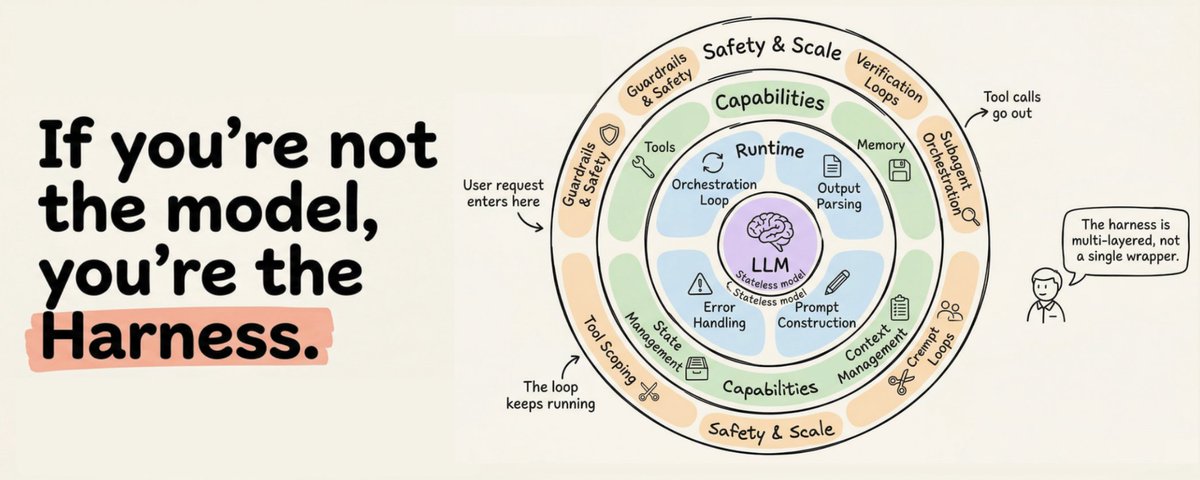
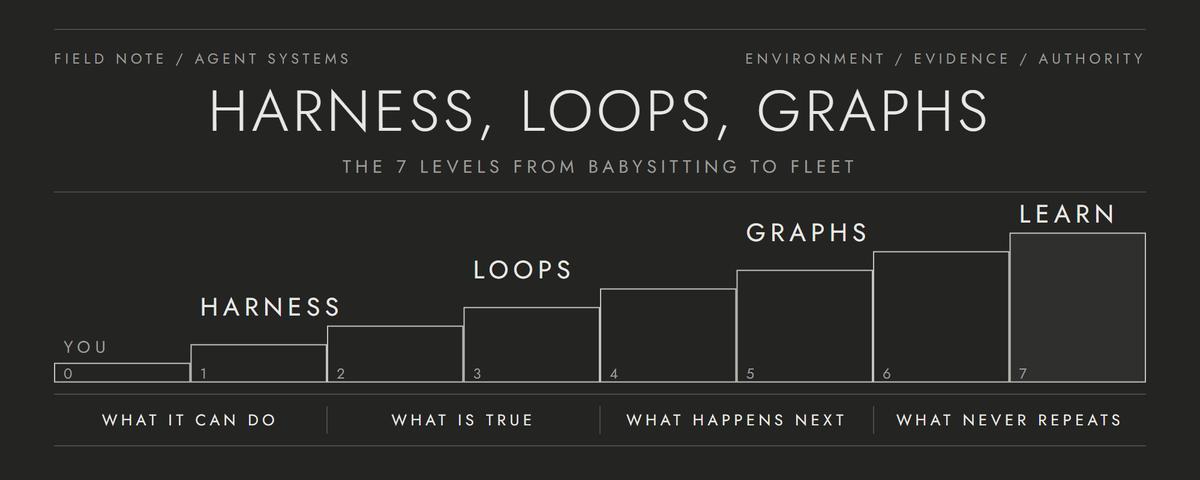
Then read how to build agents that actually finish the job in the harness engineering guide below ↓

Michael Wolfrath retweeted

The lead engineer at Anthropic who replaced 300 people with one agent and makes $2.2M - came to Stanford to share how:
03:20 - how she fired 300 people and replaced them with one agent
11:34 - how an agent replaces an entire department and works 10x faster
29:47 - $2.4M a year from one agent - the full system from scratch
after watching I replaced my team with one agent - and saved $30k in the first month.
Save & watch - the article below shows how one agent replaces the Anthropic team and generates $2.2M a year


Michael Wolfrath retweeted
Agentic Artificial Intelligence — Harnessing AI Agents to Reinvent Business, Work and Life: link.amazon/B03CGl0Ru
