

17 | metacoder, reverse engineer & Unity developer
Joined July 2023
- Tweets1K
- Following112
- Followers3.5K
- Likes1.1K




Pinned Tweet
I'm open-sourcing my biggest project as a research preview: an agentic OS for personal superintelligence.
Unlike most personal agents, its architecture is decentralized and editable through JSON. It can reshape itself, yet it doesn't feel complicated to use.
Details in replies
GPT-6 Pro can now spawn parallel agents on the web.
Reminder: you can run ChatGPT Web models directly inside Codex, using their separate quota.
I built a tool that makes this possible, with full access to your local files and Codex tools.
Repo in replies.


GPT-6 Astra Pro in ChatGPT got an upgrade with faster responses and improved use of plugins and tools.
And now, multiple agents can tackle different parts of a task in parallel. You can follow each agent’s progress and open completed tasks to review their work.
Now available to Pro users in the Chat tab.
Launcher on Windows/MacOS/Linux:
github.com/miuuyy/codex-chat…


Launcher for Windows/MacOS/Linux + Skill:
github.com/miuuyy/codex-chat…
Tibo finally acknowledged that Codex eats way too much disk space.
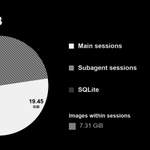
My Codex sessions went from 60+ GB to 30 GB using just 3 tricks. Guess it's time to share them.
1. Delete subagent sessions
Codex stores subagent sessions that don't even appear in your sidebar. Some of mine were over 2 GB EACH.
Ask Codex to delete inactive subagent sessions or those unused for 48+ hours.
2. Remove embedded images from sessions
Some images take 1–2 MB each and get duplicated hundreds of times inside session files.
Ask Codex to replace embedded images with tiny 1×1 pixel placeholders while preserving the session structure.
3. Reclaim unused SQLite space
Codex's SQLite database can accumulate gigabytes of unused pages (freelist). In my case, sometimes 1–3 GB.
Ask Codex to check the freelist and prepare VACUUM commands to reclaim that space after Codex is completely closed.
Exact prompts for all 3 in replies ↓


1. Delete hidden subagent sessions
Find my local Codex session storage and identify all subagent sessions inactive for 48+ hours. Safely delete them without breaking parent sessions.
2. Replace embedded images
Scan all my Codex sessions and calculate what percentage of them is occupied by embedded images. Replace images from before each session's most recent context compaction with valid 1×1 pixel placeholders.
3. Reclaim SQLite space
Find my local Codex SQLite database and check how much space is wasted on unused pages (freelist). Calculate the reclaimable size and prepare safe VACUUM commands to run after Codex is completely closed. Don't modify anything yet.
I have no plans to commercialize Octopus and will keep working on it for months to come.
The UI is inspired by ChatGPT. The current setup is built around Codex CLI, with ChatGPT sign-in.
Code and contributions:
github.com/miuuyy/Octopus-SI…

If you're familiar with Pi, the idea of an agent extending itself will sound familiar. Where Octopus takes a different direction is how the system is organized: there is no central agent directing all the others.
The system can change its own state and structure through JSON: create a goal with its own working environment, define the rules within it, connect it to other environments, and continue working across them. That structure can keep changing as the work develops.
This project brings together all my experience coordinating large swarms of agents, designing complex systems, and building the UX around them. I've put an enormous amount of effort and my own ideas into it.
It's still rough. The scope is much wider than what I've been able to test, and I'd love more people to help explore it.
The research question is whether the system will take the initiative to reshape itself, and whether those changes can fundamentally expand its capabilities over time. That's what I want to investigate.
I started this eight months ago while studying agent harnesses. It became my main project, consumed an absurd number of tokens, and stayed private because I had taken on an enormous scope.
Three rewrites later, it's over a million lines, excluding dependencies. The core architecture has stayed largely the same for six months.
The idea is to make the system's own structure something it can work with. What it can do, what it remembers, and how its parts work together are described in JSON it can inspect and edit within its permissions. When a missing capability needs code, it can write that too.
The runtime is written in Rust, with speed and responsiveness a priority throughout the design.
Launcher for macOS, Linux and Windows. Includes Zero Risk Mode with zero browser automation: you send messages manually, while the model still gets Codex tools:
github.com/miuuyy/codex-chat…
The second day of improvements in Codex ended with two features that had nothing to do with Codex, a plugin that was announced back at DevDay, and only one useful but small thing, which is free auto review
Tibo started a vote, and reset is already at 75%+. Hope it lands today!
It's been 3 hours since Tibo promised to improve the speed for Astra and Sol 6.1 in Codex
As a result, Sol 6.1 really did get faster, but Astra 6 didn't
So either Tibo lied about the timing or about the model, either way we have the right to get a reset

Day 1/
We have optimized the default speed to be ~50% faster across GPT-6 Astra and GPT-6.1 Sol through the subscription across all our products and partners using Sign in With ChatGPT (including OpenCode, Pi, Amp, Devin, ...).
No changes needed on your end and this should be felt within the next two hours.
I just bought the $500 ChatGPT plan after Tibo’s post.
Which is funny, because this is actually me cutting my OpenAI spending by $700/month.
Reasons:
- this account still has 2 banked resets from when it was on Plus, and they survived, so I can finally use them on the $500 plan
- my six $200 subscriptions just expired ($1,200/month), and I decided not to renew them
- Tibo just announced 28 days of possible resets
A month ago I paid OpenAI $1,200 because Astra had just come out and, for what I was doing, it was noticeably better than Opus 5. A month later, that changed a lot.
I’m now paying OpenAI 60% less, and I’ll probably use some of the difference on a few Claude subscriptions.
I’m 17, so $1,200/month on AI is obviously a ridiculous amount of money. I use Codex a lot, I have my workflows built around it, and after using Astra this much you also just get used to how the model works.
That’s probably the main reason I’m not dropping OpenAI completely yet.
But Codex has a lot of problems right now. The limits got worse, UX is worse, and I really don’t feel like OpenAI is paying much attention to the feedback from people who already pay them.
My previous post listed some pretty basic Codex problems and got around 1,000 likes in a day. No one at OpenAI has publicly addressed these issues yet.
OpenAI is getting $700 less from me, I’ll see what that number looks like next month.

🚨 BREAKING: Tibo announced that for the next 28 days, every day we’ll either get a new Codex sidebar or a full reset.
Realistically, I don’t expect resets at all. Compute is still tight, and I doubt most updates will be what people here actually want (see my last post).
I'm getting the $500 subscription, so I'll be able to keep an eye on what ships and post the interesting ones, but I think it's a good excuse to collect what they've been deliberately ignoring just for fun to see how this month ends
I’m tired of OpenAI pretending it listens to users while ignoring the people who actually point out what’s wrong.
Here are some real questions from real users:
- Why is ChatGPT still on GPT-5.6 instead of 6.1?
- Why does a “weekly” limit only start after your first message, so it can effectively become 10+ days?
- Why does a reset restart that whole 7-day wait, while Claude doesn’t do this?
- Why can a confirmed bug burn your weekly limit, then support closes the case, gives no compensation, no fix update, and keeps sending canned AI replies?
The last one is just one example from my own experience. I reported it two months ago, OpenAI confirmed the bug, and I still got no compensation or even an update on whether it was fixed. I seriously doubt my case is unique. Anyone who has tried getting a real issue through support probably knows what I’m talking about.
And Tibo, if hundreds of replies are piling in under your comment, how are you realistically supposed to notice the answer from the one person you actually asked?
That’s what annoys me about this. OpenAI needs to either seriously fix how it collects feedback and handles support, or stop acting like replies like this mean they’re listening.
I’m not saying Anthropic is any better internally. But at least they’re not all over X asking people for feedback they obviously aren’t going listen.
Launcher for macOS, Linux and Windows. Includes Zero Risk Mode with zero browser automation: you send messages manually, while the model still gets Codex tools:
github.com/miuuyy/codex-chat…
OpenAI released Dots about an hour ago. I already tried it and compared it with Grok Bot.
What I like so far:
- it has separate limits from ChatGPT and Codex. probably temporary, but very nice while it lasts
- it can use context from your normal ChatGPT chats. useful, but also a little weird
- there’s a web version
- OpenAI has a much bigger ecosystem of plugins and integrations
- it’s connected to the rest of ChatGPT, so it can work with image generation, GPT sites, etc.
- it gets its own computer with a bunch of stuff already set up, so you don’t have to configure everything yourself
What I don’t like:
- pretty buggy right now
- you need at least the $100 plan
- Grok Bot feels a bit more like a separate autonomous bot, while Dots feels closer to ChatGPT/Codex with more tools
My first impression: it’s basically Codex made much easier for normal people.
I’ll probably keep using Codex because I like having more control and keeping different projects/chats separate.
But overall I like it
