

Tenure-track professor and Emmy Noether awardee at the University of Göttingen || Working on intelligent decision-making in humans and machines
Göttingen, Germany
Joined August 2018
- Tweets994
- Following481
- Followers1K
- Likes7.4K


Pinned Tweet
Super happy to announce that we have got an Oral at #NeurIPS! 🥳
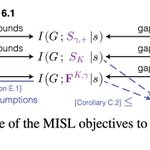
Together with amazing @ben_eysenbach, Peter Dayan, & @cpilab, we proposed a notion of controllability to derive bounds linking unsupervised skill learning to downstream goal-reaching.
arxiv.org/abs/2605.06145
1/8

Alireza Modirshanechi retweeted

Eva Xie, a neuroscience PhD student advised by @brody_lab and @nathanieldaw and me, was detained by ICE when flying back SfN. The US needs the next generation of brilliant young researchers like Eva to unlock breakthroughs in medicine, biology, AI. Help us bring Eva back! 🧵


Alireza Modirshanechi retweeted

Eva is a student at @PrincetonNeuro working with me, @brody_lab and Ben Eysenbach. She was abducted by ICE while trying to board a flight from SFN. Some thoughts below how we can help her.


Alireza Modirshanechi retweeted

Last chance to apply with deadlines approaching.

📢 The CORE COGNITION lab (core-cognition.github.io) is looking to hire another PhD student, working on automated scientific discovery and knowledge representation in cognitive science.
Starting date: March to September 2027.
🙏 Please share widely!
Alireza Modirshanechi retweeted

One of my blackboards from this semester’s Data Sciences course: explaining the asymptotic consistency of the maximum likelihood estimator. I’m teaching it in English this year—should I put the whole course on YouTube? :)

Alireza Modirshanechi retweeted

Brain circuits ↔ AI that keeps learning 🧠
Submit to our Neuro for AI & AI for Neuro workshop at #AAAI2027!
Due Nov 20, 2026 · Montréal, Feb 22–23, 2027
Archival long + non-archival short papers
Speakers include @criticalneuro; full lineup in flyer.
neuroai-multimodal-workshop.…

ALT Call for papers: 2nd Neuro for AI & AI for Neuro workshop at AAAI-27, Montréal, February 22–23, 2027. Topics: continual learning, cortical circuit principles for adaptive AI, and AI for neural and behavioral data. Invited speakers: Blake Richards, Doina Precup, Guillaume Bellec, Guillaume Lajoie, Ida Momennejad, Markus Marks, Paul Cisek, and Priya Panda. Organizers: Asim Iqbal, Shinya Ito, Reza Abbasi-Asl, Sophia Sanborn, and Anton Arkhipov. Details: neuroai-multimodal-workshop.github.io.
Alireza Modirshanechi retweeted

AI research stays true for almost exactly the amount of time it takes an academic journal to publish it

How long does a finding about LLMs stay true?
A new paper re-tested 50 widely cited findings about LLM behavior (biases, hallucination, sycophancy, etc).
Within 15 months, most no longer held or had substantially reduced effects. The shelf life of LLM findings is short.
Almost half (44%) of the tested claims are now expired in today’s models, 34% are weakener, 16% persisted, and 6% have strengthened relative to the original claim
The only effects that got stronger were about sycophancy, LLM ingroup bias, and creativity.
This means we should be cautious when interpreting the long term durability of research on LLMs.
zou-group.github.io/llm-clai…


Alireza Modirshanechi retweeted

Is meta-RL in PFC just a big RNN or can we figure out its mechanism?
Here we show that RNNs learn a particular, but general, method for meta-RL. They place options in 'ranked’ subspaces (slots), and dynamically re-rank them. Value doesn’t pick the action; it reorders the slots🧵

Alireza Modirshanechi retweeted
Super happy to announce that we have got an Oral at #NeurIPS! 🥳
Together with amazing @ben_eysenbach, Peter Dayan, & @cpilab, we proposed a notion of controllability to derive bounds linking unsupervised skill learning to downstream goal-reaching.
arxiv.org/abs/2605.06145
1/8
Alireza Modirshanechi retweeted

If you're at EMNLP, check out my coauthor Can's oral presentation in the Blackbox NLP Workshop. Many induction heads attend to successor tokens in a context dependent fashion. We give a mechanistic account of this in our paper!

Alireza Modirshanechi retweeted

Come see my oral presentation at the EMNLP Blackbox NLP Workshop this Thursday! I'll talk about how LLMs learn hierarchical structures in context. Also, say hi if you wanna chat about automated science, AI safety, or mech interp :)

Alireza Modirshanechi retweeted

The more you automate, the less you see: Hidden pitfalls of autonomous AI scientists | PNAS pnas.org/doi/10.1073/pnas.26…

Alireza Modirshanechi retweeted

Very happy that this got so much love from the reviewers and an Oral at neurips. @modirshanechi is now building his own lab and everyone should consider joining him.

Super happy to announce that we have got an Oral at #NeurIPS! 🥳
Together with amazing @ben_eysenbach, Peter Dayan, & @cpilab, we proposed a notion of controllability to derive bounds linking unsupervised skill learning to downstream goal-reaching.
arxiv.org/abs/2605.06145
1/8
Then, to study all formulations at once, we proposed goal sensitivity: High goal-reaching performance is (approximately) equivalent to a policy being maximally sensitive to the commanded goal, reflecting the environment's controllability & the agent's competence. 💪
5/8


Altogether, our work provides a theoretical foundation that connects GCRL and MISL under a common control-maximization perspective. 🔥
Main takeaway: No universally optimal MISL objective exists for all GCRL formulations! ⚠️
7/8
But the RL world is not always that catastrophic, so we also identified conditions (e.g., when the environment is deterministic) under which policies learned for one formulation can indeed be safely transferred to another. 🔥
4/8

So, we first identified three canonical GCRL formulations and proved that they can induce incompatible optimal policies, even in the same environment.
This means that algorithms designed for one may not perform well in another. 🥲
3/8
