
32% profit/year since 2020 🇩🇪 Top 10 eToro Popular Investor $5m+ AUM | Not financial advice, DYOR
Joined June 2009
- Tweets787
- Following190
- Followers1K
- Likes4.3K






Pinned Tweet
💥 𝐌𝐚𝐫𝐤𝐞𝐭 𝐌𝐨𝐯𝐞𝐬 𝐓𝐞𝐥𝐞𝐠𝐫𝐚𝐦 𝐆𝐫𝐨𝐮𝐩
I’m putting together a small private group of ~50 high-quality eToro investors.
If you want in, I’ll drop a link to the waitlist below:
forms.gle/QgQHpC9PzDxnQrXq8
Once we reach 50 waitlist entries, it will be closed and the Telegram group will be opened.
Let’s keep building growth.

1
10
944
ok guys, quick heads up before the bell… I'm rebuilding the portfolio today. let me know what you think:
short version: I was 54% semis I am trimming a bit as all 9 of my semis trade below their 50 day average right now. $SMH is down 18.8% in 3 months
I still think semis come back. but my own rules say wait for confirmation. $NVDA reports Nov 17, that's the test
so until then I build a second and third leg next to chips
here's what I'm SELLING completely:
$SIVE.ST
revenue is down 12.4% YoY and the share count went up 14%. the new Glasgow capacity only comes online end of 2027, that's too long to wait
$IOVA
revenue is growing nicely but forward EPS is still negative. the stock dropped 36% in one day on trial data, it trades on headlines and that's a coin flip for me
$PSNL
it's pure merger arbitrage now with the Tempus deal. upside is capped at around 2.9%, if the deal breaks it's roughly 28% down - dont want that
$CGNX
valuation was actually fine. but the trend is broken, it's 19% below its 50 day average and the death cross is right around the corner. sad to see it go but yea
$ABBN.ZU
EPS is down 1.5% YoY and the chart is about to death cross too. no growth, no momentum, no reason to stay
and here's what I'm BUYING (share of portfolio):
$ONC 4.1% now
my biggest new position. revenue +34% YoY and +10.8% vs last quarter alone, EPS +201%, PEG 0.52. they just raised full year guidance to 6.9 to 7.0bn and growth is speeding up
$LLY 3.3% now
revenue +39% YoY at over 1 trillion market cap, that's insane. PEG 0.82, beta only 0.41. this is my calm anchor next to all the chip volatility
$KNSA 2.5%, half now, half on a limit at 84 to 85
revenue +58%, EPS +143%, guidance raised. beta is 0.11 so it barely moves with the rest of my book. but it lives on one product and the stock jumped after earnings, so I split the entry
$SEZL 2.1% now, hard stop below 122.38
buy now pay later. revenue +43%, EPS +84%, forward PE around 21. they guide 2027 EPS above consensus. honestly this is my one rule break, 3M momentum is down 16%. that's why the stop is non negotiable
$GLBE 1.7% now
they handle cross border online shopping for brands. revenue +39%, almost no debt and Q4 is their strongest season. earnings on Nov 18. if GMV grows 30%+ and it closes above 39.81 I double it
$YOU 2.1%, half now, half on a limit at 48 to 50
CLEAR, the biometric lanes at airports. revenue +28%, EPS +79%, forward PE around 23. free cash flow was negative last quarter, so half now and the rest on a dip
$APP 1.7% on a limit at 360
revenue +55%, EPS +76%, forward PE around 20, 84% EBITDA margin. probably the best numbers on this list. but the stock ran 35% in two days and it's still below its 200 day average. not chasing that, I wait for the pullback
still thinking about these, maybe round two:
• $NFLX cheap at forward PE 16.9 but revenue only +12%. it gets until January earnings to get back above 71
• $CEVA earnings are today. above 30.69 would be nice!
• $CRDO revenue +115% at forward PE 12.5, super cheap. but fresh death cross. I might halve it
• $SNDK my biggest position at 14%. same memory cycle as $MU and 34% below its 200 day. I might be trimming into a bounce
what could go wrong? health and fintech can drop together in a risk off week. and if semis rip next week I'm a bit lighter than before. I'm ok with that
What do you think?
not investment advice, DYOR!
2
2
173





$GOOGL just had its worst trading day since 2004.
The quarter it reported the night before?
Revenue $127.6B, up 25% YoY. Google Cloud $30.7B, up 103%. It doubled.
And the stock fell 12.6% on Thursday. Roughly $500B of market value, gone in one session.
A week earlier, same movie. $META grew revenue 26% to $64.6B. The stock dropped 7% the next morning and pulled the Nasdaq down 2.6% with it. Chip stocks lost 6.7% that same day.
I keep seeing the same question under every one of these charts: what rule is this market playing by?
Here is the rule, as far as I can read it.
For two years, AI capex was treated as an investment. This earnings season, the market started treating it as a cost.
Look at what got repriced.
Meta narrowed its 2026 capex guide to $135B to $145B. Its quarterly filing shows roughly $825B of future spending commitments. Free cash flow went negative for the first time in over a decade: minus $2.1B.
Alphabet is holding its $195B to $205B capex plan.
The revenue side of these businesses is fine. Better than fine. What moved is the certainty investors assign to all that spending coming back as profit.
And the twist of the week: $MSFT spent LESS than Wall Street expected, $45.2B against $50.7B. That scared a different group of investors entirely. More on that one on Wednesday.
Spend more: punished. Spend less: punished.
When any surprise in either direction costs billions, expectations themselves have become the risk.
What I take from this week:
The AI buildout is not slowing. Capex guides went sideways or up, nowhere down. The free ride for spenders is over. From here, the market wants receipts. Receipts take quarters, sometimes years, to arrive. That gap is where volatility lives now.
The honest other side: if the receipts disappoint, this repricing has much further to run. A 12% single day drop in one of the largest companies on earth is what that looks like from the front row.
My own approach stays the same. I own companies that collect the capex. I accept the swings of companies that spend it.
Let's see what the first week of November brings.
I’m running a small private Telegram group of high-quality eToro investors.
If you want to join, visit my X account. I posted a link (post pinned on my profile) to the waitlist for the group there. Once you applied comment on this post.
Let’s keep building growth, Max
This is not investment advice, for education purposes only | Capital at risk | Past performance does not guarantee future results
4
2
232
Taiwanese press (TechNews.tw) reports JPMorgan now sees 2027 data center spending growth of +70%, up from +50%.
- Microsoft, Amazon, Alphabet, Meta: $1.12T over 2025 and 2026
- Networking is the choke point for top compute
Friday's chip selloff came while budgets rose, so imo the worry is who pays: free cash flow is already tight at some big spenders. That spend is a cost for $AMZN (10.9% of my portfolio) and revenue for $CRDO (7.8%, networking chips, on JPMorgan's list).
I hold $CRDO and $AMZN. Not investment advice.
Source: TechNews.tw finance.technews.tw/2026/10/…

2
118
Taiwanese press (TechNews.tw) reports $TSM signed a 5 year, $2 billion deal with GlobalFoundries for CoWoS silicon interposers in New York.
CoWoS is the advanced packaging that links AI chips to memory. The interposer is the base layer that connects them.
I hold $TSM. After a weak semi session, this stands out because it is one of the clearest signs a real AI bottleneck is being attacked with actual money. Volume ramp is expected in 2028 H1, so I like the direction for $AMD and $NVDA, even if the timing is not exactly near term.
I hold $TSM, $AMD and $NVDA. Not investment advice.
Source: TechNews.tw finance.technews.tw/2026/10/…
1
4
136
Max retweeted

I don’t know all the facts about this OpenAI $50B vs $70B ARR story, but what is becoming apparent once again is that this entire semi trade is levered against OpenAI and Anthropic and it is fragile AF. Any narrative on slowing growth and the street loses their mind.
Is AI just passing the same money in a circle?
Fair question. Let's follow the money properly.
The circular deal web, as reported:
Nvidia committed up to $100 billion to OpenAI, tied to 10 gigawatts of Nvidia systems. OpenAI signed a $300 billion compute contract with Oracle, running five years from 2027. OpenAI agreed to buy 6 gigawatts of AMD GPUs, and AMD granted OpenAI warrants for up to 160 million shares alongside the deal.
Samsung and SK Hynix signed letters of intent for roughly 900,000 DRAM wafer starts per month for Stargate. Fresh reports add negotiations over roughly $250 billion in Nvidia lease guarantees for OpenAI, plus an Nvidia and SK Group package reported above $500 billion.
Add all of those headlines together and you pass $750 billion in capex. If that capex would evaporate… huii
So the skeptics have a point in at least looking at the facts, right? Nvidia funds OpenAI. OpenAI rents Oracle capacity. Oracle fills its data centers with Nvidia chips. Money travels in a loop and everyone books revenue along the way.
We have seen this movie. The year was 1999.
Back then, telecom equipment makers financed their own customers during the physical buildout of the internet.
Roughly 47 telecom carriers went bankrupt between 2000 and 2003. Lucent wrote off about $3.5 billion and watched its revenue collapse 69% in three years.
That was the nightmare the word "circular" is pointing at. And the respective fear everyone is talking about.
Now today those investments come in three very different forms: Cash, equity stakes and promises contingent on buildout.
$MSFT, Alphabet, Amazon and $META plan a combined $725 billion of capex in 2026, up 77% from last year. That money comes out of operating cash flow and loans. Their advantage is that they are extremely profitable companies, even though their cashflow is going negative on some of that debt.
In 1999 the marginal customer was a debt loaded startup. In 2026 the heaviest spenders fund the buildout from profits. That difference carries the whole bull case.
Whats different too, is the insane pricing power third parties currently have, while they owe nobody a narrative.
DRAM industry revenue rose 81% quarter over quarter to $97 billion in the first quarter, with contract prices up 93 to 98%. The memory makers just posted record margins and say most of next year's supply is sold at higher prices than this year.
Nobody in the memory market is lending money to their own customers. Buyers pay cash, upfront, at rising prices, because the supply physically does not exist otherwise. The same logic holds for grid equipment and power.
The loop, if you want exposure to it:
$NVDA $ORCL $AMD
Paid in cash whichever way the loop spins:
Memory $SNDK $SKHY
Networking $ANET $CRDO
Power $GEV $VST
The circularity worry concentrates in one place: OpenAI itself.
Reported revenue around $25 billion annualized earlier this year. Commitments across Oracle, AMD and Stargate that run into the hundreds of billions. That gap has to close through usage growth, or we might have a problem. Or at least a possible buying opportunity :)
Sooo, an open questions I take seriously:
Can OpenAI grow revenue fast enough to cover its commitments? What happens to the loop if one guarantee gets called? How much of the $750 billion ever converts from headline to invoice?
Whoever wins the AI race pays for memory, networking and power in real dollars, this quarter, at rising prices. Those invoices clear no matter how circular the headlines sound.
The internet turned out real in the end. The 1999 crash still sorted companies by one question: who got paid in cash, and who got paid in promises.
Which side of that question are your holdings on? Tell me in the comments.
Let’s keep building growth,
Max
This is not investment advice, for education purposes only | Capital at risk | Past performance does not guarantee future results
1
4
222
Micron makes 50% to 60% of its chips in Taiwan. That is why today’s strike vote matters for $MU.
Yahoo Finance says hundreds of Micron workers in Taiwan backed strike action after bonus talks failed. Plain English: a pay dispute could turn into factory disruption. The two unions involved represent 12,000 of 15,000 workers at Micron’s Taoyuan and Taichung plants.
The obvious risk for $MU is lower output if this turns into actual strike dates. One layer deeper, memory pricing can stay firmer if supply gets even a bit tighter, which is also why I keep watching $SNDK and $WDC after yesterday’s selloff.
I do think this is the kind of operational risk the market can shrug off until shipments slip.
I hold $MU. Not investment advice.
Source: Yahoo Finance finance.yahoo.com/markets/st…

1
6
375
Taiwanese press (TechNews.tw), citing Korean media, reports Samsung is asking for 2027 HBM4 prices above 2x current levels.
HBM is the stacked memory that sits next to AI chips. HBM4 is the next generation.
I hold $MU, and I also watch $SNDK and $WDC in memory. If suppliers can negotiate this far out from a position of strength, tightness in supply may last longer than the market assumes.
If HBM stays this profitable, wafer capacity keeps going there first. That can keep regular DRAM tight too, which matters more directly for Micron.
Not investment advice.
Source: TechNews.tw technews.tw/2026/10/07/samsu…
1
5
454
The sleeping giant is awakening.once those funds push semi demand even further great earnings/guidance might have a "chance" again…

Hedge Funds and Asset Managers showed increased demand for Semis this week.
In fact, US Tech stocks were the *only* net bought sector in September as long buys outpaced short sales by over 2:1.
This level of buying was driven by some big catalysts this week, specifically $MU's earnings and $NVDA buybacks.
However, prime broker data shows that Semis demand isn't absolutely skyrocketing yet and there's significant headroom for institutional positioning.
After speaking with many investors over the past week, I would say that there's some anxiety around putting more chips in on the AI trade.
I think this is due to a few factors that are currently in-play:
1. Macro shitshow - Iran, oil, rates situation.
2. Midterms.
3. Constant shifts in the AI story (tech is moving faster than investors' brains).
That said, we're coming up to Q4 earnings in Tech/Semis Land...all while forward tech/semis valuations are relatively low right now.
So I think the issue now centers around whether we can see a re-rating in Semis as we start to see positive Q4 earnings/guidance despite the current macro and midterm hurdles.
If we can get past those hurdles unscathed, then I think my prediction of a tech rally into 2027 looks highly likely as institutions size up for 2027+.
1
70


Yesterday was about where scarce chip capacity might go next.
Taiwan Semiconductor Manufacturing $TSM rose 2% to $484.19 after touching an intraday record high. The trigger was a report that TSMC is exploring ways to work with Terafab on new chip factories in Texas.
Why did that stand out when the whole market was green?
Because the move was company specific. The iShares Semiconductor ETF fell 0.3% while Broadcom $AVGO rose 2% and Qualcomm $QCOM fell 2%, even as the Nasdaq 100 closed up 0.81%.
That tells you investors were pricing a possible new capacity customer and a new route for foundry spend, not simply buying all semis together. The risk is simple: Elon Musk said these were just discussions, and no agreement has been announced.
The backdrop still helped. The S&P 500 closed at 7,785.10, up 0.72%, and 72 S&P 500 companies have now issued positive third quarter earnings per share guidance out of 116 that gave outlooks.
I own Taiwan Semiconductor because foundry capacity is still one of the hardest constraints to bypass, so any sign of who gets access to the next factory build goes to the top of my reading list.
TSMC rising 2% to a record while the semiconductor ETF fell 0.3% says the market cared about a possible factory path, not a sector wave. When capacity is scarce, even early talks can move valuations, but guidance only hardens when contracts and capex turn real.
I’m running a small private Telegram group of high-quality eToro investors.
If you want to join, visit my X account. I posted a link to the waitlist for the group there.
If you enjoyed "Market Moves", make sure to leave a like and follow me. I'll be back tomorrow.
Let’s keep building growth,
Max
Copy Trading is not investment advice | Capital at risk | Past performance does not guarantee future results
4
3
243
Of all 12 points, #3 is the one I keep rereading.
JPM sees memory supply-constrained through at least 2028... and customers are already discussing orders out to 2031.
When buyers start booking capacity 5 years ahead, it stops looking like a normal cycle imo.
$MU $SNDK

A TON OF THINGS HAPPENED IN THE STOCK MARKET TODAY.
Here's a full recap:
1. SpaceX $SPCX rose about 7.6% on Monday to roughly $171.09 after Elon Musk confirmed that discussions with TSMC are real, though still in the early stages. The talks follow reports that TSMC is exploring a role in Terafab, the Texas chip venture tied to Tesla, SpaceX, and xAI, which could eventually invest $119B to manufacture chips for products including Optimus, Cybercab, and future AI infrastructure. The prospect of TSMC participating was viewed as strengthening SpaceX’s long-term AI chip supply strategy and potentially reducing Intel’s future role in the project, helping send Intel shares lower while TSMC reached a new all-time high. A reiterated Morgan Stanley Overweight rating and $300 price target provided additional support for the stock.
2. Meta $META and Microsoft $MSFT are reportedly reducing internal use of Anthropic’s Claude as they increasingly shift employees toward their own AI tools, according to The Information. Microsoft had been on pace to spend at least $1B annually on internal Claude usage earlier this year but has since reduced that level by more than one-third. At Meta, the number of Claude Code users has reportedly fallen to about 30,000 from roughly 60,000 earlier this year, while MetaCode now has more than 30,000 users and Muse Code has surpassed 6,000. Despite the shift, Meta still spent more than $105M on Claude Code over a recent 28-day period.
3. JPMorgan expects the memory market $MU $SNDK $WDC $SKHY $STX to remain supply-constrained through at least 2028, with customer order discussions already extending as far out as 2031. The firm forecasts HBM bit demand to grow 63%, non-HBM server DRAM demand to increase 37%, and CY2027 HBM blended ASPs to rise 54% year over year. JPM also believes Micron’s expectation of having more than 35% of revenue covered by long-term supply agreements through 2030 may prove conservative, noting that several Asian memory manufacturers already have 50%+ of their capacity secured under similar long-term agreements.
4. RBC Capital Markets reiterated its Outperform rating on Zeta $ZETA and raised its price target to $40 from $31, implying roughly 22.6% upside. Analyst Matt Swanson said recent investor meetings highlighted growing momentum around strategic partnerships and adoption of Athena, while emphasizing that RBC does not believe these opportunities are materially reflected in either current guidance or the company’s 2030 outlook. RBC also argued that Zeta has increasingly differentiated itself from traditional ad-tech peers and is now being valued more like a software company. The latest increase marks RBC’s third price target raise on Zeta this calendar year.
5. Ondas $ONDS secured a $56M order for Electronic Safe & Arm Devices (ESADs) supporting a European loitering munition program. The contract will be fulfilled through Ondas' recently acquired Bron Technologies and GATE Technologies businesses. ESADs manage a munition’s safety, arming, and initiation functions, with production set to move forward using technology that has already been qualified for deployment. The award further expands Ondas’ presence in the growing European defense and precision munitions market.
6. Bank of America, Citi, and Morgan Stanley have begun syndicating a $60B debt package tied to Anthropic’s lease of Google-designed TPUs supplied through Broadcom $AVGO, making it the largest chip-financing deal to date. The package includes $42B of senior secured debt backed by Broadcom and $18B of junior debt without Broadcom guarantees, with Blackstone already committing roughly $9B to the junior tranche. The financing is expected to fund Anthropic’s 2027 chip orders, with Broadcom’s support helping reduce borrowing costs and potentially allowing the senior debt to be refinanced into the investment-grade market. The deal centers on Google $GOOGL TPUs, developed with Broadcom as an alternative to NVIDIA $NVDA GPUs for large-scale AI workloads, while Broadcom filings also indicate Anthropic could issue up to $42B of convertible notes to Broadcom to cover future lease payments.
7. U.S. Strategic Petroleum Reserve (SPR) inventories fell another 767,000 barrels last week to 283M barrels, the lowest level since 1982. The decline marks the 28th consecutive weekly drawdown, leaving the SPR down nearly 133M barrels from its recent peak. As a result, America's emergency crude oil reserves continue to sit near their lowest levels in more than four decades, underscoring the limited strategic buffer available despite elevated geopolitical risks.
8. The Consumer Confidence Index fell 6.7 points in September to 81.9, its lowest level since April 2014, marking a fourth consecutive monthly decline and an 11.2-point drop over that period. The Present Situation Index declined 7.9 points to 109.3, its weakest reading since February 2021, while the Expectations Index fell 5.9 points to 63.6, its lowest since April 2025 and a third straight monthly decline. Confidence has weakened across all age groups and nearly all income brackets over the past six months. Consumers increasingly cited high prices, the cost of goods and services, and oil and gasoline prices as the primary factors weighing on the economic outlook.
9. Brazilian markets rallied after Flávio Bolsonaro finished ahead of President Luiz Inácio Lula da Silva in the first round of Brazil’s presidential election, with investors reacting positively to the prospect of a more market-friendly policy agenda ahead of the October 25 runoff. Brazilian assets including Nu Holdings $NU, the iShares MSCI Brazil ETF $EWZ, and other Brazil-exposed equities such as MercadoLibre $MELI outperformed following the result. The market reaction reflected optimism around potential fiscal and economic policy changes, though the election remains undecided with a runoff still to come.
10. The top 10 most active options today by contracts traded were $NVDA with 4.0M contracts, $TSLA with 3.2M contracts, $SPCX with 1.7M contracts, $AAPL with 1.1M contracts, $MSFT with 874K contracts, $MU with 872K contracts, $AMZN with 844K contracts, $INTC with 835K contracts, $META with 790K contracts, and $GOOGL with 502K contracts.
11. OpenAI is reportedly in talks with UAE investment funds, including MGX, and BlackRock $BLK to anchor a new $30B+ funding round at a valuation of roughly $1.4T, according to Bloomberg. UAE investors have discussed contributing as much as $10B collectively, while existing backers Thrive Capital and Andreessen Horowitz are also considering additional investments, alongside discussions with the University of California endowment. Rather than negotiating with a lead investor, OpenAI is reportedly presenting investors with a fixed ~$1.4T pre-money valuation. The fundraising comes as OpenAI continues to delay an IPO until at least 2027 while raising unprecedented amounts of capital to fund AI model development and large-scale infrastructure expansion.
12. Melius upgraded Microsoft $MSFT to Buy with a $665 price target, arguing that growing concerns around AI safety are actually strengthening Microsoft's competitive position. The firm said enterprises are increasingly choosing to spend on a secure AI wrapper that can route models to the right tasks, manage AI agents, and provide governance rather than relying directly on frontier AI labs. Melius believes Satya Nadella and Microsoft's leadership are becoming the "adults in charge" for AI security and governance, and now expects Azure revenue growth to accelerate to above 50% by F4Q27.
WALL STREET IS THE GREATEST SHOW ON EARTH.
1
5
431
$AMZN just put a $1 billion price tag on something AI bulls often gloss over: local permission.
$AMZN is one of my positions, and I added more 4 days ago, so this stood out today.
Tom's Hardware says Amazon will spend more than $1 billion over 5 years on host communities, stop requiring NDAs from government officials, and publish annual data on energy, water and carbon free electricity. Plain English: building AI data centers now also means paying for local acceptance.
That matters because AWS capex is no longer just chips, servers and power. There is a new cost layer in permitting, community concessions and timing. That does not break the $AMZN case imo, but it can make each new site slower and more expensive to get live.
I like the transparency. I am less comfortable with the fact that this is clearly becoming a real line item.
I hold $AMZN. Not investment advice.
Source: Tom's Hardware tomshardware.com/tech-indust…

1
123
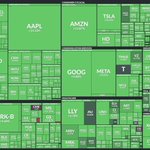
Touch grass they say
Here a picture of a family trekking through a green meadow. Calming, no?
All on April 9th, 2025, the day of the biggest MC increase in the history of the S&P 500

3
74
GUC revenue just jumped 97.8%. For $TSM, where do you think the squeeze hits first?
I hold $TSM. GUC designs custom AI chips for customers, so this looks like more demand lining up for foundry capacity. My deeper read is that if ASIC demand keeps widening beyond GPUs, the next pinch point could move to packaging or the links between racks.
I like getting these Taiwan numbers before US earnings. I still want to see if this also shows up in TSMC monthly sales.
I hold $TSM. Not investment advice.
Source: TechNews.tw technews.tw/2026/10/05/guc-2…
2
133
Oct. 2 gave silicon photonics its first shared reliability standard, and that matters for $CRDO.
I added more $CRDO 4 days ago and more $SIVE.ST 3 days ago, so this Taiwan item stood out to me overnight.
- TechNews says JEDEC published JESD264 on Oct. 2, the first common reliability standard for silicon photonics
- Silicon photonics means using light to move data between chips and systems, where copper links start to struggle
- The standard covers qualification and reliability checks for parts like modulators, photodiodes and waveguides
- It also sets rules for assembly, laser integration, process control and traceability
My read: this does not create demand by itself. It can make customer qualification less messy, which matters when buyers want to scale AI networks faster. For $CRDO, the prize is being able to ship reliable links at volume when customers start standardizing around a shared rulebook.
2
208
The 10 year Treasury pays more than 5% for the first time since 2007.. thats wild
So the headlines now say dividend stocks are toast.
Are they?
The yield math is mathing. The 10 year touched 5.04% on September 15 and traded near 5.18% by Friday last week. A bond with no equity risk out yields most dividend portfolios today. Naturally risk averse investors are thinking and respectively moving funds into bonds.
Only catch is a coupon is frozen. A dividend stock still has the potential to grow their stock-price and outrun inflation.
That bond pays the same 5% in year ten. A dividend grower raising its payout 8% a year doubles your income in nine years.
One layer deeper: check what your safe dividend fund actually owns. The utilities and industrials inside it are quietly becoming AI infrastructure plays, with the capex bills and the growth that come with that.
On the other hand business owners like myself might use bonds or money market ETFs to safe unused liquidity of their company from inflation. At a certain size they do not hold their assets in cash but in bonds and ETFs with no or almost no volatility and low profit margins.
Imagine how much money/liquidity is tied up in large companies that now think about buying longterm bonds. Thats whats normally cooling inflation.
BUT: We have a special scenario now. The AI buildout. It forces the biggest companies in the world to borrow money and spend it like a maniac although interest are climbing. All that debt- and money floating the economy will force even higher interest rates and inflation.
While the bar for income investing just moved up to 5%, we are in for a ride. I am sure of it.
Touch grass
—
I'm running a small private Telegram group of high-quality eToro investors.
If you want to join, visit my X account (link on eToro profile). I posted a link to the waitlist for the group there. Once you applied comment on this post.
Let's keep building growth, Max
This is not investment advice, for education purposes only | Capital at risk | Past performance does not guarantee future results
$BTC $SPX500 $NSDQ100 $GOLD
3
196