

Dad/ Dork/CMT. Often wrong. Always in doubt. Musings about 🇺🇸 markets. Inanities about everything else.
Here, There and Everywhere
Joined November 2008
- Tweets26.6K
- Following1.7K
- Followers2K
- Likes84K






Pinned Tweet
Weekly Market Recap
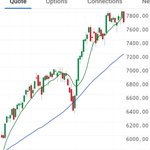
$SPX chart below
Some people say the selling has become too frantic, the bearishness too extreme, and that we're due for a rebound, if not a resumption of the ever-higher race to infinity.
Yet looking at the weekly $SPX chart, one barely notices the selling. The index finished around 7620, with 7600-ish support still standing.
Apparently, the weekly chart hasn't been reading the headlines.
The pain in parts of the AI trade is real. So far, though, the so-called AI panic remains fairly circumscribed. The Dow and Russell 2000 actually finished the week higher.
So is this a bout of nervousness that could subside, perhaps if Anthropic goes ahead with its IPO without a glitch? Or are we in the early innings of a broader, bona fide correction?
An orderly IPO could reassure investors that the AI story remains financeable. Whether the returns ultimately justify the spending is a separate question.
More immediately, next week's results from Microsoft, Alphabet and Amazon should give us something substantial to chew on. Their spending plans, guidance and, especially, the market's reaction will matter. Good numbers that fail to lift stocks (see $META) would hardly support the argument that the selling has exhausted itself.
Technically, $SPX remains below its fast weekly MA but comfortably above its rising 50-week SMA. The shorter-term picture has weakened; the longer-term uptrend remains intact.
7600-ish is still the line. Holding it keeps the consolidation scenario alive. A weekly close below it brings 7400-ish into play. Reclaiming 7800-ish would strengthen the case for a resumption toward 8000-ish.
For now, the panic remains louder than the weekly chart. That can change in a New York minute. Or a Silicon Valley nanosecond.
Thanks for reading.
🙏🙏👊🍻

The most 'tarded thread of all time. Wait for the apology for the apology. Anytime now.


Readers added context they thought people might want to know
Mao Zedong is under any single social metric a dictator. Not a single popular election, single government party and lifetime leadership. Not even taking into account the millions of deaths under his reign.
en.wikipedia.org/wiki/Mao_Zedong
Rio, Market Catnician retweeted
Judging by your post, I don't think it's for you.
It depicts losers of all races, genders and backgrounds in often very complicated and very dangerous situations.
People of all kinds love this show.
Like I said, imvvho it's probably not for you.
But I know nothing.


Rio, Market Catnician retweeted
Weekly Market Recap
$SPX chart below
Some people say the selling has become too frantic, the bearishness too extreme, and that we're due for a rebound, if not a resumption of the ever-higher race to infinity.
Yet looking at the weekly $SPX chart, one barely notices the selling. The index finished around 7620, with 7600-ish support still standing.
Apparently, the weekly chart hasn't been reading the headlines.
The pain in parts of the AI trade is real. So far, though, the so-called AI panic remains fairly circumscribed. The Dow and Russell 2000 actually finished the week higher.
So is this a bout of nervousness that could subside, perhaps if Anthropic goes ahead with its IPO without a glitch? Or are we in the early innings of a broader, bona fide correction?
An orderly IPO could reassure investors that the AI story remains financeable. Whether the returns ultimately justify the spending is a separate question.
More immediately, next week's results from Microsoft, Alphabet and Amazon should give us something substantial to chew on. Their spending plans, guidance and, especially, the market's reaction will matter. Good numbers that fail to lift stocks (see $META) would hardly support the argument that the selling has exhausted itself.
Technically, $SPX remains below its fast weekly MA but comfortably above its rising 50-week SMA. The shorter-term picture has weakened; the longer-term uptrend remains intact.
7600-ish is still the line. Holding it keeps the consolidation scenario alive. A weekly close below it brings 7400-ish into play. Reclaiming 7800-ish would strengthen the case for a resumption toward 8000-ish.
For now, the panic remains louder than the weekly chart. That can change in a New York minute. Or a Silicon Valley nanosecond.
Thanks for reading.
🙏🙏👊🍻
Hear, hear.

How good is Slow Horses?
I know there are a lot of people throwing nice words at it but - after finishing series 6 this week - I wanted to throw something into the praise pot.
There are so many amazing performances in there. Saskia Reeve’s is stand-out as Standish, Kristen Scott Thomas is immense and - I can only fit 6 pictures on this grid but there are so many to choose from. They all play characters who are brilliant at their jobs but terrible at life.
Gary Oldman’s Jackson Lamb is on another planet. He is desperate to look like he couldn’t care less but occasionally there is a believable flash of loyalty that makes an otherwise repulsive human genuinely compelling. His acting is so good you can smell him through the telly.
You care about all the failures because you want the Slough House rejects to find a bit of purpose and meaning. It is laugh-out-loud funny but the humour never gets in the way of the danger or the drama. A wince can be seconds away from a cackle.
It also has just the right level of complication. There is a lot going on but it doesn’t keep stopping to explain to the audience what is happening and, even though there is international spy stuff going on, there is a grubby earthiness that makes it feel relatable.
The insults are top-tier and, at the heart of it, it’s about people who have been written off realising that they still count. 9.9 out of 10.
I’m taking off 0.1 for all the swearing 😂
Bring on season 7 🎯


Rio, Market Catnician retweeted

Feels like this report is going to generate a lot of articles, posts, and takes: wsj.com/economy/affluent-and…


Rio, Market Catnician retweeted
This is obvious rage baiting .
Respectfully, a few notes, in order of appearance.
1. "What do people actually use AI for?" is a question. "I've found it to be completely useless" is the answer. You asked and answered it before anyone could reply. That's not a question; it's a verdict wearing a question mark as a disguise. (Also, "to be" is optional there. Cut it. You're welcome.)
2. "Completely" is doing heroic work. "Completely useless" is a universal negative, and a single useful output, anywhere, ever, disproves it. I've personally seen several. This morning it turned an 87-page 10-K into the three paragraphs that mattered and found the footnote where management buried the bad news. (Footnote 14. It's always footnote 14.)
3. "Gets a lot of information wrong." "A lot" isn't a number. Compared to what? Your brother-in-law? Cable news? Sell-side price targets? The weather app? The bar was never "never wrong." The bar is "wrong less often and faster than the alternative," which is the same bar we use for doctors, mechanics, and the guy at Home Depot who swears it's in aisle 9.
4. "Incapable of doing tasks better than a human." Which human? This is a quantifier problem. Better than EVERY human at EVERYTHING? No, but nothing is. A forklift is useless at poetry, and nobody calls forklifts useless. Better than SOME humans at SOME tasks? It's been better at chess since 1997. It cracked protein folding, which got a Nobel. It'll translate a French lease at 2am without sighing, and it'll write the Excel formula you've been googling for 40 minutes. Also, the comparison human has to be awake, available, free, and not mad at you.
5. Minor point: the spam filter that keeps your inbox usable, the autocorrect that fixed "completly," and the algorithm that served me this post are all machine learning. You've been using it all day. You just didn't call it AI because it worked.
6. To answer the actual question: people use it to summarize, draft, translate, debug, outline, sanity-check, explain things they're too embarrassed to ask a human about, and argue at 3am about whether their thesis holds up. Its main weakness is that it's only as good as the question it's asked. Which, respectfully, brings us back to point 1.
Disclosure: this reply was drafted with AI. Under your framework, it's riddled with errors and worse than what a human could have written. Please identify which part.
I'll wait.
Rio, Market Catnician retweeted

The six most important things we look at when we consider a trade
1. Price
2. Price
3. Price
4. Risk
5. Risk
6. Risk
We do NOT NOT NOT consider fundamental narratives

Bro moved from hawking NFTs to hawking AI monthly plans.
🤣🤣🤣
Better get 3 different $20 plans wirh 3 different model providers than one $100 plan.

Rio, Market Catnician retweeted
Bro moved from hawking NFTs to hawking AI monthly plans.
🤣🤣🤣
Better get 3 different $20 plans wirh 3 different model providers than one $100 plan.
Good knowledge is few and far between on X.
This is that rare specimen.

THE LONG-TERM DEBT CYCLE IS UPON US!
What is the long-term debt cycle, you ask? Read this and don't say I didn't warn you!
Here's how governments run this cycle:
1. Fuel economic growth by incentivising private sector to take on debt. Debt brings spending forward, stimulates the demand, funds investment.
2. Keep calm and keep going until private sector is drowning in debt.
3. Once private debt becomes crippling, bail out the private sector. Convert private debt into government debt by putting it on the government's balance sheet via fiscal deficits and monetary policy.
4. Well done, comrade! Private sector has more capacity to take on more debt. This is the start of another business/credit cycle, also known as the short-term debt cycle.
5. Once the private sector reaches the debt limit again, convert its debt into taxpayers' debt. Again.
6. Keep going and continue incentivising the private sector to borrow more, occasionally putting its debt onto a government's balance sheet. With every cycle, private and public debt reaches higher highs and higher lows and the total debt keeps growing.
7. To slow the pace of these short-term debt cycles, run a mild level of inflation in the background and structurally decrease interest rates to make debt servicing more affordable.
8. Once rates hit zero and the government capacity for debt is reached, inflate the debt away via currency debasement. Force domestic holders (banks, pension funds) to own your bonds, run large budget deficits, increases spending, supported by central bank debt monetization. Hold rates below inflation and below nominal growth. Debt to GDP drops. Job well done.
9. Start the cycle again.
The chart below shows the intricate dance between private sector and government debt in the US.
You can see the end of the previous long-term debt cycle in 1930's. Private debt peaked via a combination of modest deleveraging, gold revaluation, and nominal GDP growth.
The Federal debt exploded shortly after via massive fiscal deficits that were monetised by the Fed. The debt was then deflated away via a combination of low rates, high inflation, and high nominal growth.
Over the last 50 years, you can also see how private debt reductions are accompanied by public debt growth, most notably in 2008. While we passed a recent peak in private debt, the government debt keeps on rising with no end in sight for deficit spending.

Rio, Market Catnician retweeted
Don't forget who his mentor was:
Roy Cohn.
Now that's quite the rabbit hole.