

Tech 👨💻 • Finance 💰 • Piano 🎹
Vietnam
Joined August 2011
- Tweets4.9K
- Following728
- Followers877
- Likes1.2K





Dong Nguyen retweeted

Everything you need to understand Go concurrency, explained from zero with examples.

Dong Nguyen retweeted

This is f*cking insane. Andrej Karpathy spent 8 years building AI at OpenAI and Tesla
Now he has packed everything he learned into one free 2-hour lecture
Prompts → Agents → Harness → Loops → Graphs
People pay $20K for bootcamps that teach less than this
This lecture beats most paid AI engineering courses
You probably don't have 2 hours right now
Don't let it slip out of your feed
Bookmark it and watch it tonight
Then read the full guide on harness, loops and graphs below ↓


Dong Nguyen retweeted

In 1998, Warren Buffett gave a 1-hour masterclass on how to never lose money investing.
Here are the 22 most valuable lessons from his lecture:
1. You only have to get rich once. If you have $100 million and can make 10% unleveraged or 20% leveraged, the difference between $110 million and $120 million at year-end means nothing to your life, your family, or anything. But the downside, especially with other people's money, is disgrace, humiliation, and facing the friends whose money you lost. The equation never makes sense.
2. To make money they did not need, they risked money they did have and needed. That is just plain foolish, Buffett says, regardless of your IQ. If you hand him a gun with a million chambers and one bullet and offer him any sum to put it to his temple and pull once, he will not do it. There is nothing on the upside that justifies the downside. People do this financially all the time without thinking.
3. The smartest people in finance went broke, and that is the most fascinating story Buffett knows. Long-term Capital Management had 16 people with possibly the highest average IQ of any business in the country, 350 to 400 combined years of experience, and most of their own net worth in the firm. They still went bankrupt. Buffett says if he ever wrote a book, it would be called why smart people do dumb things.
4. Beta and sigmas tell you nothing about the real risk of going broke. The LTCM team relied heavily on mathematics and believed a six- or seven-sigma event could not touch them. They were wrong. History does not tell you the probabilities of future financial events. The real risk is not volatility. It is a permanent, irreversible blind spot in something crucial, often caused by knowing a great deal about something else.
5. Invest only in businesses you can understand. That one rule narrows the field by about 90%, and that is fine. Buffett can understand Coca-Cola. he cannot value an internet company, and he says if a student handed him a valuation of one on a final exam, he would flunk them. People thought Enron was incredible because it had a good track record, but almost nobody understood how it made money. That was the signal to avoid it.
6. You want a business that is a castle with a wide moat around it. Inside the castle, you want an honest, able, hard-working duke. The moat can be low cost, like Geico in auto insurance, or brand, or patents, or location. But a wonderful castle will always be attacked, so the job of every manager Buffett owns is one thing: widen the moat. Throw crocodiles and sharks into it to keep competitors out.
7. Moats change slowly and invisibly, but they change. Thirty years ago, Kodak's moat was as wide as Coca-Cola's. They had share of mind; the little yellow box meant best in everyone's head. Then they let Fuji into the Olympics and narrowed their own moat. Coca-Cola's moat, by contrast, is wider now than 30 years ago. Every time infrastructure gets built in a country that is not yet profitable, the moat widens a little. You cannot see it day by day, but in 10 years, the difference is enormous.
8. Share of mind beats share of market. When you say Disney, every person in the room has something in their head. Say Universal Pictures or 20th Century Fox, and you have nothing. A mother with two kids will pick the $17.95 Disney video over the $16.95 alternative because she knows it will be fine and does not want to preview ten videos to decide. That little bit of certainty in the customer's mind is worth a fortune.
9. The best businesses have pricing power and require little capital. see's candy sold 16 million pounds at $1.95 when Buffett bought it for $25 million. The entire thesis was whether the price could go to $2.25 without hurting sales. It could, because nobody wants to hand their valentine a box of candy and say, "This year I took the low bid." Today, See's makes $60 million on the same formulas and still takes almost no capital. Compare that to GM, which had to reinvest every dollar into better factories and whose stock barely moved over 50 years.
10. The best businesses earn a royalty on other people's capital. Coca-Cola sells a formula and collects a royalty on every drink. American Express takes a few percent of every dollar you spend. You put up the capital, they take a cut. Low capital intensity is one of the most underrated qualities in a business and one of the surest paths to durable wealth.
11. Define your circle of competence and stay inside it. The size of the circle does not matter. Staying inside, it does. If you know which 30 companies out of thousands you actually understand, you are fine. Buffett understood H.H. brown shoes and Frank Rooney, so he closed that deal in five minutes. If you do not know enough to understand a business instantly, you will not understand it in a month either.
12. Ignore the macro entirely. Buffett has never bought or skipped a business because of a feeling about interest rates, the economy, or any macro forecast. If Alan Greenspan and Bob Rubin both whispered exactly what they would do for the next 12 months, it would not change what he pays for anything. You want to focus on what is important and knowable. The macro is important but not knowable, so you ignore it.
13. Inactivity is the strategy, not a flaw. Wall Street makes money on activity. You make money on inactivity. A broker is like a doctor paid by how often he changes your pills. If everyone in a room trades their portfolio with everyone else every day, they all end up broke, and the intermediary keeps the money. Buffett looks for one good idea a year and rides it to its full potential. He measures Berkshire by how little turnover there is, like a church where the same people fill the seats every Sunday.
14. If you understand businesses, diversification is a mistake. For the 99% who will not evaluate businesses, Buffett recommends a low-cost index fund and extreme diversification. But if you bring real intensity to evaluating companies, owning more than six is a terrible idea. Very few people got rich on their seventh best idea. A lot of people got rich on their best one. Buffett keeps about half his money in what he likes best.
15. Buffett's biggest mistakes are mistakes of omission, not commission. The times he understood a business well enough to act and instead sat there sucking his thumb. He passed on healthcare stocks during the Clinton plan and on Fannie Mae in the mid-eighties, each a multi-billion-dollar miss. Accounting never captures these. The $2,000 he put into a Sinclair service station as a young man, money he lost, has an opportunity cost of about $6 billion today.
16. Focus on what will happen, not when. Coca-Cola went public in 1919 at $40 a share and dropped to $19 within a year. There was always a reason not to buy: the great depression, world war, sugar rationing, thermonuclear weapons. But one share bought then and reinvested would be worth about $5 million. If you are right about the business, you will make a lot of money. The timing is the tricky part, so do not focus on it.
17. When hiring, look for integrity, intelligence, and energy. But if the person lacks the first one, you actually want them dumb and lazy. Because a person with intelligence and energy but no integrity will destroy you. Buffett borrowed this from Pete Kiewit. The trait everyone screens for last is the one that matters most.
18. Here is a thought experiment Buffett gives students. Imagine you could own 10% of one classmate for the rest of their life. You would not pick the highest IQ or the best grades. You would pick the person you respond to best, the one who is generous, honest, gives credit to others, and has leadership qualities. Now imagine you also had to short one classmate. You would pick the egotistical, greedy, slightly dishonest one. The qualities that decide both are not talent. They are character.
19. Every quality on the admirable side is achievable, and every quality on the repellent side is removable. The things that make you want to own 10% of someone are not the ability to throw a football or run fast; they are behavior, temperament, and character, all of which anyone can choose. Buffett's point: you already own 100% of yourself, so you might as well become the person worth betting on.
20. The chains of habit are too light to be felt until they are too heavy to be broken. Buffett sees people in their forties and fifties trapped by self-destructive patterns they can no longer change. At a young age, you can choose any habits you want. Ben Franklin and Ben Graham both did exactly this, looking at people they admired and simply deciding to behave like them. There was nothing impossible about it.
21. Take a job you would take if you were already independently wealthy. Buffett told a 28-year-old at Harvard who wanted a consulting job "to look good on his resume" that it was like saving up sex for your old age. There comes a time to just start doing what you love. Buffett offered to work for Ben Graham for free, was told he was overpriced, and kept pestering him for years. Take the job you would jump out of bed for. You cannot miss.
22. You won the ovarian lottery, and that should shape how you think. Buffett imagines a genie 24 hours before your birth letting you design the world's rules, with one catch: you do not know which of 5.8 billion balls you will draw. Born here or in Afghanistan, with an IQ of 130 or 70, male or female, able-bodied or not. If you could put your ball back and draw one of 100 random others, most people would not, because they are already in the luckiest 1%. Buffett knows he is perfectly wired for a market economy that pays him like crazy, while an equally good citizen leading scout troops and teaching Sunday school is not, purely by luck.

IDK who needs to hear this, but you don’t need to know a single keyframe or editing shortcut to ship clean Black Friday videos anymore 🙌
If you’re looking for a faster desktop setup right now, CapCut Desktop Only gives eligible new users, users nearing the end of their subscriptions, and lapsed users whose subscriptions expired over 30 days ago 90% off for the first month ($3.99 or less; free trial for select eligible new users, prices vary by region)
Once you’re inside the editor, instead of memorizing dozens of menus, you can open CapCut PC and use CapCut Agent EditPilot to edit videos through simple conversation across 100+ tools:
→ Describe what you want in one sentence
→ It adds Transitions, Auto Captions, Filters, Audio & Templates straight onto Multi-Track Editing
→ You can still preview & tweak every layer manually
Plus, if you ever run short on B-roll, Seedance 2.5 supports up to 4K generation via AI Video or Video Studio (available in select regions outside the US, with US rollout coming soon).
Want to try this workflow on your next edit? Get started here 👇
tinyurl.com/2v23rn22
#CapCutPro90Off #CapCutPC #CapCutDidThat #ChatwithCapCutAgent #CapCutMarketing #CapCutSeedance254k


Dong Nguyen retweeted

we announced Jev 1.14 on 10.14 at 1:14pm PT 🔥
a new and improved model, along with experimental features for our dreamers:
• images
• a new box type
• longer context
surprise, Jev was already able to see you! 👁️
BUT our bar for production-grade intelligence is quite high, so builders beware, these are preview features.
enter the ~*~ danger zone ~*~ at your own risk. 🚨


Dong Nguyen retweeted

The top 1% of AI spenders now outspend the bottom 50% combined
They spend an average of $903/month, while the median customer spends just $25
More charts in our Top 100 Consumer AI Apps breakdown: a16z.news/p/top-100-consumer…


The seventh edition of our Top 100 Consumer AI Apps is here.
New this time: a revenue leaderboard, alongside the usual web and mobile traffic rankings.
Three years ago we published the first edition. ChatGPT was #1, Claude was unranked, and the entire category was chatbots, image generators, and not much else.
In today's edition:
- ChatGPT still holds the throne, now with 1B+ monthly actives on mobile
- Claude has climbed to #3 on web with nearly 1B monthly visits
- The category has expanded to vibe coding (Lovable, Cursor, Replit), music (Suno), design (Figma), voice (ElevenLabs), video (Higgsfield, Kling), agents (Manus), and even hardware (Plaud)
Full breakdown from @omooretweets: a16z.news/p/top-100-consumer…


Dong Nguyen retweeted

90% of Go in 2026 comes down to mastering these 10 concepts:
1) Context everywhere
Plumb ctx through handlers, clients, DB calls; timeouts and cancelation stop goroutine leaks and tail latency.
2) Concurrency with bounds
Goroutines are cheap until they aren’t; limit fanout with semaphores/worker pools and design backpressure, not infinite queues.
3) Interfaces + error design
Small interfaces, wrap with %w, sentinel vs typed errors; make call sites able to branch without string matching.
4) Memory + allocation hygiene
Know when you’re copying vs sharing, avoid accidental retention (slices/maps), use pprof allocs to fix GC-driven p99.
5) HTTP client/server gotchas
Reuse http.Client, set transport limits, close bodies, tune timeouts; on servers, avoid unbounded request bodies and slowloris.
6) Tooling that catches real bugs
go test -race, fuzzing, govulncheck, staticcheck; wire them into CI so correctness isn’t a vibe check.
7) Debugging production Go
Read goroutine dumps, block/mutex profiles, and execution traces; most incidents are deadlocks, thundering herds, or stuck I/O.
8) Observability that helps at 3am
Structured logs with request IDs, RED/USE metrics, tracing with sampling; instrument DB calls and external APIs first.
9) Security basics that ship safely
TLS defaults, secret handling, least-privilege IAM, input validation; watch for SSRF, path traversal, and unsafe deserialization.
10) Real-world mistakes to avoid
Sharing mutable state across goroutines, forgetting to drain channels, retrying without jitter, and treating nil errors as success paths
Dong Nguyen retweeted

If I had 6 months to become a Backend Engineer in the AI era.
I’d do this.
Stage 1: Core Languages and Concurrency
- Learn: Go, Rust or advanced Python. Goroutines, async/await, memory management, thread safety.
- Practice: Build a high-throughput HTTP server from scratch handling 10k+ concurrent connections.
- Why: AI generates code but you must architect the concurrency models that don't crash under load.
Stage 2: Modern Databases and Vector Stores
- Learn: PostgreSQL (deeply), pgvector, ClickHouse for analytics, Redis for caching, partitioning, indexing strategies.
- Practice: Build a multi-tenant database with Row-Level Security (RLS) and hybrid search (BM25 + vector).
- Why: Structured data and semantic embeddings now live in the same query engine.
Stage 3: Event-Driven Architecture
- Learn: Kafka, NATS or RabbitMQ. Pub/Sub patterns, event sourcing, dead-letter queues, exactly-once processing.
- Practice: Build an order-processing pipeline where every state change is an immutable event.
- Why: AI workloads are slow and asynchronous. You cannot block the main thread waiting for an LLM.
Stage 4: Durable Execution and Workflows
- Learn: Temporal or Inngest. State machines, saga patterns, infinite retries, checkpointing.
- Practice: Build a 3-day automated onboarding workflow that survives server restarts and API timeouts.
- Why: Background jobs are for emails. Durable execution is for multi-step AI agents.
Stage 5: AI Gateways and Semantic Caching
- Learn: API rate limiting, token budgeting, semantic caching (embedding similarity), fallback routing.
- Practice: Build a proxy that caches identical LLM prompts and automatically fails over to a cheaper model if the primary API 503s.
- Why: LLM APIs are expensive and flaky. The gateway protects your margins and your uptime.
Stage 6: Identity, Security and Zero Trust
- Learn: OAuth2, OIDC, JWTs, PII redaction, agent sandboxing, least-privilege access.
- Practice: Build an auth middleware that masks PII before it hits your logs and restricts AI agents to read-only DB roles.
- Why: When AI agents can write to your database, a bad prompt injection is a data breach.
Stage 7: Streaming and Real-Time Protocols
- Learn: Server-Sent Events (SSE), WebSockets, gRPC streams, WebRTC, backpressure handling.
- Practice: Build a real-time collaborative dashboard that streams LLM token generation and database updates simultaneously.
- Why: Time-To-First-Token (TTFT) and perceived latency are the new UX standards.
Stage 8: Full-Stack Observability
- Learn: OpenTelemetry, Prometheus, Grafana, Langfuse. Distributed tracing, custom metrics, log aggregation.
- Practice: Build a tracing pipeline that correlates a user's HTTP request with the exact LLM prompt and database query it triggered.
- Why: You cannot debug an AI hallucination if you can't replay the exact context the model saw.
Stage 9: Infrastructure as Code (IaC) and CI/CD
- Learn: Terraform or Pulumi, Docker, Kubernetes basics, GitHub Actions, ephemeral environments.
- Practice: Write scripts that spin up a complete, isolated staging environment for every pull request automatically.
- Why: Manual deployments are a liability. Infrastructure must be version-controlled and reproducible.
Stage 10: Cloud FinOps and Autoscaling
- Learn: Queue-based autoscaling (KEDA), spot instances, cost allocation tags, resource limits.
- Practice: Build an autoscaler that spins up GPU/CPU nodes based on Kafka queue depth and shuts them down when empty.
- Why: Backend engineers are now responsible for the cloud bill. Idle resources burn runway.
Stage 11: System Design and Resiliency
- Learn: Circuit breakers, bulkheads, rate limiting, chaos engineering, CAP theorem, distributed locks.
- Practice: Design a globally distributed rate-limiter using Redis that handles network partitions gracefully.
- Why: Systems fail. Your architecture must degrade gracefully not cascade into a total outage.
Stage 12: Public Portfolio and Teardowns
- Learn: Writing architecture decision records (ADRs), drawing system diagrams, benchmarking.
- Practice: Publish 3 deep-dive articles on how you scaled a specific bottleneck (e.g., "How I reduced DB latency by 80%").
- Why: Senior engineers are hired for their judgment not just their syntax.
CRUD is dead. AI writes the boilerplate.
The modern backend engineer builds the nervous system for global scale and autonomous agents.
Bookmark and Repost!


Big news from Xiaomi: MiMo v2.6 series released:
- MiMo v2.6 pro & flash, same price as v2.5, but 1/20–1/60 the cost of top overseas models
- UltraSpeed mode = 20x faster inference
- auto-code gen, 3D reasoning, Blender, robotics, even music creation
- Open-source weights + full training code
Xiaomi token plan is just what I need: no bloat, just power for building. #Xiaomi #MiMo
mimo.mi.com/docs/en-US/news/…

1
80

Dong Nguyen retweeted

I read 10+ articles and watched 5 hours of content to understand what Jev actually is.
This is my attempt to put it all in one place, from how it works and what you can build + list of useful resources needed to go deeper.

Dong Nguyen retweeted

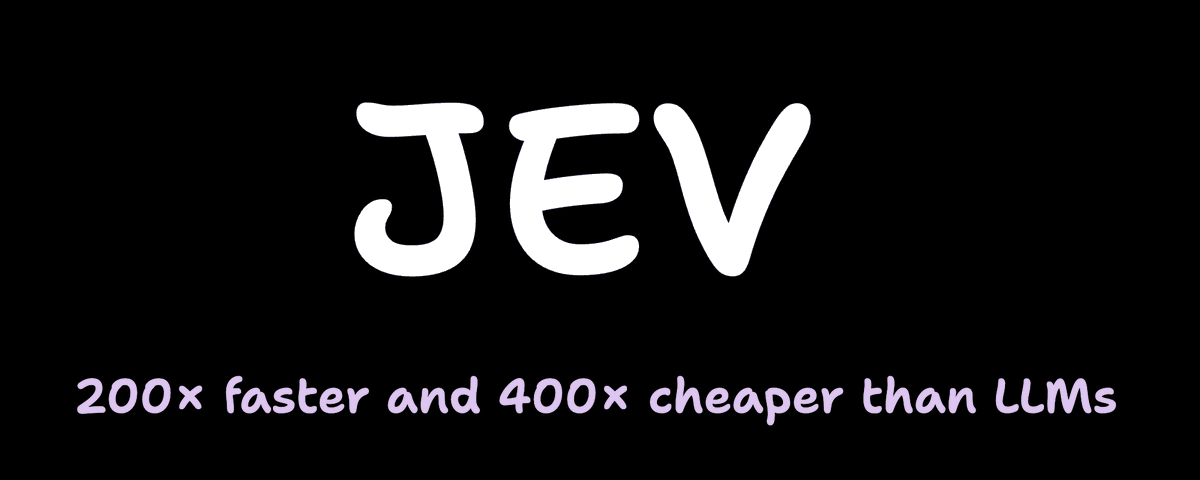
LLMs vs. Jev, clearly explained!
TL;DR
The key difference is not that Jev generates faster.
Jev does not generate text at all.
A traditional LLM receives context and produces an answer one token at a time. Even when the output is a small JSON object, every token depends on those generated before it.
Jev receives the same context but evaluates predefined decisions directly. When those decisions are independent, it can evaluate all of them in parallel.
Consider an agent handling a failed deployment. It may need to determine:
→ Whether the incident is urgent
→ Which team should handle it
→ Whether the proposed command is risky
→ Whether the task is complete
An LLM generates a response containing these answers sequentially. The application then parses and validates it.
With Jev, you define the questions and expected answer types upfront. It evaluates them together and returns typed answers with probabilities.
Jev supports three decision primitives:
1. **Choice** selects from known options, such as engineering, billing, or sales.
2. **Score** places the input on an ordered scale, such as low, medium, or high risk.
3. **Noul** evaluates a yes-or-no condition and returns the probability that it is true.
The probabilities matter as much as the selected answers.
If engineering receives 91% probability and billing receives 9%, automatic routing may be reasonable. If the probabilities are 52% and 48%, the system can escalate, gather more context, or call a stronger model.
This keeps control inside ordinary software.
Code owns the thresholds and consequences. Jev supplies the semantic judgment that a normal `if` statement cannot derive from unstructured text.
It works best when the possible answers are known, the decision depends on meaning, and a careful person could judge the input quickly.
It is not designed for writing, summarization, code generation, arithmetic, or decisions requiring several dependent reasoning steps. Independent questions can run in parallel, but decisions that depend on earlier results must remain sequential.
Jev also cannot return an option outside the declared schema, but it can still select the wrong valid option. Type safety prevents malformed outputs, not incorrect judgments.
The clean mental model is this:
LLMs generate new language when the answer space is open.
Jev evaluates known paths when the answer space is bounded.
I wrote the full breakdown explaining Jev and where it fits.
The article is quoted below.

Dong Nguyen retweeted

System Design Concept diagrams of the week.🚀
1. Rate Limiting
2. CRON Jobs
3. Load Balancers and Load Balancing Algorithms
4. Pub-Sub
5. Message Queues
I’ve been posting 1 system design concept every day.
Interested in learning system design? Follow along.


Dong Nguyen retweeted

In this article, the @golang team gives a detailed explanation of how the new goroutine leak profiler works (and when it doesn’t) with multiple examples of bad patterns and how to fix them 👉 go.dev/blog/goroutine-leak-p…
GoLand may not fix your leaks, but the new profile is already available in the “Go Optimization” tool, so that you can find and analyze them without having to leave your IDE.

Used to juggle Postgres, Redis, Meilisearch in separate apps. Switched to DBX - one lightweight open-source client for 90+ databases.
Built-in AI that actually sees db schema, so generating SQL is almost unfairly easy.
github.com/t8y2/dbx

74
Stumbled on this gem: Music Theory for Programmers.
As a coder who plays piano, seeing scales & chords built from pure math + JS arrays? Absolute mind-blow 🎹#MusicTheory #Programming #Piano #Coding @RunJS_app runjs.app/blog/music-theory-…

Dong Nguyen retweeted

Can a sufficiently powerful quantum computer forge the signatures used to authorize Bitcoin and Ethereum transactions? What would it take to upgrade both networks before that happens?
In this new lecture, Stanford cryptographer @danboneh explores why blockchains may turn to signatures built from hash functions. He also presents new research on threshold signing.
The talk ends with the questions Bitcoin still has to answer, including whether post-quantum signatures will require larger blocks, what happens to abandoned coins, and how someone such as Satoshi could prove ownership after Bitcoin’s current signatures have been retired.
00:00 Why blockchains need to prepare for quantum computers
03:05 Why Bitcoin may bet on hash-based signatures
06:25 The “big footgun” in stateful signatures
08:58 A quantum-safe signature that takes one billion hashes
14:13 Inside SLH-DSA’s virtual tree
20:30 How Bitcoin and Ethereum could make the switch
23:48 What happens when a wallet loses its state?
32:47 Can threshold signing survive the quantum transition?
36:39 How to hide lattice cryptography from the blockchain
38:49 Why threshold one-time signatures seem impossible
45:36 How context prevents forged signatures
49:37 The forgotten idea behind Winternitz signatures
54:50 Turning one-time signatures into threshold signatures
1:04:27 Will quantum-safe signatures require bigger Bitcoin blocks?
1:06:26 Abandoned bitcoin and Satoshi’s recovery problem