

Fractional CTO for crypto & blockchain companies | Custody, tokenization, onchain tooling | Degen since 2015
Utah, USA
Joined February 2015
- Tweets52.8K
- Following4.1K
- Followers19.1K
- Likes22K





Pinned Tweet
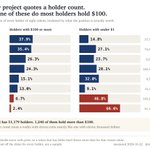
ethereum:0x5283d291dbcf85356a21ba090e6db59121208b44 has 51,179 holders.
34,077 of them hold less than one dollar. 1,240 hold more than a hundred.
I pulled the balance of every holder of eight tokens and bucketed them by what the position is actually worth. The spread is wider than I expected.
Share of holders with $100 or more:
$STRK · 37.9%
$ENS · 35.4%
$ZAMA · 26.3%
$FET · 24.3%
$W · 15.1%
ethereum:0xa27ec0006e59f245217ff08cd52a7e8b169e62d2 · 13.0%
$APE · 6.7%
ethereum:0x5283d291dbcf85356a21ba090e6db59121208b44 · 2.4%
A holder count treats a wallet with eleven cents exactly like a wallet with eleven thousand dollars. For most of these the headline number is largely counting residue that people never bothered to clear out of an airdrop.
Caveat worth stating up front: these are dollar thresholds, so a token that has fallen hard shows more dust for that reason alone. ethereum:0x5283d291dbcf85356a21ba090e6db59121208b44 at 2.4% is partly a price story rather than purely a behaviour one.
Balances read off the chain for every holder, not a sample.

Where my model and the market disagree most this Saturday 🏈
This week, my model and Polymarket disagreed hard on three weeknight games. The market was closer every time. So here are Saturday’s biggest gaps, and fair warning: history says bet on the market.
My model likes them more than the market does:
• Mississippi State over Oklahoma: model 61%, market 40%. QB Kamario Taylor is questionable but trending toward playing, and the market has climbed from 36% as the news improved.
• Tennessee at South Carolina: model 64%, market 45%. The line flipped from Tennessee favored to South Carolina favored last weekend, with no injury news to explain it.
The market likes them more than my model does:
• LSU at Auburn: market 72% LSU, model 61%
• Oregon at Illinois: market 76% Oregon, model 67%
• Ole Miss at Texas: market 60% Texas, model 52%
When the market is more confident than my model, it usually knows something I don’t. Injuries, matchups, lineups: my model only sees final scores.
5 games, 2 directions. Let’s see how many the data gets right. Scoreboard Sunday. 👀

Read eight token contracts balance by balance this week.
ethereum:0x5283d291dbcf85356a21ba090e6db59121208b44 reports 51,179 holders, but only 1,240 of them hold $100 or more.
The gap between a holder count and a holder isn't a rounding error, it's most of the number.


What’s a starting quarterback worth? I measured it. 🏈
I found every FBS game from 2024 to now where a team’s established starter (the QB with the most starts that season) didn’t play, then compared how those teams did against what my model predicted.
The first game without the starter: teams did 2.5 points worse than expected. That’s across 213 games, and it held up in all three seasons.
But here’s the twist: after that, the effect mostly fades. Across every game a starter missed, it’s less than 1 point. Once a backup has a game or two of tape, the results start to reflect who’s actually playing.
So the big drop is the surprise game, the first time a team takes the field without its guy.
Which brings us to Saturday: Oklahoma at Mississippi State.
Mississippi State QB Kamario Taylor is questionable with a foot injury. Here’s what my model says:
• Taylor plays: Mississippi State 61%
• Taylor out (−2.5): Mississippi State 55%
• Taylor out, valued as a star (−5): Oklahoma 52%
@Polymarket has Oklahoma at 64%.
Even taking Taylor out, my model likes Mississippi State more than the market does. Either the market knows the backup is a big step down, or it’s overreacting to one 31-0 loss at LSU.
Final injury report is 90 minutes before kickoff. We’ll see who’s right. 👀

This is what institutional tokenization actually looks like in practice.
Not every company needs to build its own regulated trading infrastructure from scratch.
Temple Digital Group brings the trading technology. tZERO provides the regulated broker-dealer and ATS infrastructure. Canton Network provides the underlying network.
That separation of responsibilities is important. It lets companies focus on their products and customers while leveraging established infrastructure for regulated securities trading.
The next phase of tokenization won’t just be about simply issuing assets onchain, it’ll be about making institutional-grade market infrastructure composable.

@temple_ny selects @tZERO as broker-dealer and ATS operator for its tokenized securities platform on @CantonNetwork.
Expanding tZERO’s Infrastructure-as-a-Service business.
Your brand. Your clients. Our infrastructure.
🔗 tzero.com/news/tzero-selecte…


Model report card, as of Tuesday night 🏈
I said I’d track every pick in public, including the bad nights. This was a bad night.
✅ Delaware over Missouri State (62%): won 61-38
❌ FIU over Middle Tennessee (78%): lost 26-23
❌ South Alabama at Marshall (66%): lost 20-13
1 for 3. And the South Alabama game was my first paper bet against Polymarket. My model said 66%, the market said 58%. The market was closer.
That’s the whole experiment. Over a full season, does my model know anything the market doesn’t? One night says nothing either way. A few hundred games will.
Tonight: New Mexico State at Sam Houston. My model calls it 51/49 for Sam Houston, about as close to a coin flip as it gets. 🪙
Meanwhile Tennessee is still sitting at 45¢ on Polymarket for Saturday, three days after the big drop, with no injury news. The market isn’t blinking.

AI just helped expose critical vulnerabilities in PHP, one of the technologies underpinning a huge portion of the web.
Two flaws, critical severity (CVSS 9.2), potential unauthenticated remote code execution.
The fixes are out today, and developers running PHP need to pay attention.
What makes this story especially interesting is the role AI is playing in security research. We’re moving toward a world where AI can help find vulnerabilities, develop exploits to validate them, and help engineers build fixes.
That cuts both ways. The same capabilities that help defenders find flaws can also help attackers exploit them.
The security arms race is becoming an AI arms race.
If you maintain PHP infrastructure, check your versions and patch now.
Official advisory: php.net/
Nothing like being ready to ship code and discovering your deployment platform has other plans.
Railway is experiencing a major outage. The dashboard and API have been affected, and builds are paused across regions.
So here I am, with code ready to go and absolutely no ability to deploy it.
My code has no bugs. My productivity has no path to production. 😂
The joys of modern software development: we’ve automated so much of the process that sometimes we can’t do our jobs until someone else’s infrastructure starts working again.
Status: status.railway.com/incident/…

Yesterday I posted fees per dollar of TVL and someone pointed out it rewards bot flow. They were right, so I went and counted.
Every block on eight chains for 24 hours, the window ending yesterday afternoon. Distinct addresses that sent a transaction, and what share of transactions came from the busiest 1% of them.
Hyperliquid earns $247 per paying wallet, more than any chain here. It has 19,821 of them. Ethereum has 511,663, twenty six times as many. On Hyperliquid, 198 addresses send 77% of all transactions.
Here’s the part I didn’t expect. Hyperliquid isn’t the concentrated one.
Optimism · 86.4%
Base · 85.1%
Arbitrum · 81.7%
Hyperliquid · 77.0%
Polygon · 68.5%
BSC · 68.3%
Avalanche · 65.7%
Ethereum · 48.8%
Seven of eight chains push two thirds to seven eighths of their transactions through their busiest 1% of addresses. Ethereum is the only one where paying for blockspace is something a broad set of people do.
That reframes yesterday’s chart. “Capital works harder here” and “a small number of actors do nearly everything here” turn out to be close to the same sentence on most chains.
Caveat worth stating: distinct senders isn’t quite distinct payers. Relayers and account abstraction let one address pay gas for many users, which compresses the count on chains that lean on them.
24 hours of blocks, every one of them. Distinct addresses don’t extrapolate from a sample, so sampling isn’t an option.


Crypto spent years telling people to become their own bank.
Then we gave them seed phrases, gas fees, chain switching, bridge risk, nonce errors, and transactions that fail for reasons nobody can explain.
We built powerful infrastructure and made users learn how it works.
The next wave of adoption should reverse that relationship.
This is a significant milestone for tZERO and for the broader evolution of digital asset market infrastructure.
Tokenization gets a lot of attention at the issuance layer, but the real transformation requires the plumbing underneath: clearing, settlement, custody, and compliance built to operate within established regulatory frameworks.
CFTC approval for tZERO DCO is another step toward bringing regulated derivatives infrastructure into this evolution.
The future of tokenized markets won’t be built on tokenization alone. It will be built on the market infrastructure that makes these markets work.
@tZERO has received CFTC approval for its wholly owned subsidiary, tZERO DCO, LLC, to operate as a Derivatives Clearing Organization (DCO).
The approval expands tZERO's regulated infrastructure beyond securities markets and furthers our long-term vision of connecting traditional financial markets with blockchain technology through trusted, regulated market infrastructure.
Read more: tzero.com/news/tzero-opens-n…

Which college football teams have been the luckiest this season? 🍀
I compared every FBS team’s record with how many games it should have won based on how it’s played: each game’s win chance from my ratings, added up across the season.
Luckiest
• Kentucky: 6-1, but plays like a 4.5-win team. 3-0 in one-score games, including two 1-point wins over South Carolina and LSU
• UTSA: 6-1, 4-0 in one-score games
• BYU: 6-0, expected 4.7
• North Carolina: 4-2, expected 2.8
Unluckiest
• UConn: 3-3, plays like a 4.4-win team
• Penn State: 3-4, 0-3 in one-score games. Better than its record says
• Kennesaw State: 1-5, 0-3 in one-score games
• Navy: 2-4, 1-4 in one-score games
Why it matters: winning close games is part skill, but mostly it’s bounces. Teams that go 3-0 in coin-flip games usually don’t keep doing it, and teams that go 0-3 usually don’t stay that unlucky.
So when people ask why my model has 6-1 Kentucky at #13 and not in the top 10, this is a big part of it. The wins count. The model just doesn’t expect the coin flips to keep landing their way.
Who on this list are you buying, and who are you selling? 👇

Ethereum holds $49.5B in capital. Solana holds $5.9B.
Over the last 30 days Ethereum collected $345.6M in fees. Solana collected $445.1M.
Per $1,000 parked on the chain, that’s $6.98 for Ethereum and $75.76 for Solana. Eleven times the work out of the same dollar.
Across the 18 chains I pulled:
Hyperliquid · $164.14
Solana · $75.76
Polygon · $53.71
BSC · $14.04
Base · $8.79
Ethereum · $6.98
Tron · $1.47
Hyperliquid squeezes 111x out of a dollar that Tron does.
This is where people argue past each other. “Biggest chain” has three answers. By TVL it’s Ethereum with 64% of all capital measured. By fees it’s Solana at 36%. By DEX volume it’s Solana again, with Base third at 15% while paying 4% of the fees, because Base made its blockspace cheap on purpose.
None of those three is wrong. They measure different things, and a chain built for one will read as weak on another. Worth knowing which one someone picked before you accept their league table.
Fees and DEX volume are 30-day totals, TVL is as of today, all from DeFiLlama and all checkable.

