
Open-source cybersecurity, cryptography, and privacy R&D at Breaks & Ciphers
Joined August 2021
- Tweets220
- Following149
- Followers133
- Likes941





Was your favourite AI product bought out recently by a Big Tech company?
We've seen this story many times before, and it didn't work out great (it's how we ended up with the word 'enshittification').
This time is different though, because the open-source alternatives are already just as good. And this time, as a final favour, the product you used to love will actively help you to migrate.

2
124
Just added a Contributions section to the Breaks & Ciphers website with the meaningful contributions made so far to open-source cybersecurity and privacy.
The first three have been privacy improvements to existing projects used by thousands of people.
In the open-source world, everyone is welcome to contribute with their own expertise or enthusiasm.

1
2
56
Google keeps losing court cases about Android. They have been getting hammered this year for monopolistic practices, yet they still have highly questionable ongoing initiatives.
Their losses so far this year:
* The EU successfully fined them €4.1 billion for anti-competitive practices in Android, including that Google required device manufacturers to pre-install Google Chrome and Google Search as a condition for giving their users access to the Play Store.
* Epic Games successfully sued them over their Play Store practices. This has resulted in upcoming changes in the US that include reduced commission rates and a requirement for the Google Play catalogue of apps to be shared with third-party app stores. Further news broke this week that the proposed settlement between Epic Games and Google was withdrawn, resulting in an additional requirement for the Google Play app itself to host third-party app stores.
Here's some ongoing initiatives I have encountered myself, which could see them back in court:
* Devices without Play Protect certification are unable to attain the MEETS_DEVICE_INTEGRITY or MEETS_STRONG_INTEGRITY labels in the Play Integrity API. This can result in app developers locking out all devices that haven't gone through Google's device certification programme. Thankfully, very few apps are currently requiring MEETS_STRONG_INTEGRITY.
* Google is replacing some CAPTCHA puzzles on websites with QR code scanning. For Android users, the device you scan the QR code with must have Google Play Services installed. So your browsing experience on your laptop is becoming affected by your choice of mobile device. I've encountered this QR code scan requirement once so far.
* Google is bringing in a requirement that Google-certified Android devices must only allow app installs from developers who have gone through Google's Developer Verification programme. This includes apps installed from third-party app stores. Most devices are Google-certified so they can give Play Store access to their users, but soon that same certification will lock out developers who have rejected Google's verification process.
I don't like how Android has been a treasure trove of user data for Google, and I also don't like when security features have a dual purpose of monopolising. In the past, we might see these initiatives and hope they are for our benefit. But now we have strong evidence from the courts that Google's past actions haven't put Android users and developers first. This is a strong motivation for engineers to contribute to the software ecosystem of de-Googled Android, including projects like @GrapheneOS, F-Droid, Accrescent, and Obtainium.

Public link to the post, which also includes links to all sources: breaksciphers.com/notes/goog…
31
Earlier this week I submitted a privacy vulnerability disclosure to an open-source app, and the solo maintainer merged a patch the next day. The whole experience strengthened my belief that open-source apps can finally defeat the “free” apps that have been extracting data out of us for years 🧵
2
3
100
1/ Historically, the open-source projects that had the strongest level of maintenance were packages and infrastructure. Companies that have lots of money and engineers depend on those, and some of these companies have provided funding for maintainers and dedicated their engineers’ time toward contributions.
1
1
15
Yesterday I attended the Neocypherpunk Summit in Berlin with hundreds of people from various backgrounds who all care about the human right to privacy.
The term “cypherpunk” used to refer to extremely technical lone wolves who dedicated their lives to privacy. Thankfully, it has now evolved into a movement where anyone who cares about privacy is welcome, no matter their background. In one day I heard talks from human rights organisations, activists, engineers, academics, and philosophers.
People care about privacy to differing degrees and for various reasons. Some people need to protect their safety, some want to chat with their loved ones in a safe space, while others simply don’t want their data to enrich a tech oligarch who they don’t trust.
Privacy doesn’t mean isolating yourself from society, it is about the right to choose what information you share with whom. Yesterday was the opposite of isolation, with hundreds of people making friends, sharing ideas, and feeling inspired.
Whatever your reason, if you feel a bit uncomfortable about where your data flows behind your back, feel free to message me and we can come up with something small you can do today. It’s usually as simple as replacing one of your apps with another that has the same features, but is more secure. It feels empowering!
Thanks to @web3privacy for organising ♥️

At Breaks & Ciphers I’m building a secure open-source tasks app. Our day-to-day tasks are some of the most valuable data points to creeps, so I think we should protect them.
I intend to use this as a testbed for what the state of the art is in building, testing, and deploying applications when security and privacy are uncompromising goals.
This may have some measures that seem extreme for a tasks app, but the underlying purpose of this project is to push open-source security and privacy forward. I hope to find where these are most difficult to achieve for maintainers, and publish research and tools to fill these gaps.
Some of the early security design investigations I’m doing are:
* Using Rust + FFI vs app development languages like Kotlin/Swift
* Using cross-platform frameworks vs per-platform development
* Peer-to-peer sync / backup options
* Where to use formal verification
As references, I’ll be comparing other apps that are known for their security:
* @signalapp
* @GrapheneOS's built-in applications (SMS, PDF viewer, etc.)
* @Bitwarden
* Apps recommended by @privacy_guides
Let me know if there’s a different app you consider to be the gold standard in secure development!

1
53
It’s currently too hard for users and developers to figure out which open-source software is secure and trustworthy.
The most prominent assessment tool I’ve found is OpenSSF Scorecard, which assesses projects for security risks through a series of automated checks, assigning each project a score out of 10.
Unfortunately, it hasn’t proliferated enough yet. Most users have never encountered Scorecard, so it doesn't affect their choices. And if it doesn’t directly affect weekly downloads or clout, most maintainers aren’t incentivised enough to adopt it. Scorecard also isn’t a fully comprehensive security assessment.
Whether it’s Scorecard or something else, I do believe automated assessments have strong potential. At Breaks & Ciphers I’ve been considering some features that could result in a successful movement:
* Fact-checking: a trustworthy assessment can’t currently be achieved solely through static checks or AI (hallucinations, prompt injections). There need to be incentives designed to encourage fact-checking or approval of automated results, similar to X’s Community Notes feature.
* Stages instead of scores: a scoring system may be too daunting for maintainers if their projects start out with very low scores. One alternative I like is a stage-by-stage framework, where projects work their way up through several security and trust model stages over time. I saw the effectiveness of this approach in the L2BEAT initiative, and there is a similar Walletbeat initiative in beta (both linked in the replies for those interested in learning about these). Perhaps we need a Softwarebeat.
* Inform the user: the security and trust status of the project needs to be shown clearly in GitHub, app stores, and package providers. Otherwise users and developers won’t hear about it, and maintainers won’t care about it. Even if we can’t get GitHub or Google Play onboard at the beginning, we could demonstrate the effectiveness by achieving integration in smaller platforms, such as the Obtainium APK installer.
Reply or DM me with your thoughts!

1
1
51
* OpenSSF Scorecard: scorecard.dev/
* A recent study including data on the proliferation of OpenSSF Scorecard: Kubo, Yusuke, et al. "Action Required: A Mixed-Methods Study of Security Practices in GitHub Actions.” ndss-symposium.org/wp-conten…
* L2BEAT: l2beat.com/about-us, Walletbeat: beta.walletbeat.eth.limo/abo…
* Breaks & Ciphers: breaksciphers.com/
1
62
After a couple of months travelling, I am announcing a small R&D lab, Breaks & Ciphers, which is focused on open-source cybersecurity, cryptography, and privacy.
I want to live in a world where the software we use is highly secure, including security against mass surveillance by advertising agencies and intelligence agencies. I don’t believe this will happen if the software we use daily continues to be owned by companies whose primary incentive is to maximise shareholder value. I believe this is achievable through open-source software, now more than ever before, because today’s engineers can build good software on much tighter resources.
There was once an implicit deal between society and big tech: we give you our data, you provide us with great free products, good jobs, and positive economic impact. Whether through greed or other reasons, big tech has betrayed this deal. Products become worse for our health to maximise profits (slot machine algorithms, AI slop, TikTok-like videos). Jobs cuts are encouraged in favour of centralised AI. Wealth doesn’t trickle down effectively, and the divide seems to be accelerating.
On the surveillance side, whistleblowers and leaks over the years have demonstrated how some states are willing to violate the privacy of innocent people across the globe via software exploits and backdoors. The current geopolitical climate leads me to believe we may see further steps backward in this area. As a citizen of a neutral country, Ireland, I think it's completely reasonable to demand the ability to verify that the technology I use does not contain backdoors or vulnerabilities accessible by foreign states.
At Breaks & Ciphers, we will do consistent work toward regaining our security and privacy. We will analyse trust models deeply to provide recommendations on which software to use, along with how we can improve these trust models over time. We’ll make contributions and security improvements to open-source projects. We’ll produce new open-source projects when necessary.
While the need for Breaks & Ciphers comes from quite a sad state of the digital world, I don’t see the road forward as a lonely, dark path. I see it as a hopeful path where the thousands of engineers, researchers, journalists, activists, lawyers, communities and organisations who have fought for people’s digital sovereignty can win. And we’re going to have tonnes of fun and fulfillment along the way.
For examples of software to be optimistic about, think of Signal, GrapheneOS, Tor.
But I’m not recommending these yet, you’ll need to wait for the research!

Most post-quantum migrations require an initial crypto-agility phase: adapting your system to accept new cryptography schemes, whether they are post-quantum or not.
Ethereum is no exception. To achieve post-quantum security, the network must first become crypto-agile. The @ethereumfndn is addressing this by steering the ecosystem toward Account Abstraction, which lets accounts define custom validation logic. This gives users greater asset control and the ability to swap in new signature schemes.
However, crypto-agility migrations can also introduce vulnerabilities. Ethereum is currently seeing this recently with its Account Abstraction rollout. Recently, a vulnerability was disclosed in the ERC-4337 system which required a patch to the primary smart contract. For the full breakdown, check out our latest article.

This week we launched a new series on the Project Eleven blog: PQ Implementation Vulnerabilities.
While we’ve built trust in the theoretical foundations of NIST’s lattice and hash-based post-quantum schemes, the next challenge is implementing and distributing them securely. In this series, we’re explaining the vulnerabilities that occur during this process as they emerge in the wild.
My colleague @conordeegan opens this series by analyzing a side-channel attack vulnerability that was recently disclosed in RustCrypto’s ML-DSA implementation.

A quick in-browser race of NIST’s smallest post-quantum signature schemes. In JavaScript, the lattice-based ML-DSA-44 beats the hash-based SLH-DSA-SHA2-128s by a long way.

Did you know you might be using post-quantum cryptography every time you clone a GitHub repo?
GitHub recently added support for the sntrup761x25519-sha512 key exchange algorithm. This ensures your data is protected by a post-quantum encrypted channel, shielding it from "harvest now, decrypt later" attacks.
The algorithm is a hybrid, combining classical Elliptic Curve Diffie-Hellman (X25519) with the lattice-based Streamlined NTRU Prime scheme.
You can verify this yourself: run your next clone with verbose SSH logs enabled and grep for "kex algorithm". If you see sntrup761x25519-sha512, then your connection was resilient against future quantum attacks 🥳

Today is a proud milestone for us as we announce Project Eleven’s $20M Series A funding.
Whether you believe the quantum threat will arrive in 2026 or 2036, as security professionals we must not gamble on critical risks. We must proactively prevent them. That is our mission at Project Eleven.
We’ve spent the last year researching and building solutions for the quantum threat to digital assets while raising ecosystem awareness. This round validates that we aren't the only ones taking this risk seriously.
We are no longer limited by our resources – only by our ability to execute our plan. If you understand the importance of this threat and are passionate about securing people’s assets, we're hiring.
Project Eleven Raises $20M to Prepare
Digital Asset Infrastructure for the Quantum Era
Project Eleven, the leader in post-quantum security and migration for digital assets, today announced a $20 million Series A funding round led by Castle Island Ventures with participation from Coinbase Ventures, Fin Capital, Variant, Quantonation, Nebular, Formation, Lattice Fund, Satstreet Ventures, Nascent Ventures, and Balaji Srinivasan.
The round comes as post-quantum cryptography becomes a planning priority for government and industry. Advances in quantum computing could eventually weaken elliptic curve cryptography (ECC), the public-key standard used by networks such as Bitcoin, prompting a staged transition across an ecosystem that secures more than $4 trillion in digital assets.
Project Eleven is building the tools to make complex, multi-year migrations practical for networks and institutions, including readiness assessments, migration test environments, and deployment sequencing.
“As quantum capabilities advance, the stakes couldn’t be higher. We can’t afford to ignore this existential risk posed to the digital asset ecosystem,” said Alex Pruden, CEO and Co-Founder of Project Eleven. “Trillions in value depend on these cryptographic assumptions. Networks like Bitcoin take years to upgrade because they’re governed cautiously by design. We’re focused on making the transition practical now, so the industry can migrate deliberately instead of improvising under pressure.”
“Useful quantum computing is the biggest and most complex threat public blockchains have ever faced,” said Nic Carter, General Partner at Castle Island Ventures. “Project Eleven is building the practical bridge from research to real-world deployment.”
Project Eleven is collaborating with the Solana Foundation and other leading protocols and Layer 1 ecosystems on post-quantum readiness planning and technical work.
The company raised a $6 million seed round in June 2025 led by Variant and Quantonation, with participation from Castle Island Ventures, Nebular, and Formation. Project Eleven plans to unveil its next major product release in early 2026, adding capabilities for institutions, protocols, and end users looking to future-proof long-lived cryptographic systems.
🤝
@CastleIslandVC
@nic_carter
@cbventures
@Fin_Capital_VC
@variantfund
@Quantonation
@Nebularvc
@formation_vc
@lattice_fund
@Satstreet
@nascent
@balajis
🤝
@apruden08
@conordeegan
@graememoore
@Dr_DAO_
@nuggimane
🤝


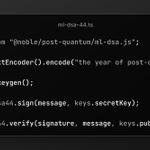
Let's make 2026 the year of post-quantum cryptography. Here's how simple it is to use the TypeScript package `@noble/post-quantum` by @paulmillr to sign and verify a message using NIST's ML-DSA-44 scheme.

Proud to share Project Eleven's collaboration with the Solana Foundation, including the deployment of post-quantum signatures on a Solana testnet. The quantum threat to blockchains is real, so it’s great that Solana are taking it seriously.

Go to projecteleven.com to find out if your browser supports post-quantum security – or if your data could be harvested now and decrypted later.
Bonus points for guessing how we check this 👀

1/6 @conordeegan published an explainer for lattice cryptography on the Project Eleven Blog, titled “Post-quantum digital signatures & the lattice city - what is a lattice and how does ML-DSA work?” I think it’s great because it pulls off two tricky things: 🧵


2/8 Most modern Bitcoin accounts only expose their public key on-chain when they first spend funds. Until then, their public key isn’t visible on-chain, and a quantum attacker can’t derive their private key.
blog.projecteleven.com/posts…

1
3
30