






I like the use of the event reducer and partial implementation of an ecs in this article
"Making a turn-based multiplayer game in Rust" herluf-ba.github.io/making-a…
2
blenderbot.ai is a fascinating project from @meta, the developing persona from the AI's long term memory as a way to reduce the vector search space while also developing a model of the person interacting with it
1
“My hope is someday, when the next Aristotle is alive, we can capture the underlying worldview of that Aristotle - in a computer. And someday, some student will be able not only to read the words Aristotle wrote, but ask Aristotle a question - and get an answer!"- Steve Jobs,1985
It is remarkable how coherent this interview is. The cadence of Steve Jobs voice however doesn’t sound great, perhaps due to the available training data mostly comes from his presentation voice. Impressive nonetheless! podcast.ai/
1
2
If #AlphaTensor can effectively bootstrap itself into greater efficiency in discovering a more efficient matrix multiplication algorithm, what is the upper limit to this method? What else can we push it to discover
2
So this would be cool. B-Tree lookups without round-trips to userspace using kernel eBPF modules, much closer to NVMe devices asafcidon.com/uploads/5/9/7/…
Large language models are going much further than I think anyone can even imagine. It's entirely plausible that LLM are the key to training autonomous systems on completely unlabeled data
1
AI capabilities are accelerating unbelievably fast it's absolutely mind exploding. DL being layered as a way to completely predict entire frames, SER shader scheduling. I am close to believing the simulation theory with this stuff youtube.com/watch?v=PWcNlRI0…
1

Exploring lock free #rustlang morestina.net/blog/742/explo…

1
K-Pop is a big surprise here. We are quickly approaching the full creative spectrum alongside specialized tasks outperforming human level performance. It's incredible how fast this space is continuing to improve exponentially

We've trained a neural net called Whisper that approaches human-level robustness and accuracy on English speech recognition. It performs well even on diverse accents and technical language. Whisper is open source for all to use. openai.com/blog/whisper/

We seem to be accelerating Moores law when it comes to AI. Given a few more years I suspect we will have entire films entirely generated from derivatives of stable diffusion and the like.
1
Browsing the wasmtime implementation here shows the use of cap-std as a capabilities based std library. Interesting note is the Pool concept to limit network address access docs.rs/cap-std/0.25.2/cap_s…
Rust and AF_XDP; Another Load Balancing Adventure | by Ben Parli | Nerd For Tech | Medium medium.com/nerd-for-tech/rus…
1
All the cool challenging problems to work on are in open source, hobbyist work, building stuff from scratch.
2
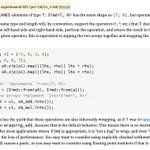
#rustlang Portable SIMD github.com/rust-lang/portabl… is an initiative to enable writing vectorized operations using a single high-level API (with fallbacks to scalar). Primitive types with a number of lanes generally map to intended vectors. (i.e. 128-bit vector = f32x4, f64x2).


2
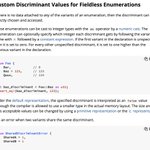
Representing field enums from #rustlang in C with #[repr(C)] effectively creates a struct implementation, a corresponding discriminant enum and a tagged union for the field values. doc.rust-lang.org/reference/…
