

founder @AxioraHQ - Japanese financial data software, markets, and the systems behind them
Japan
Joined July 2015
- Tweets30
- Following29
- Followers108
- Likes129

we are so back

NVIDIA Board reinstates Jensen Huang as President, CEO and Board Director.
Read the release: nvidianews.nvidia.com/news/n…

1
32
Been thinking about how much power there is in deciding what gets measured
Two people can agree on all the facts and still reach completely different conclusions
But once one person's definition of success becomes the default, the other is stuck arguing on their terms
We question the conclusions all the time, but rarely who got to set the criteria
20
I think one reason AI struggles with business is that its so hard to learn from failure
A deal falls through. Was it the price? the timing? or the buyer?
You cant rerun the same negotiation with one variable changed
30

Increasingly convinced that most of docs/ is just bloat in agent-driven codebases
The codebase itself is the context yet we keep filling it with plans, summaries that go stale and then agents read those instead of inspecting the actual code
1
43
The temptation to offload your thinking to AI is enormous.
But imagine someone who resists that and spends the next five years learning everything they can get their hands on. Finance, biology, history, completely unrelated fields.
The rate at which that person could grow is almost ridiculous
34
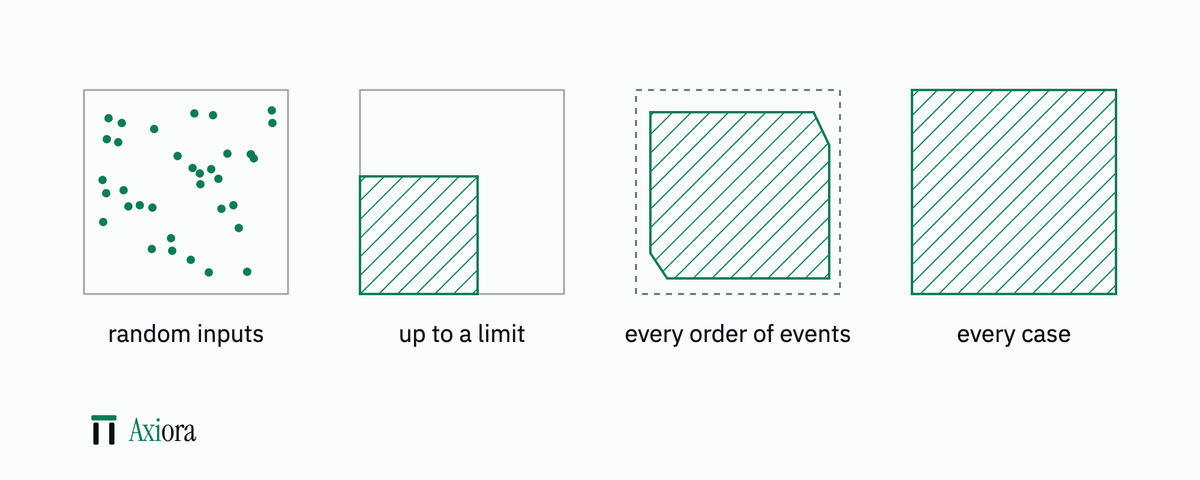
I asked on here what formal verification actually is
So i read up, and we tried it on our own code at @AxioraHQ. It found bugs our tests had missed
Wrote up what i learned, starting from zero

1
93
Perhaps theres an opportunity to invent new incentive machines around status and achievement
While the companies displacing current systems themselves are in the best position to build them, there is an obvious conflict of interest

Smith and Montesquieu thought that markets and commerce made us better: that they create an incentive to pursue self-improvement and to create things of value for others. In the positive AI visions, where the labor of humans is made redundant, I find myself wondering how we fare in the presumptive absence of these incentive gradients. Perhaps we are released to a life of freedom, where we can study Mozart and read Dickens, but that still seems complicated: both Mozart and Dickens were themselves deeply commercially-motivated in the production of their work, as were most of the great artists through human history. If the premise is that nobody will need to work or produce, how confident are we that we actually get the next Mozart and Dickens? The relevant question is not the partial equilibrium of whether one individual can pursue a life of enlightened leisure, but the general equilibrium of what form a society as a whole will take on.
One could maybe invoke Periclean Athens or the aristocratic gentleman scientists of Victorian England as a counterpoint. While these individuals were perhaps not motivated by commercial considerations, they were embedded in wider societies shaped by commerce, attendant betterment, and trade: Byron was himself upper class, but he was also surrounded by and writing for an educated bourgeois audience. So we’re back to the equilibrium question. Furthermore, even these individuals were surely motivated by a sense of high-stakes and consequential agency: if they did not apply themselves to their labors, they presumably believed that the work would not otherwise exist. Thucydides was addressing pressing military matters.
So I would like to read more optimistic cases from AI proponents about what a society (vs individual life) looks like if everything goes well: what people do, why they do it, whether humans achieve excellence (and in which domains), and which historical groups we should look to as relevant precedent.
One can perhaps imagine that humans will turn out to have a strong preference for work created by other humans. This may work in certain domains (ceramics?), but for how many will it actually apply? (I’m told that much of what is sold on indie crafts websites is now in fact manufactured in China.) It’s hard to see how this human preference, even if strong, would, for example, save scholarship.
Another idea would be to accept that nobody will become Einstein or Mozart or Byron, and that human excellence as such diminishes, but that there are compensatory benefits (planet brains and Dyson swarms?).
I believe that we can satisfy individual desires, but to what extent will we cultivate behavior worthy of admiration? Will a post-scarcity society mold capable and ambitious people? Which institutions will sustain them and which responsibilities will they have? I’d like to hear more of the equilibrium for the maximalist case spelled out.
78
As writing software and extracting data get cheaper, I believe distribution becomes valuable for reasons beyond acquiring customers
It creates a direct channel of information from customers back into what you build, allowing the product to evolve towards stronger differentiation
2
105
We see competition produce better products and assume it would do the same to people
But people arent products. They need room to fail repeatedly without every failure costing them the next opportunity
I believe a lot of people would develop further in less competitive environments
1
2
123
Interesting finding from Japan’s TSE reforms
In Jan 2024, the exchange published a list of companies that had disclosed plans to improve capital efficiency. All of this was already public in individual governance reports
The market reacted anyway. Companies that hadnt disclosed were penalized, even though persistently undervalued, profitable companies did better. No corresponding improvement in earnings forecasts
It is intriguing that something as simple as making existing information easier to compare - with the exchange drawing attention to it - can change how investors price businesses
Makes you question how much of what we call public information is actually being processed by the market
1
1
79
What is all this formal verification business about?
Might go down the rabbit hole and write about what i learn
66
The recent trend of System One models is interesting - jev for decisions and clairic for extractions
I think theres an interesting class of problems between the two, especially in financial research where you need classification AND the exact evidence supporting it
85

Ive seen way too many people get so good at finding reasons something might not work that they end up talking themselves out of ideas worth trying
At some point,all that analysis is just a way of avoiding the uncertainty and discomfort that come with working on ideas
3
162

