







The texture of history meets the tranquility of the mountains.
Nothing quite like feeling the traces of the past on a cloudy day.


Where the vast blue meets ancient stone, nature invites us to pause, reflect, and find peace in simple permanence.

With a capacity of nearly 5,000, it remains one of the most majestic open-air venues from antiquity, still staging world-class concerts and performances today. Imagine experiencing a live show surrounded by two millennia of history!

While Ancient Egypt is known for grand monuments, its most captivating art lives in the intimate moments of royal life.
This papyrus scene depicts Tutankhamun and Queen Ankhesenamun. Originally carved into the backrest of the famous Golden Throne, it showcases the expressive and naturalistic style of the Amarna Period.

The Greek on this papyrus is clear: ΤΕΛΕΤΗ ΑΦΗΣ ΟΛΥΜΠΙΑΚΟΥ ΦΩΤΟΣ, “Ceremony of the Lighting of the Olympic Flame.” A youth touches his torch to the altar fire, a priestess raises a cup behind him. It looks ancient.
It isn’t.
Papyrus is an Egyptian medium; the Greeks painted their vases on fired clay. This is a modern workshop piece applying Greek iconography to Egyptian paper.
The ceremony is newer still. The ancient Olympics had sacred fires and torch races, but no flame carried city to city from Olympia. That idea was invented for the 1936 Berlin Games. The parabolic mirror, the white-robed priestesses, three thousand runners. The point was to present Nazi Germany as heir to the classical Greek inheritance.
A ninety-year-old ritual now feels old enough that nobody questions it. A good example of how tradition gets manufactured.

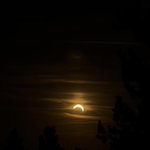
The light drained out of the evening and the whole sky turned copper. The sun had thinned to a crescent behind the haze, and everything below it, the trees, the rooftops, had already gone to silhouette. That is the quiet beauty of a partial eclipse: nothing dramatic, just the light slowly leaving, and you standing there looking up for longer than you meant to.

Apollo and Daphne, painted on papyrus in the Attic red-figure manner of the early fifth century BC.
The inscriptions name both figures: ΑΠΟΛΛΩΝ at right, ΔΑΦΝΗ divided around the woman. Apollo stands on an Ionic base, crowned with laurel and holding the lyre. Daphne holds a bird, framed by two young laurel shoots.
The composition places the transformation before it happens. The tree she is to become is already rooted at her feet.

The best thing about a tent is opening your eyes to the sea instead of a wall. The coffee water boils while pine needles drop to the ground, dry grass gone yellow between the rocks. Nothing to do, nowhere to hurry. Sometimes a holiday is this simple.

Puglia. The name comes from the Greek Kallipolis, beautiful city. Beneath these narrow streets lie underground olive presses carved into the rock. Workers lived down there for months at a time, turning stone wheels to draw the oil. Much of the lamp oil that lit Europe once passed below these very stones.

The stone here remembers the sun. Lecce’s streets draw the morning into honey-colored limestone, carved and recarved across centuries. No one on the balconies, the geraniums thirsty. A Vespa leans against the wall as if someone stepped off and forgot to come back. The baroque facades carry their own shadows; ornament here is not display but habit. The city has not woken yet, or has not found it necessary.

Two blue chairs on the pebbles, facing the sea. The woven seats are worn, the paint cracked. They have been here a long time.
The water is clear enough to show the stones on the bottom. Farther out, a line where shallow turns to deep, and a hazy stretch of land at the back. The horizon has almost dissolved; sky and sea share the same blue.
The chairs are empty but not abandoned. Someone left them exactly this way, side by side, facing the same direction. Not for talking, just for looking.

A thin ribbon of light between the pines. The far shore, a town gone quiet. The sky isn’t fully black yet, still holding deep blue at its edges.
Garden lamps have turned the trees blue. Not a natural color, but it gets along well with the night. In the foreground, a lounge chair, a folded umbrella, an empty table. Someone sat here in daylight and looked at the sea. Now there’s only stillness.
Maybe that’s the best part: a moment where nothing happens.

Sunset over the Adriatic
A peninsula town, stone houses packed to the waterline, a bell tower at the summit. Sailboats at anchor in the bay. Islands laid out along the horizon as the sun drops behind them.
This coast has been read this way for millennia. Illyrian settlements, Greek trading posts, Roman ports, Venetian defences. The same sightlines that make the view worked first as navigation.
The light is the reason people came. The harbour is the reason they stayed.

A Wall in Monopoli
Number 45, Via Santa Caterina. Lime-washed plaster, a copper downpipe, a rusting post box, a B&B sign, a portulacaria in a wall-mounted pot.
Monopoli grew on a Messapian settlement, took a Greek-derived name, and sat on the road Rome rebuilt as the Via Traiana. The stone beneath this plaster has heard several languages.
The wall is not a monument. It is a surface still in use. History here is not preserved. It is working.

Ancient Greeks stored oil and wine in amphorae like these. Three thousand years later the same shape sits on a Puglian street corner, glazed green, holding nothing. Form outlives function.


