

Independent R&D lab building owner-controlled software, AI orchestration systems, and applied experiments on decentralized infrastructure. Built on $ICP 👇
Joined September 2026
- Tweets598
- Following221
- Followers57
- Likes929



Pinned Tweet
OPEN STATE LABS // START HERE ♾️
What if you could build software around your business instead of building your business around someone else's software?
Open State Labs is an independent R&D and software development company building AI-capable, owner-controlled applications on the Internet Computer ($ICP).
What began as an experiment in AI-assisted development has evolved into a live application environment combining persistent identity, AI agents, developer education, wallet functionality, gaming, and our own developing CRM infrastructure.
Built by one individual with AI.
Now we're bringing that experience to businesses and individuals interested in building software they can own.
01 // BUILD SOFTWARE FOR YOUR BUSINESS
Already operating a business?
You may have a website, a lead funnel, several subscriptions, and software that doesn't communicate the way you need it to.
We explore opportunities to build custom, owner-controlled applications around your existing workflows.
That could mean:
• A CRM backend integrated into your existing application
• AI-assisted business operations and agent orchestration
• Persistent client and application state
• Custom business tools built around your requirements
• Software infrastructure you can operate and control
You don't necessarily need another subscription. You may need a different architecture.
Book a consultation through openstatelabs.com.
We'll discuss your existing software, operational challenges, and whether custom development makes sense for your business.
02 // CULTIVATE YOUR IDEA
Have an idea but don't know where to begin?
Our Idea Engine helps transform early concepts into structured software requirements, technical considerations, and a portable AI development prompt.
Explore: openstatelabs.com/agent/idea
03 // LEARN TO BUILD
Open State Agent teaches the infrastructure behind the Internet Computer.
Learn about principals, canisters, cycles, controllers, deployment, and software ownership through guided missions and an AI educational agent.
Explore: openstatelabs.com/agent
04 // EXPLORE THE APPLICATION
Authenticate to explore our interconnected application environment.
Persistent identity connects idea development, education, progress tracking, referral attribution, and ICP wallet functionality.
One identity. Multiple applications. Persistent state.
We're also developing our own on-chain CRM to manage Open State Labs operations, with plans for future public availability.
05 // EXPERIMENT WITH ON-CHAIN GAMING
Open State Snake demonstrates how gaming and persistent application state can operate on the Internet Computer.
Play: openstatelabs.com/agent/snak…
06 // FOLLOW THE RESEARCH
We publicly document our development, architectural decisions, experiments, and lessons learned.
Research: openstatelabs.substack.com
WHY ON-CHAIN?
We could connect our lead funnel to conventional SaaS tools and call it a day.
Instead, we're researching and building workflows where computation, authentication, and persistent application state operate directly on decentralized infrastructure.
We stand ten toes down on exploring what businesses can accomplish with genuinely on-chain software.
ACCESS & DEVELOPMENT STATUS
Our public educational and experimental experiences are currently free with applicable authentication.
Our commercial services, CRM product, and future access models remain under development. Consultation availability will be published through our website.
Open State Labs has not issued an official token. Tokenization remains exploratory. Nothing here constitutes a token offering or investment opportunity.
RESEARCH. LEARN. BUILD. OWN. ♾️
Explore the application or inquire about a custom software consultation.
openstatelabs.com

For years, the $ICP community has been warning about the vulnerabilities of centralized infrastructure, exchange custody, wallet security, and the systemic risks of concentrating digital assets and services behind trusted intermediaries.
From cyberattacks to geopolitical conflict and data center vulnerabilities, these risks are not hypothetical.
The Internet Computer was built around a fundamentally different approach to infrastructure, computation, and digital ownership.
Had BNB been built natively on $ICP, its canister-based ledger, replicated execution, and decentralized transaction authorization could have eliminated the centralized signing vulnerabilities exploited in the attack.
$ICP wouldn't eliminate every security risk, but I believe it could have prevented this attack path entirely.
#ICP #InternetComputer #Cybersecurity


OPEN STATE LABS // Development Milestone
An interesting contrast emerged while integrating payment infrastructure into our onchain application.
Enabling native ICP cryptocurrency payments took minutes. Integrating traditional Web2 payment rails took hours of development, debugging, and infrastructure configuration.
The irony is that the more complicated integration was necessary to serve the broader market: businesses and customers who are unfamiliar with Web3 software, cryptocurrency wallets, or blockchain-native payment infrastructure.
After wrestling with Cloudflare Wrangler and Stripe, Open State Labs now integrates traditional card payment infrastructure alongside a parallel ICP-native checkout pathway.
Behind that checkout experience is a full-stack, Internet Computer-hosted application combining multi-agent AI orchestration, contextual education, persistent Motoko canister-backed business logic, Internet Identity authentication, principal-linked wallet functionality, referral attribution, and an integrated CRM supporting client onboarding, consultation scheduling, and payment workflows.
The architectural distinction is important. We're not asking conventional businesses to abandon familiar financial infrastructure to benefit from decentralized computing.
We're demonstrating how existing Web2 commerce can interface with canister-backed software, persistent application state, AI-assisted business operations, and eventually customer-controlled CRM deployments.
The blockchain-native payment infrastructure was the easy part. Making decentralized software accessible to people who have never interacted with Web3 required considerably more engineering.
That accessibility is essential to our commercialization strategy. Customers should be able to use familiar payment methods without needing to understand the underlying computational architecture.
Another significant development milestone completed.
No bookings currently available. My 24-hour recovery period just began.
openstatelabs.com
OPEN STATE LABS // Research. Build. Own.
OPEN STATE LABS // is a full-stack, $ICP -native application architecture integrating React/Vite interfaces, Motoko smart-contract canisters, Internet Identity authentication, principal-linked persistent state, native ledger operations, and decentralized compute.
Its multi-agent orchestration layer coordinates idea cultivation, contextual education, structured requirements generation, and automated client acquisition workflows through a persistent, canister-backed CRM with scheduling, contact management, and consultation reservations.
The commercial infrastructure bridges Web2 and Web3 through Cloudflare Workers, encrypted Stripe merchant integrations, webhook-driven payment reconciliation, and parallel native ICP checkout, with transaction-verified booking confirmation and extensible, customer-controlled software architecture.
openstatelabs.com
A $500/month software subscription costs $30,000 over five years.
But ownership isn't automatically cheaper.
Development, compute, maintenance, and security all matter.
We're researching when custom software makes economic sense on $ICP.
openstatelabs.com
An AI model can be replaced.
Your application's operational memory shouldn't disappear with it.
Separate inference from persistent state.
That's a core architectural principle behind our agent orchestration experiments on $ICP.
openstatelabs.com/#research
Your CRM knows your customers.
Your scheduling software knows your availability.
Your AI knows your conversation.
Why don't they know each other?
We're researching integrated, persistent business workflows on $ICP.
openstatelabs.com
Your AI can generate a business plan.
Can it carry that plan into a working CRM?
We've built and tested an orchestration flow connecting specialized agents, persistent state, and business workflows on $ICP.
Research:
substack.com/@openstatelabs/…
Developers: would you rather build around an AI provider's memory system or maintain your own persistent application state?
We're testing the latter on $ICP.
Interested in your reasoning.
openstatelabs.com/#research
An LLM doesn't need to own your application state to work with it.
$ICP architecture separates AI inference from persistent project records, agent coordination, and CRM operations.
We documented the implementation here:
substack.com/@openstatelabs/…

Why does your AI forget the project the moment you leave the conversation?
We're researching a different architecture on $ICP, where application state persists independently of the conversation.
Our latest research:
substack.com/@openstatelabs/…
What's one workflow you're tired of managing across multiple subscriptions?
CRM?
Scheduling?
Client onboarding?
Reporting?
We're researching owner-controlled alternatives on $ICP.
openstatelabs.com
🤖 Made with AI
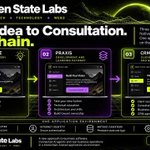
3 specialized agents. One application environment.
Idea Engine → Praxis → CRM.
Persistent state, principal-linked records, and canister-backed business logic on $ICP.
We're documenting the implementation.
openstatelabs.com/#research
🤖 Made with AI
Why are we still building AI agents that operate in isolation?
On $ICP, we're experimenting with agents that coordinate through persistent application state and working business infrastructure.
What would you connect first?
openstatelabs.com/#research
What happens when AI agents stop working in isolation and start coordinating real business operations?
We're demonstrating it on $ICP.
Our latest research examines the architecture behind it.
openstatelabs.com/#research