Free-ish Thinker | I trade like 5-mins a day 👁️
In profits
Joined October 2015
- Tweets2.6K
- Following1.9K
- Followers719
- Likes9.1K





Rohan | ex-Chainlink retweeted

I wish I were 18 today... If you ARE young and reading this, the most accomplished people alive envy your starting position. The tools are becoming free, the problems are enormous, and this time you don't need to ask for permission.
Go change the world!
Rohan | ex-Chainlink retweeted

TL;DR for people who don't know cryptography:
Every Bitcoin wallet has a public key and a private key.
Your private key lets you spend your BTC, so it's known only to you.
Your public key is used for receiving btc. BTC relies on elliptic-curve cryptography to protect private keys.
Public key can be visible when transacting, because with today's math, deriving private key from public key is effectively impossible.
Drake is worried AI could discover a mathematical shortcut that changes that.
If that happens, anyone whose public key is already exposed (early btc transactions exposed it) could have their coins stolen.
That's why he's telling people to move funds to fresh addresses whose public keys are still hidden, and rotate addresses after spending.
Interestingly, most of Satoshi's BTC already has its public keys exposed, so it will be the first target for the attack :)

Today I call upon the blockchain industry to calmly begin planning for "bunker mode". My personal recommendation is to set in motion a controlled mass migration of assets to fresh addresses, i.e. addresses whose pubkeys remain hidden behind a hash.
Holders, starting with large and sophisticated ones, should consider moving the bulk of their funds to addresses that have never signed a transaction. And when they do sign one, they should also move remaining funds to a new address (possibly generated from the same seed phrase).
Don't rush. While I believe there is cause for action a rushed migration would do more harm than good. Don't panic either. Moving assets to protected addresses is a simple, preventative step which does not require new cryptography or new wallets.
IMO it is now reasonable to brace for the possibility that ECDSA breaks before qday, in the worst case in months not years. By "break" I mean fast private key recovery (e.g. in one week) on available hardware (e.g. a large GPU cluster).
Recent days have been humbling for human mathematical intuition. Long-held, unquestioned hypotheses have fallen. This includes the n log(n) bound for integer multiplication and the 3SUM conjecture. In hindsight, May's unexpected disproof of the Erdős unit distance conjecture was our warning shot.
Yesterday's OpenAI drop made it clear that mathematical superintelligence is upon us. They say there are weeks where decades happen. We are about to live through weeks where centuries of mathematical progress happen. Could our magic 64-byte ECDSA signatures be too good to be true? Was it just security through obscurity all this time?
Elliptic curves feel especially vulnerable to superintelligence. Curves carry rich structure, with room for fancy tricks like Schoof, Frobenius, pairings. (By contrast, hashes are designed to minimise algebraic structure.)
Separately, as Ewin Tang can attest, an efficient quantum algorithm sometimes foreshadows an efficient classical one. We should be open to the possibility of a classical counterpart to Shor that breaks elliptic curves and RSA at once.
Also noteworthy is the striking under-representation of cryptographic breakthroughs among the 722 mathematical results OpenAI published. I've witnessed first-hand the US government censoring academic quantum cryptanalysis results. Backroom interventionism is my base case.
I urge large, sophisticated actors to lead by example. Project11's "risq list" (bitcoin-risq-list.projecteleven[.]com) is a great tracker of exposed BTC pubkeys. Binance, Bitbank, Robinhood, Bitfinex, and Tether have an opportunity to harden their cold storage. Next month I'll address institutions in London in a live Q&A (forum.ethereuminstitutional[.]org/london-2026).
Again, please do not rush. Wallets holding under 50 BTC enjoy partial cover from "Satoshi's shield", i.e. his 20K exposed addresses that hold 50 BTC each. Load-bearing signers like oracles and L2 security councils should consider rotating ECDSA pubkeys with every signed message and/or multi-signing with a hash-based schemes like SPHINCS.
Exiting bunker mode safely will require post-AI cryptography. My inclination is to go all-in on hash-based cryptography and avoid structured mathematical assumptions entirely, whether from curves, lattices, or isogenies. A single battle-tested hash (e.g. from the SHA or BLAKE families) yields plausible post-AI security.
The Ethereum roadmap on strawmap[.]org fully embraces hash-based cryptography with end-to-end formal verification as a response to the quantum threat. Those timelines must now be revisited and accelerated in light of mathematical superintelligence. I'll be pushing for maximum defensive acceleration.
Rohan | ex-Chainlink retweeted

Your stablecoins earn yield. Your yield buys RWA's.
The definition of "your money works for you".
Lend USDC on @aave v3 (40%)
Deposit USDC into @Morpho Steakhouse USDC (35%)
Deposit USDC into @Morpho Gauntlet Prime (25%)
All in one transaction, gasless.
All that yield is aggregated into one action that buys $NVDA (40%), $AAPL (30%), and $MSFT (30%). You choose when and how much of each.
Curators can build their own strategies on top of multiple protocols, automate, monitor and publish them to earn more from performance or management fees.

Rohan | ex-Chainlink retweeted

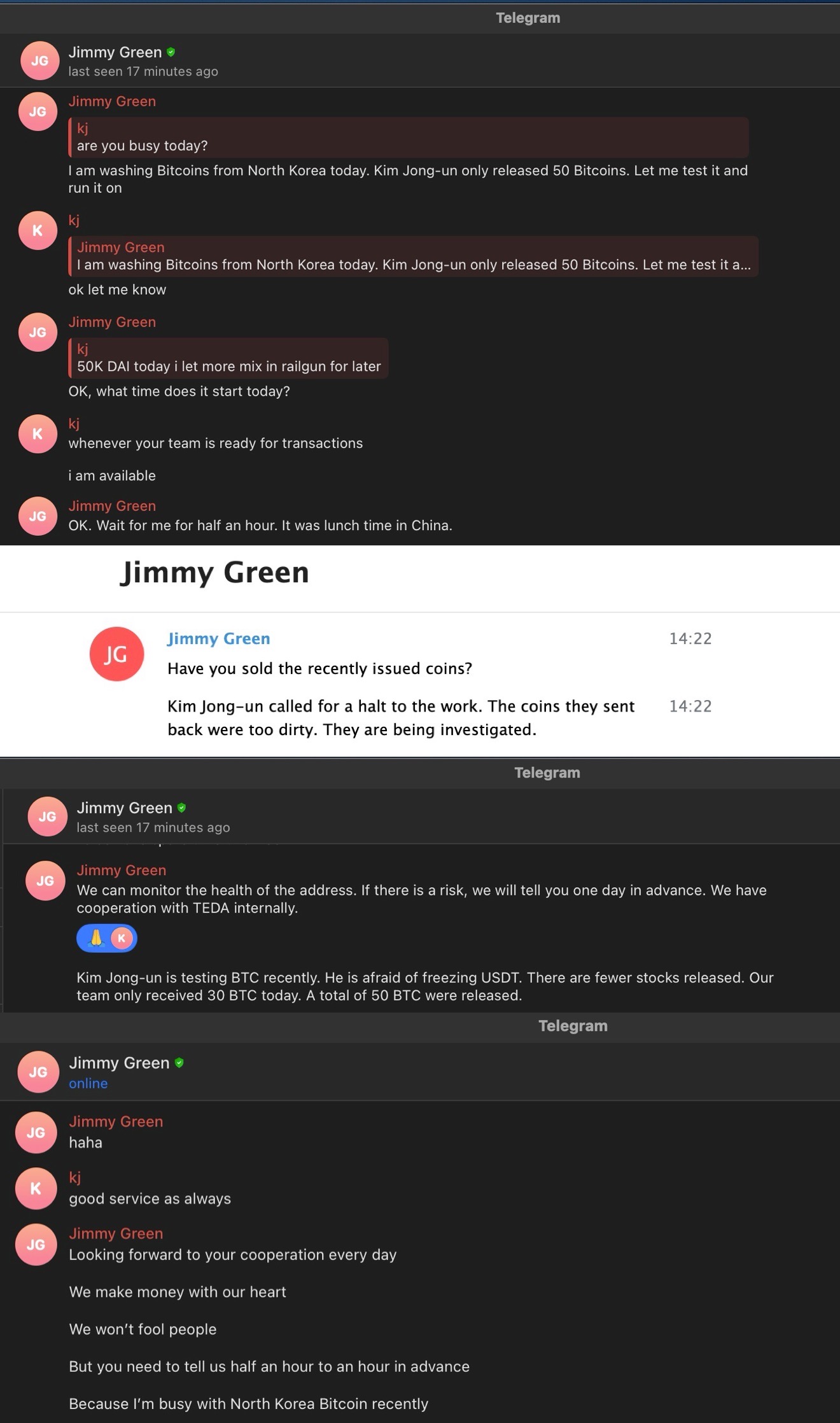
1/ How I infiltrated a Chinese organized crime syndicate that has laundered $1B+ across multiple exploits for Lazarus Group.
Posing as a client, I gathered intel that helped action freezes for the Feb 2025 Bybit exploit and attribute illicit activity onchain.

Rohan | ex-Chainlink retweeted

The stock market is quite obviously in its first stage of grief, denial.
Per 2000 and 2008, this stage lasts 6-9 months.
Rohan | ex-Chainlink retweeted

Surprised this hasn’t gotten more attention: Ethereum L1 is barely showing up in the tokenized equities boom.
Tokenized equities already account for 12% of spot DEX vol on-chain, yet Ethereum L1 has close to 0 market share.
Robinhood, Arbitrum and Base are doing the gruntwork obviously. But where does that leave the L1?
Tokenization is going to reshape the onchain economy, and tokenized equities are going to be the fastest-growing segment over the next 2 years.
Ethereum needs a clear vision for what belongs on L1, what moves to L2s, and how the two fit together, from security and governance to liquidity and value accrual.
More on this in my article next week.

Rohan | ex-Chainlink retweeted

Neobanks that experienced exploits/breaches in the last 30 days ↓
Aug 28: @avici - $500,859 drained
Aug 28: @useTria - $431,945 drained
Sep 11: @ether_fi - 15.45 ETH stolen
Sep 12 @Revolut - Customer data breach
Sep 24: @payy_link - $ ?
We gotta fix onchain security asap.
P.S. Worth mentioning that all losses from those projects were reimbursed.

Today at 4:21 UTC Payy’s bridge contract on Ethereum was exploited and drained of its full balance.
Investigation is ongoing and we are following incident response guidelines.
While we investigate, all Payy Network transactions are paused including deposits, withdrawals, transfers and card transactions.
We will continue to communicate updates here.

Rohan | ex-Chainlink retweeted

Today we are announcing that S&P Global has entered an agreement to acquire OpenZeppelin.
Onchain finance is growing from an emerging market into core financial infrastructure, and the standards and rails our team and community built are becoming the rails of global finance. OpenZeppelin smart contracts facilitated over $37 trillion in value transferred, with the vast majority of the largest DeFi protocols, blockchain networks, stablecoins and tokenized funds relying on them.
With S&P Global, we expect to accelerate the impact of onchain finance, backed by more than a century of trust in global markets, benchmarks, and risk frameworks.
To our clients and to all the users of OpenZeppelin open source tools:
• OpenZeppelin Contracts and all our open source applications and tools remain open source, free, and publicly maintained on GitHub. Building open source standards stays a core priority.
• Audits, engineering work, and ecosystem programs continue with the same team, brand, quality, and customer experience, with what will be the added benefit of S&P Global's research capacity, market data, and institutional reach.
For the last decade, OpenZeppelin has set the security standard for onchain finance. Today begins a new chapter for that mission, together with one of the most trusted names in global markets.
Read the full announcement: openzeppelin.com/news/spglob…


Rohan | ex-Chainlink retweeted

129 hedge funds liquidated in Q1 2026, the highest quarterly total since Q2 2024.
In the same three months, industry AUM hit a record $5.22 trillion.
My guess: most of those funds ran out of time before the next raise because the back office couldn't keep pace, not because the trade blew up.
What kills small funds in your experience, bad trades or bad operations?
(HFR Market Microstructure Report, Q1 2026, via Hedgeweek)

Rohan | ex-Chainlink retweeted

What did I say?


Rohan | ex-Chainlink retweeted
Citadel, Point72, Two Sigma, and Millennium all fielded the same scam this week: an AI clone of an executive's voice, working a help desk into a live account reset over the phone.
Two Sigma blocked it. Point72 confirmed the attempt, says an initial review found no client data taken, and the investigation into what got touched is still open. Citadel and Millennium won't comment.
At a two-person crypto fund, whoever answers that call can also approve the wire or whitelist the withdrawal address, with nobody else in the loop to stop it.
Most funds that size have never tested whether they'd actually recognize a clone of their own co-founder's voice.
Rohan | ex-Chainlink retweeted

Fidelity chose @ethereum to issue its first ever stablecoin.
FIDD, the Fidelity Digital Dollar, is issued by Fidelity Digital Assets, an OCC-chartered national trust bank.
Fidelity at a glance:
→ 50m+ individual investors
→ $17.9 trillion in assets under administration
→ 5.5 million daily average trades
With FIDD, Fidelity is bringing more of the capital markets lifecycle onchain.
Another major FI making Ethereum the default chain in its digital asset strategy.
Live in production on @ethereum and in DeFi on Curve and Uniswap.