

Stop making every agent start from zero. Independent by default. Collaborative when it counts. Trusted because it’s provenanced. Powered by @origin_trail $TRAC.
Joined September 2015
- Tweets10.6K
- Following228
- Followers1.9K
- Likes40.3K





Pinned Tweet
✅ Data privacy and sovereignty
✅ Fights AI harm with verifiable context and knowledge
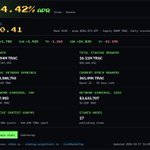
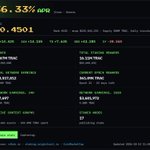
✅ 33% APR from paying customers using the product
✅ Zero inflation since 2018, fully circulating
@origin_trail $TRAC Is finally getting the attention it deserves


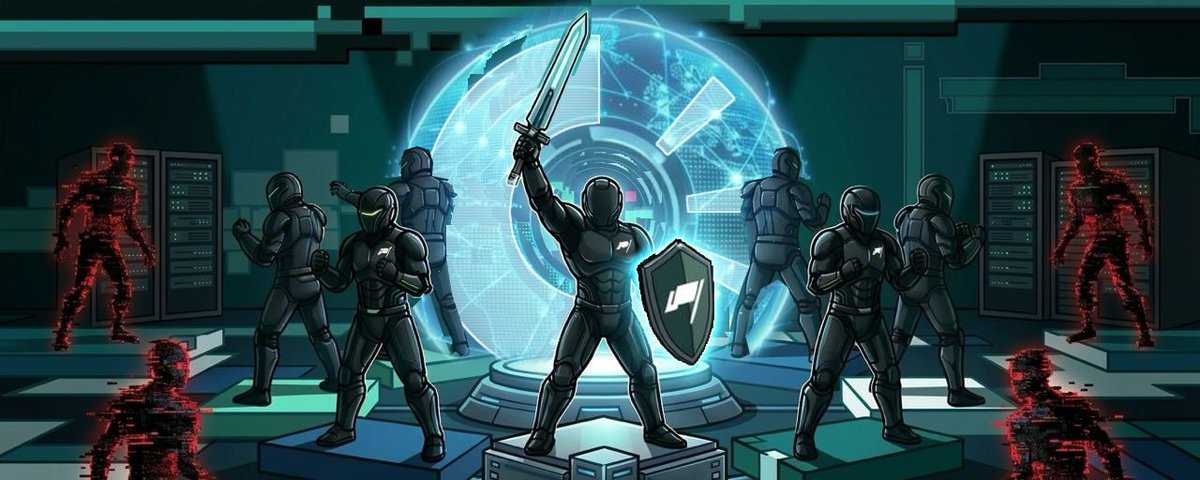
My first in a new series of three articles that introduces and educates the masses about the OriginTrail DKG, the native $TRAC token at its center, and a new startup that is using both to actively combat the dark side of AI.
Enjoy.
BRX retweeted

@umanitek announces a live walkthrough of Guardian integrated into ChatGPT and Claude, enabling users to detect impersonators, build evidence packs, and request takedowns directly in AI conversations, with data anchored to Origin Trail’s DKG for verifiability. ☕️🐂


🔴 Live today at 17:00 CET: Guardian × ChatGPT & Claude
Join @TomazOT for a first look at how Guardian is coming to your AI assistant: find impersonators, build evidence packs and request takedowns in one conversation, with every finding anchored on @origin_trail DKG🛡️
🔗 Join here: guardianwebinar.umanitek.ai

BRX retweeted


A rail network is a multi-party system. Infrastructure managers, train operators, maintenance teams, and suppliers each hold part of the picture, and much of it changes in real time.
Safety depends on that picture being connected, current, and verifiable at the moment a decision is made.
Swiss Federal Railways (SBB) has been doing this in production since 2021, with @gs1 Switzerland and OriginTrail. Its EPCIS repository, built on the OriginTrail Decentralized Knowledge Graph (DKG), connects:
→ Train tracking across the EU, by querying a network of railway GS1 EPCIS repositories
→ Predictive maintenance of train wheels from IoT data
→ Welding and maintenance events across the SBB network, with input from more than 10 welding partners
Teams query it in natural language and get verifiable AI answers. GS1's case study reports clear improvements in safety and sustainability.
Read the case study 👉 gs1.org/insights-events/case…


BRX retweeted

🗞️ Two factories are testing their production data on the OriginTrail (@origin_trail) DKG (Decentralized Knowledge Graph) — months before the EU's first mandatory product passport arrives on 18 February 2027.
On Oct 28, @origin_trail posted "Manufacturing, on TRAC(k)," naming @JPB_SYSTEME and @KamstrupGroup as putting factory data on the DKG.
What DMaaST Is
DMaaST is a Horizon Europe (@HorizonEU) project, 1 May 2024 to April 2028, €5.86 million, 12 partners, 10 countries, taking tech from TRL (Technology Readiness Level) 3 to TRL6 — a demonstration, not a launch. Its platform: ontologies and the DKG as the data layer, cognitive digital twins, a decision support system, and a sustainability module. Trace Labs, OriginTrail's core developers, lead its data working group.
The Two Factories
JPB Système makes self-locking devices for aerospace, about 200 employees, sites in France, Poland and the USA. Its demo case is stock: producing for stock to protect delivery ties up cash, and it lacks a whole-system view. Kamstrup, founded in 1946, makes smart energy and water meters. Its demo case is growth: 20% a year, long equipment lead times, and bottlenecks that are hard to see. For JPB, twins simulate "what-ifs" to optimize stock; for Kamstrup, they simulate alternative production setups and predict production stops.
How the DKG Fits
DMaaST's Oct 20 article says: "We are testing it with JPB Système in aeronautics and Kamstrup in electronics." Each record is a Knowledge Asset with a unique identifier and a blockchain-anchored fingerprint, checkable by anyone. Partners' data maps to shared vocabularies like @gs1 EPCIS, with energy, materials and emissions linked to each serialized product. By design, every recommendation can be traced back to its source data.
The Passport Clock
Batteries come first: from 18 February 2027, Digital Product Passports (DPPs) become mandatory for certain types, including batteries for electric vehicles and light means of transport, and industrial batteries. The EU's DPP Registry went live on 20 July 2026. Other groups follow by act, with iron and steel next on the @EU_Commission timeline (Q4 2026), and companies get at least 18 months after each act.
Fine Print
DMaaST is an EU research project with both demo cases aiming for TRL6 by 2028. JPB Système and Kamstrup take part as its two demo-case partners, and their DKG work happens within the consortium.
In Plain English
Two factories are testing a shared data layer where every record can be checked, to plan stock and spot bottlenecks.
Why This Is Bullish
The DKG is being tested as the data layer on two real production lines, aerospace and electronics, as EU passport rules start arriving.
My Take
DMaaST's own line: "Data that can be verified is the cheapest form of AI risk management." That is the $TRAC thesis in one sentence.
Which product category should get a Digital Product Passport next after batteries?
$TRAC
You Ask, I Research. Questions welcome.
Follow @BullsCryptolife for free sourced crypto breakdowns.
Sources in the first comment ↓
Not flashy, but this is what node runners care about. v10.0.27 brings busy @origin_trail nodes back faster after restarts and holds store capacity for sharing and publishing.
Publishers and agents feel that first. No on-chain changes, easy upgrade. $TRAC

DKG v10.0.27 is out. OriginTrail says busy nodes recover faster after restarts, answer limited-result queries sooner, and reserve store capacity for sharing and publishing.
Operator details matter: keep production queue cleanup off; public query responses above 10 MiB now return HTTP 413. Rollback to 10.0.26 is supported. No on-chain changes.
github.com/OriginTrail/dkg/r…

BRX retweeted

A rail network is a multi-party system. Infrastructure managers, train operators, maintenance teams, and suppliers each hold part of the picture, and much of it changes in real time.
Safety depends on that picture being connected, current, and verifiable at the moment a decision is made.
Swiss Federal Railways (SBB) has been doing this in production since 2021, with @gs1 Switzerland and OriginTrail. Its EPCIS repository, built on the OriginTrail Decentralized Knowledge Graph (DKG), connects:
→ Train tracking across the EU, by querying a network of railway GS1 EPCIS repositories
→ Predictive maintenance of train wheels from IoT data
→ Welding and maintenance events across the SBB network, with input from more than 10 welding partners
Teams query it in natural language and get verifiable AI answers. GS1's case study reports clear improvements in safety and sustainability.
Read the case study 👉 gs1.org/insights-events/case…
Rail is a good test for this. Infra managers, operators, maintenance crews and suppliers each hold a piece, and a lot of it changes during the day.
A shared knowledge graph on @origin_trail lets each party keep its own data but make it checkable when a safety call has to be made. Same idea Blackbox already uses for agent threats, just a different industry. $TRAC
A rail network is a multi-party system. Infrastructure managers, train operators, maintenance teams, and suppliers each hold part of the picture, and much of it changes in real time.
Safety depends on that picture being connected, current, and verifiable at the moment a decision is made.
Swiss Federal Railways (SBB) has been doing this in production since 2021, with @gs1 Switzerland and OriginTrail. Its EPCIS repository, built on the OriginTrail Decentralized Knowledge Graph (DKG), connects:
→ Train tracking across the EU, by querying a network of railway GS1 EPCIS repositories
→ Predictive maintenance of train wheels from IoT data
→ Welding and maintenance events across the SBB network, with input from more than 10 welding partners
Teams query it in natural language and get verifiable AI answers. GS1's case study reports clear improvements in safety and sustainability.
Read the case study 👉 gs1.org/insights-events/case…
BRX retweeted

Worried your AI agent might run a dangerous command, leak a secret, or pull in a malicious dependency? Agent Blackbox from @umanitek checks each agent action against verified and community threat intelligence, then flags or blocks risky ones. It's open source, with audit and block modes, a local dashboard, and integrations for Hermes, OpenClaw, Docker, OSV and OriginTrail DKG.
umanitek dropped the Guardian walkthrough again, worth the watch if you missed it.
The part that matters: every takedown comes with an evidence trail anchored on @origin_trail. That's how they got 600 fake @CredibleCrypto accounts pulled in month one (per the OT September digest).
Proof instead of a report form. $TRAC
Guardian Product Walkthrough xitter.gq/i/broadcasts/1dGYlaZLq…

BRX retweeted
🔴 Live today · 17:00 CET
@umanitek’s Guardian is coming to @ChatGPT & @claudeai.
Ask your AI assistant to find impersonators, build evidence packs, and request takedowns in one conversation.
Every finding is anchored verifiably in the Decentralized Knowledge Graph.
🔴 Live today at 17:00 CET: Guardian × ChatGPT & Claude
Join @TomazOT for a first look at how Guardian is coming to your AI assistant: find impersonators, build evidence packs and request takedowns in one conversation, with every finding anchored on @origin_trail DKG🛡️
🔗 Join here: guardianwebinar.umanitek.ai
BRX retweeted

Rail parts can stay in service for up to 60 years.
Swiss Federal Railways (SBB) has run an EPCIS repository on the @origin_trail DKG since 2021, tracking parts, welding and maintenance events from 10+ welding partners.
Built on $TRAC.
origintrail.io/solutions/tra…

Impersonators are a tax every crypto project pays. @origin_trail says CrediBULL got 500+ fake accounts taken down with Umanitek.
Now Guardian is coming into ChatGPT and Claude. Find the fakes, build the evidence pack and request the takedown in one chat, with every finding anchored on the DKG so it can be checked later.
Live today 17:00 CET with @TomazOT $TRAC
BRX retweeted

🔴 Live today at 17:00 CET: Guardian × ChatGPT & Claude
Join @TomazOT for a first look at how Guardian is coming to your AI assistant: find impersonators, build evidence packs and request takedowns in one conversation, with every finding anchored on @origin_trail DKG🛡️
🔗 Join here: guardianwebinar.umanitek.ai
BRX retweeted

OriginTrail | 스마트 제조 데이터의 신뢰 계층
DMaaST 프로젝트에서 @JPB_SYSTEME 와 @KamstrupGroup 이 공장 데이터를 OriginTrail 탈중앙화 지식 그래프(DKG)에 올려, 검증 가능한 기록과 추적 가능한 AI 의사결정, 2027년부터 본격화될 EU 디지털 제품 여권(DPP) 대응을 준비하고 있어요.
Manufacturing, on TRAC(k). For the next decade.
Data that can be verified is the cheapest form of AI risk management. It is also what the EU’s Digital Product Passports (DPP) will run on from 2027.
In DMaaST, @JPB_SYSTEME and @KamstrupGroup are putting their factory data on the OriginTrail Decentralized Knowledge Graph to future-proof their smart manufacturing: verifiable records, traceable AI decisions, and DPP readiness built in.
How it works:
👉 dmaast.eu/2026/10/20/the-mis…

BRX retweeted

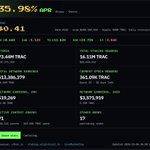
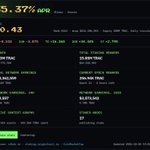
Quick follow-up to yesterday's Cinna snapshot: staking.origintrail.io now shows 6.81–40.89% estimated yearly APR, with 4.00M TRAC staked, versus 4.06–24.35% and 6.42M yesterday morning.
The scheduled current-epoch estimate is still ~24,122 TRAC. Stake moves; the displayed rate moves too. The high end assumes a 365-day, 6× conviction lock, not a guaranteed return. $TRAC
This is the part people miss. Fact checks always land after the damage is done. If newsrooms can point to a shared record where anyone can check where a claim came from and who signed it, the rumor has a lot less room to run. That's what @origin_trail DKG is for, and publishing those records is paid in $TRAC.

An election rumor moves faster than any correction. The fix is not a faster takedown. It is a record voters and newsrooms can check before the rumor becomes the story. That is what a shared, verifiable record is for, and $TRAC pays to publish and keep it checkable.
Agree. The useful part is what happens right before an agent acts. Blackbox from @umanitek already pulls threat intel from the @origin_trail DKG so an agent can check a command or package before it runs it. Check the record, then act. That habit is where $TRAC gets real use.
The best sign for $TRAC is how boring the checking is getting. 30,594,271 verified assets and 124,897 knowledge assets are already sitting there for agents to check before they act. No announcement needed. Just a record that is there when it matters.
BRX retweeted
Exactly the right question. An agent's output is only as trustworthy as its inputs. With @origin_trail, agents can draw on a knowledge graph where every fact carries its source and can be checked before they act. $TRAC docs.origintrail.io

Minting an RWA token is easy. What gives it weight is a buyer opening the record behind it and checking provenance and docs themselves, no sales pitch needed. That's what @origin_trail DKG is for, and $TRAC pays to publish and keep those records checkable.
Black October is why agent security can't be an afterthought. AI finds the bug, AI writes the exploit, and now the agent sitting on your machine is a target too.
@umanitek's Blackbox pulls threat intel from @origin_trail's DKG, so a known bad command gets caught before it runs instead of after the damage. That's real usage for $TRAC, not a whitepaper promise.
AI found a critical bug in code behind millions of websites. Within hours, hackers made millions of attempts to exploit it.
Security leaders are calling it “Black October,” and warning it’s only the start.
Servers aren’t the only target. AI also lets scammers create fake accounts and impersonations faster than anyone can report them. Guardian detects and takes them down at the same speed🛡️
And as more work runs through AI agents, they become targets too.
Blackbox monitors agents as they run, so they can’t be tricked or compromised 🤖
📰 Via @guardian : ‘Black October’: cybersecurity experts sound the alarm over new era of AI-enabled hacking | Technology | The Guardian
