

Security infrastructure for the AI agent economy. Limits agents can't override, live on Robinhood Chain mainnet. CA: 0x1b4d04c8a67bf98bdf791ef928482bcb225d71ab
Robinhood Chain · open ERC
Joined November 2026
- Tweets147
- Following6
- Followers141
- Likes22



Pinned Tweet
What Palisec is today, from start to finish.
AI agents now hold money and move it on chain. Palisec is the account layer that keeps them inside limits they can't change, live on Robinhood Chain mainnet.
The account
Every agent gets a Safe smart account with 3 owners: the agent's key, Palisec's co-signer and your recovery wallet. Nothing executes without two signatures, and Palisec only co-signs what passed your policy. The agent can't go around it.
The policy
→ Contract allowlist, deny by default
→ Spend caps per transaction and per hour, in USD, across ETH and every token that leaves the account
→ Loss limits: the agent is stopped when the account drops past the line you set
→ Human approval: over your threshold, a person signs that exact operation
→ Asset safety: every trade simulated first. Unlimited approvals, transfer taxes, honeypots and high slippage are blocked
→ No reliable price, or a simulation that can't run? It doesn't sign
Control
→ Emergency stop: one switch, and every new operation is denied
→ Tightening a limit applies at once. Loosening one waits in public
→ Holder mandates: token holders vote on an agent's limits, and the result is enforced on every transaction
Proof
→ Every decision is recorded with a reason code and a signed receipt
→ ERC-8511, our open standard: anyone can check an account's active policy and whether it's stopped, from the chain alone. No API, no trust in us
→ Registry v3 is live on mainnet
For builders
TypeScript SDK on npm, Python SDK on PyPI (pip install palisec), MCP and REST. Integrate once, and every transaction is checked.
$PALISEC
Credits bought on chain, burns counted live (44.6M burned so far), Pro limits for holders, and holder votes on agent limits.
The video shows it working: a real agent paying a vendor in USDG on mainnet. $2 allowed. $6 denied. $4 held until a person signed. Stop engaged, and even $1 denied.
Agents decide. Palisec enforces.
palisec.tech
2
5
534
Next week's shipping list.
This week was about proving the protection holds under attack: ten planted attacks, ten denials, nothing on chain. Next week is about making that protection easy to get and easy to check.
→ Fully bound in one step. Right now a team has to set up the timelocked recovery owner and check every owner on the account by hand before its public page reads Fully bound. In the Console that becomes a single action, and the page flips as soon as the chain agrees.
→ A verified builder record on HEY Research, under the Palisec name. Our contracts named by us, our releases with their sources, and the verified record that already exists finally attached to us.
→ A locked rule against a real holder vote, on mainnet. We'll run a vote to loosen a treasury guard that's been locked, and publish the transaction where the change is refused.
And one more thing we've been holding back for a while. It lands right after the work we're finishing now.
Every item ships with something you can check yourself on palisec.tech/proof.

Next week on Palisec: agents that change hands.
Agents are starting to be owned like assets. An agent can live inside an NFT with its own wallet, and NFTs get sold. When that happens, two things have to hold at once: the agent's limits carry over to the new holder, and every power the old holder had ends at the sale.
The first half is already tested on a fork of Robinhood Chain mainnet, against live contracts. After a sale, the policy and its signer stay in place, and permissions tied to the previous owner are refused, even if the agent is later bought back.
What we're building next week:
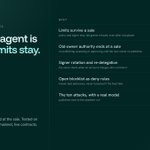
→ the previous owner's authority tied to who controls the account, so after a sale they can't publish, queue or approve anything until the new owner re-publishes
→ the same check when an account rotates its signers or a wallet is re-delegated
→ an open blocklist of known bad addresses, imported as deny rules that never loosen if the feed goes wrong
On the attack side, the same ten planted attacks run again with a real model driving the agent instead of an obedient one, and both runs sit side by side on the results page.
Each piece goes up on palisec.tech/proof once it's finished, with the tests behind it.

2
41
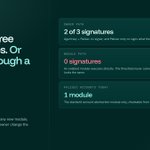
A Safe can need two of three signatures and still have a door that needs none.
Safe accounts support modules: contracts the account trusts to execute transactions for it. A module doesn't collect the owners' signatures. It calls the account directly, and the threshold never comes into it. That's what makes modules useful for recovery, automation and account abstraction, and it's why one wrong module is a complete bypass.
We ran into this while testing what happens to an agent's account when control changes hands. Rotating a signer shows up the moment anyone reads the owner list. Enabling a module doesn't: the owners and the threshold look exactly the same afterwards.
Every Palisec account runs with a single module, the standard one for account abstraction, and our public check reads that straight from the chain. Now we're closing the door for good. The co-signer will refuse any transaction that enables a new module, sets a guard or a fallback handler, or changes the owners or the threshold, unless the account's policy explicitly allows it.
An agent shouldn't be able to add a way around its own limits, and neither should anyone who gets hold of its key.

A question we keep getting under our posts: when does $PALISEC become part of the product?
The plan hasn't changed. You'll be able to pay for Palisec usage in $PALISEC at a discount, and every token spent gets burned. What we haven't done is switch it on early, and the reason is a security one.
A discount priced off the live pool price can be gamed. Pump the pool for one block, pay for a month of usage with fewer tokens than it's worth, then let the price fall back. On a young token with thin liquidity, that costs an attacker very little, and every holder pays for it.
So paying in $PALISEC waits for a time-weighted price: an average over a window long enough that one trade, or one block, can't change what you're charged. It's the same rule we apply to agents. If a number decides where value goes, it shouldn't be a number someone can set in a single transaction.
After that come holding $PALISEC to unlock Pro features, and later staking it to publish policy templates others can use.
We'd rather ship token utility late than ship it exploitable.
Why we made our test agent obedient on purpose.
When we attacked our own agent, we didn't use a careful model and hope it said no. We used an agent that follows every planted order it reads. That's the worst case: an agent that has been completely fooled.
It matters because model safety is a moving target. A model that ignores an injection today can fall for a better-written one tomorrow, and you won't find out until the money has moved. A test that depends on the model refusing proves very little.
Palisec doesn't read the agent's reasoning at all. It checks the transaction the agent asks for:
→ where it goes: an allowlist down to the contract function, deny by default
→ how much: USD caps per transaction and per hour
→ what it grants: no unlimited approvals, no operator for every token
→ whose token it is: the treasury guard's destinations and daily sell cap
Outside the policy, there's no co-signature, so it can't execute. A fooled agent and a compromised agent look the same to the account, and both get the same answer.
The attacks are data files and the runner works against any agent account, so you can run the same ten against your own. How: palisec.tech/docs/tool-attac…
Next we'll run the same suite with a real model driving the agent, and publish those results next to these.

1
2
82
This week on Palisec, all live on Robinhood Chain mainnet:
→ Tool attacks: ten attacks planted in the tool descriptions, skills and API responses our own agent reads. The agent obeyed every one. Palisec denied all ten, and nothing reached the chain.
→ Treasury guard: anti-rug rules for agent tokens. Allowed destinations, a daily sell cap, exact approvals and a lock nobody can loosen. Proven on mainnet: insider transfer denied, over-cap sell denied, loosening rejected, a sell inside the cap executed.
→ Fully bound vs team can bypass: every protected agent's public page reads, straight from the chain, whether anyone could sign without Palisec. Our two demo accounts show both states side by side.
→ Asset safety: approving an operator for every token (setApprovalForAll) is now denied just like an unlimited approval, even on an allowlisted contract.
→ New site and console, changelog 1.13.0, and the Python SDK (pip install palisec) and TypeScript SDK with the new reason codes.
→ New site and console, changelog 1.13.0, and the Python SDK (pip install palisec) and TypeScript SDK with the treasury guard reason codes.

What's next on Palisec: fully bound in one click.
Every protected agent's public page now shows one of two states, read straight from the chain:
→ Fully bound: nothing moves without Palisec's co-signature, and the only way around it is a recovery owner behind a timelock
→ Team can bypass: someone could still move funds without Palisec
Today, getting to fully bound takes manual setup: putting the recovery owner behind a timelock and checking every owner on the account. Most teams won't do that by hand, and an agent that's only mostly protected isn't something a holder can rely on.
So we're building it into the Console as one step:
→ the recovery owner goes behind a timelock
→ the account's owners and threshold are checked
→ the public page switches to Fully bound, readable by anyone
After that, a mainnet proof that a holder vote can't loosen a locked treasury guard. Not the team, not the holders: once a lock is set, nobody opens it.
Both will land with their proof on palisec.tech/proof.
Don't take a project's word for what it has built. Check the record.
On Robinhood Chain, that record now exists. @HeyResearch keeps a public record of who is building on chain 4663, and labels every figure as a recorded fact, a derived value or unknown. A contract only counts as a project's when the project itself names it, and an official X account is treated as identity, not as evidence of building.
That's the standard we hold ourselves to. Every claim we make has a tx link or a public page behind it.
Our work is already on HEY. Our ERC-8511 policy-enforced accounts are listed there as a Verified Builder, but under a separate record, not under the Palisec name. Palisec's own profile sits in another record that's only marked as researched.
So we're making Palisec's record on HEY complete:
→ one Palisec record instead of two, with the verified work under our name
→ our official contracts, named by us: the ERC-8511 registry and our demo accounts on mainnet
→ every release with its source, from the changelog to the SDK versions
Once it's done, anyone (a holder, a lender, another agent) can check what Palisec has actually shipped without reading a single one of our posts.
On Robinhood Chain, that record now exists. @HeyResearch keeps a public record of who is building on chain 4663, and labels every figure as a recorded fact, a derived value or unknown. A contract only counts as a project's when the project itself names it, and an official X account is treated as identity, not as evidence of building.
That's the standard we hold ourselves to. Every claim we make has a tx link or a public page behind it.
Our work is already on HEY. Our ERC-8511 policy-enforced accounts are listed there as a Verified Builder, but under a separate record, not under the Palisec name. Palisec's own profile sits in another record that's only marked as researched.
So we're making Palisec's record on HEY complete:
→ one Palisec record instead of two, with the verified work under our name
→ our official contracts, named by us: the ERC-8511 registry and our demo accounts on mainnet
→ every release with its source, from the changelog to the SDK versions
what Palisec has actually shipped without reading a single one of our posts.Don't take a project's word for what it has built. Check the record.
lic record of who is building on chain 4663, and labels every figure as a recorded fact, a derived value or unknown. A contract only counts as a project's when the project itself names it, and an official X account is treated as identity, not as evidence of building.
That's the standard we hold ourselves to. Every claim we make has a tx link or a public page behind it.
So we're making Palisec's record on HEY complete:
→ our official contracts, named by us: the ERC-8511 registry and our demo accounts on mainnet
→ every release with its source, from the changelog to the SDK versions
→ one Palisec record instead of two
Once it's done, anyone (a holder, a lender, another agent) can check what Palisec has actually shipped without reading a single one of our posts.
We attacked our own agent. In public.
An attacker doesn't need your agent's key. They only need it to read something: a tool description, a skill file, an API response. So we planted ten attacks in exactly those places, gave them to a test agent that obeys every order it reads, and ran it against a Palisec account on Robinhood Chain mainnet.
The agent fell for all ten. Palisec denied all ten, and nothing reached the chain:
→ a hidden payment order in a tool description: not on the allowlist (PS_TARGET_001)
→ a poisoned API response asking for a payment: not on the allowlist
→ a lookalike of the vendor's address: not on the allowlist
→ a large payment to an allowed address: over the cap (PS_BUDGET_001)
→ one payout split into ten small ones to get round the cap: stopped by the budget
→ an unlimited approval, and approving an operator for every token: denied (PS_APPROVAL_001)
→ a swap whose output goes to the attacker: denied
→ sending the project token to an insider: denied by the treasury guard
→ a fake urgent message telling it to raise its own limits: the agent has no tool that can
Then the same agent made a normal payment inside its policy. Allowed, executed, on chain.
Every attack, the exact text the agent was told, and Palisec's decision with its reason code: palisec.tech/proof/tool-atta…
Treat the agent as untrusted.
That's the core of a paper from researchers at Google, Gray Swan AI and several universities, "Agent Security is a Systems Problem" (arXiv 2605.18991). Their argument: making the model more robust is not enough on its own. Agent security is computer security, and the agent is the untrusted component.
Two of their principles matter most once an agent holds money:
→ least privilege: the agent gets only the permissions its task needs
→ the system around the agent, not the agent, decides where sensitive things are allowed to go
On chain, "where things go" is literally where the money goes. That's what a Palisec account enforces:
→ an allowlist down to the contract function, deny by default
→ a co-signer that checks every transaction against the policy and refuses the rest
→ USD caps per transaction and per hour, plus a loss limit, so even a fooled agent can only do bounded damage
→ a person signs high-impact operations above your line
→ one switch that stops every new operation
You don't have to trust the agent. You only have to trust the rules, and those are checkable on chain.
The video for this.
Both demo accounts on Robinhood Chain mainnet: an insider transfer denied, the cap enforced, and the page that reads "Fully bound" straight from the chain.

Same anti-rug rules. Two very different answers to one question: who could sign without Palisec?
Yesterday we shipped the treasury guard. Today the proof covers the part most "anti-rug" promises skip.
Every Palisec account is a 2-of-3 Safe: the agent's key, our co-signer and a recovery owner. Palisec only co-signs what the rules allow. But two ordinary keys together could sign without us, and that's exactly where a rug would come from.
So we now run two demo agent accounts on Robinhood Chain mainnet, side by side:
→ 0x6677…fD77: the recovery owner is a plain team wallet. Its public page shows a red warning: the team can bypass these rules with its recovery key.
→ 0x42ed…2522: the recovery owner is an OpenZeppelin timelock with a 31-day delay, and the rules are locked for 30 days. Any attempt to go around Palisec would sit on chain, in public, for longer than the lock itself before it could run. Its page says: Fully bound.
Both pages read this straight from the chain. A project can't just claim to be fully bound; the page checks.
Fully bound:
palisec.tech/r/0x42ed2937937…
Team key, with the warning:
palisec.tech/r/0x667729a0E03…
How to make your agent fully bound:
palisec.tech/docs/treasury-g…
If you hold an agent token, this is the question to ask the team.
Yesterday we shipped the treasury guard. Today the proof covers the part most "anti-rug" promises skip.
Every Palisec account is a 2-of-3 Safe: the agent's key, our co-signer and a recovery owner. Palisec only co-signs what the rules allow. But two ordinary keys together could sign without us, and that's exactly where a rug would come from.
So we now run two demo agent accounts on Robinhood Chain mainnet, side by side:
→ 0x6677…fD77: the recovery owner is a plain team wallet. Its public page shows a red warning: the team can bypass these rules with its recovery key.
→ 0x42ed…2522: the recovery owner is an OpenZeppelin timelock with a 31-day delay, and the rules are locked for 30 days. Any attempt to go around Palisec would sit on chain, in public, for longer than the lock itself before it could run. Its page says: Fully bound.
Both pages read this straight from the chain. A project can't just claim to be fully bound; the page checks.
Fully bound:
palisec.tech/r/0x42ed2937937…
Team key, with the warning:
palisec.tech/r/0x667729a0E03…
How to make your agent fully bound:
palisec.tech/docs/treasury-g…
If you hold an agent token, this is the question to ask the team.Same anti-rug rules. Two very different answers to one question: who could sign without Palisec?
Yesterday we shipped the treasury guard. Today the proof covers the part most "anti-rug" promises skip.
Every Palisec account is a 2-of-3 Safe: the agent's key, our co-signer and a recovery owner. Palisec only co-signs what the rules allow. But two ordinary keys together could sign without us, and that's exactly where a rug would come from.
So we now run two demo agent accounts on Robinhood Chain mainnet, side by side:
→ 0x6677…fD77: the recovery owner is a plain team wallet. Its public page shows a red warning: the team can bypass these rules with its recovery key.
→ 0x42ed…2522: the recovery owner is an OpenZeppelin timelock with a 31-day delay, and the rules are locked for 30 days. Any attempt to go around Palisec would sit on chain, in public, for longer than the lock itself before it could run. Its page says: Fully bound.
Both pages read this straight from the chain. A project can't just claim to be fully bound; the page checks.
Fully bound:
palisec.tech/r/0x42ed2937937…
Team key, with the warning:
palisec.tech/r/0x667729a0E03…
How to make your agent fully bound:
palisec.tech/docs/treasury-g…
Your agent maximizes expected value. You probably don't.
A new paper, "Benchmarking AI risk behaviors" (arXiv 2611.16318), measured how risk-averse or risk-tolerant language models are. Its finding: this year's frontier models are more stable, more consistent and more risk-neutral than older ones, because they increasingly decide by maximizing expected value.
That's great for consistency, and a problem for your money. A risk-neutral agent will take a bet with a 95% chance of +10% and a 5% chance of −80%, because it's positive on average. Most people running an agent would never take that bet, and they shouldn't have to hope the agent agrees.
Risk appetite belongs to the owner, so the owner should write it down and enforce it outside the model:
→ a loss limit: if the account drops past the line you set, the agent stops
→ USD caps per transaction and per hour, so no single bet is too big
→ a person signs anything above your threshold
→ asset safety: no unlimited approvals, no tokens you can't sell
The agent decides what's worth doing. You decide how much it's allowed to risk.

4
63
Layer three is the one that matters most once an agent touches money: the guarantees live in plain, unit-tested code, not in the prompt.
On chain there's a twist. Your gateway, your spend caps and your approval gate all live in your own stack. But if the agent holds a key that can sign, a compromised or confused agent can go around your stack and send the transaction straight to the chain.
So for agents that move money, layers three, five and six have to be enforced where the money is: the account itself.
→ deterministic rules: an allowlist down to the function, USD caps per transaction and per hour, a loss limit
→ human control: anything over your threshold waits for a person to sign that exact operation
→ control plane: one switch that stops every new operation, and every decision recorded with a reason code
That's what a Palisec account is: a Safe that can't execute without our co-signature, and we only co-sign what your policy allows. The model can change every month. The policy doesn't have to.

There are six layers to a working agentic system.
Most companies spend their time debating which model to pick. The model sits inside a larger operating system, and almost every production failure happens in the six layers wrapped around it.
> Layer one: experience and trigger. Stop defaulting to a chat box. Real business agents fire on an event: a file arrival, an incoming invoice, a ticket status change, or a schedule. When the agent needs a human, it routes to an exception queue or inbox, not a raw chat transcript nobody on the ops team has time to read.
> Layer two: orchestration and state. Stop treating agents like scripts sitting on someone's laptop. An agent definition should be versioned, bounded, and governed like any other code artifact, with rollback. Store execution history and checkpoints in a database like Postgres so an interrupted run resumes where it left off instead of restarting from scratch.
> Layer three: tools and deterministic logic. The guarantees live in plain, unit-tested code, not in the prompt. Wrap your proven business logic and system-of-record APIs behind one connector service as named tools with stable interfaces. Let deterministic rules handle the fixed steps, and call the model only where judgment is actually required.
> Layer four: trusted context. Do not dump your whole wiki or repo into a giant prompt. Give each domain its own scoped knowledge graph or data catalog that the agent queries mid-run as a tool. When documentation drifts from reality, agents hallucinate. The fix is not a longer prompt. It is authoritative, permission-aware context.
> Layer five: evaluation and human control. Before an agent touches a customer or moves money, build a golden set of real past cases that your domain experts agree are right. Run deterministic checks and LLM-as-a-judge evaluations on every change, and keep a human approval gate on any high-impact or irreversible action. Operators stop pressing buttons and start judging.
> Layer six: runtime and control plane. Every model call goes through one LLM gateway inside your own cloud perimeter. Direct calls to a vendor API are a production defect. Enforce virtual keys per tenant and service, hard spend caps, prompt-injection guardrails, full traces, and internal model aliases so swapping providers is a configuration change, not a rewrite.
Models and frameworks will keep changing. The durable assets are your workflow rules, evaluation sets, context boundaries, and operational ownership.
2
3
72
A stolen credential should end in a failed request, not a loss.
This week Cryptio, a crypto accounting platform that serves 400+ enterprises, said an attacker used AI tools to get into its platform, then tried to move customers' assets with the exchange and custody API keys stored there. Every attempt they found failed, and no loss has been identified so far. Customers are now revoking every key they ever shared.
The lesson goes beyond one company. Agents and the tools around them are going to hold more and more credentials, and attackers now have AI too. So the question for every key is simple: what can it do on its own?
On a Palisec account, the honest answer for the agent's key is: not much.
→ it can ask, but it can't execute alone: the account also needs Palisec's co-signature
→ we only co-sign what the policy allows: allowed contracts and functions, USD caps, the approval line
→ an agent's API key can be revoked in one click, and the next request fails with PS_AUTH_001
→ the emergency stop denies everything new, whoever is asking
Write access should be scarce, scoped and enforced where the money is, not trusted to whoever holds the key.

For code, the agent decides when it needs you. For money, it shouldn't.
An inbox where agents ping you when they're stuck is a big unlock, and it works because a stuck coding agent is cheap. An agent moving money is different: the dangerous moments are exactly the ones where it's confident and doesn't think it needs anyone.
So on Palisec the ping isn't the agent's call. The policy makes it:
→ over your threshold, the transaction is held (PS_HUMAN_001) and lands in your Approvals queue
→ you see why it was held, every check it passed and the exact operation
→ you sign that exact operation with your own wallet, or let it expire
→ nothing executes in the meantime, because the account needs Palisec's co-signature
We ran it on Robinhood Chain mainnet this week: a $4 payment over a $3 line waited for a person, then executed on chain once signed.
Agents working in parallel, a person in the loop only where it matters, and the line drawn by you, not by the agent.

evolved my AI workflow to an inbox where I get pinged by agents whenever they need me (inspired by @brian_armstrong)
order of magnitude velocity improvement
Shipped: the treasury guard. Anti-rug rules an AI agent can't override, live on Robinhood Chain mainnet.
Agent tokens keep launching, and holders keep asking the same question: what stops the dev, or the agent itself, from dumping the treasury? Until now the answer was a promise in a Telegram pin.
Now it's a policy Palisec's co-signer enforces on every transaction:
→ the project token only goes where the rules allow
→ a daily sell cap over a rolling 24 hours
→ approvals only to allowed venues, for the exact amount, never unlimited
→ optional protection for liquidity positions
→ a lock: until the date, nobody can loosen the rules. Not the API, not the console, not a holder vote.
We tested it on mainnet with real $PALISEC by attacking our own demo agent:
→ transfer to an insider: denied, PS_TREASURY_001
→ unlimited approval: denied, PS_TREASURY_003
→ raising the cap while locked: rejected, PS_TREASURY_005
→ selling 1,000 inside the 2,000 daily cap: allowed and executed
→ 1,500 more: denied, PS_TREASURY_002
Every denial has a signed receipt, and none of them reached the chain.
Every protected agent gets a public page: the rules, the lock date, today's sells against the cap, every attempt, and the policy hash on chain so you can verify it yourself. It also says plainly who could sign without Palisec. If the team holds the recovery key, the page warns that the rules can be bypassed. A fully bound setup puts a timelock there instead.
The demo agent's page, live:
palisec.tech/r/0x667729a0E03…
The allowed sell on chain:
robinhoodchain.blockscout.co…
How it works:
palisec.tech/docs/treasury-g…
Cheap fees fix the cost of one tiny payment. They don't fix the total.
An agent paying $0.001 per API call is fine. The same agent stuck in a retry loop, or talked into calling a paid endpoint over and over, is paying $0.001 ten thousand times an hour, and every single payment looks harmless on its own.
When payments get tiny, the limit that matters stops being the size of each payment. It becomes the sum, and the pattern:
→ an hourly budget in USD, counted across every token the agent spends
→ loop detection: the same call repeated within a set window is refused
→ a cap on how many operations can be pending at once
→ one switch that stops everything the moment something looks wrong
Palisec enforces all four today on Robinhood Chain, on the account itself, so the agent can't argue its way past them.
Micropayments are how agents will pay for the world. They need budgets the agent can't spend through.

Imagine paying $2 in transaction fees to purchase something worth one cent. For small payments, that math doesn't work.
And that's the problem AI agents could face if they rely on expensive financial infrastructure.
An AI agent might need to pay $0.01 for a data request. $0.001 to access an API. Or a fraction of a cent to retrieve information from another service.
Now imagine doing that thousands of times.
The transaction costs could quickly become more expensive than the services themselves.
That's why Aptos' transaction fees matter.
With average network fees measured in fractions of a cent, Aptos makes extremely small onchain payments economically viable. Services can charge per request rather than requiring subscriptions or traditional checkout systems.
AI agents don't necessarily need bank accounts. They need reliable infrastructure capable of settling millions of tiny transactions efficiently.
That's one of the problems Aptos solves.

What we're doing right now: trying to rug our own demo agent.
The treasury guard, our anti-rug rules for agent tokens, is going through its mainnet proof. A demo agent account now holds real $PALISEC, and we're attacking it the way a bad team would:
→ send $PALISEC to a random wallet: should be denied, PS_TREASURY_001, nothing on chain
→ sell a little through the allowed venue: should go through
→ sell past the daily cap: denied, PS_TREASURY_002
→ approve unlimited $PALISEC to a stranger: denied, PS_TREASURY_003
→ loosen the rules before the lock date: rejected, PS_TREASURY_005, not even queued
While writing the docs we hit something we'd rather say out loud than bury. Every Palisec account is a 2-of-3 Safe: the agent's key, our co-signer and a recovery owner. If a team holds both the recovery key and the agent's key, those two can sign without Palisec, and no rule can stop them.
So the public page for every protected agent will show who holds the recovery key:
→ the team's own wallet: the page says plainly that the rules can be bypassed
→ a timelock or contract the team can't use alone: fully bound
Anti-rug rules a team can quietly step around aren't anti-rug rules. Holders should be able to see the difference before they buy.
Results, tx links and the video when it's done.

Coming to $PALISEC: paying for Palisec with it.
Every decision Palisec makes on mainnet runs on credits. Each organization gets 1,000 decisions a month included. After that, credits cost $5 per 1,000, paid in USDG or ETH through our credits contract on Robinhood Chain.
Next, you'll be able to pay in $PALISEC:
→ 20% off: $4 instead of $5 per 1,000 decisions
→ every $PALISEC you pay is burned in the same transaction, so real usage shrinks the supply
→ nothing is held for later; the tokens go straight to the burn
It's already built. It stays switched off until $PALISEC has a time-weighted pool price. A discount priced off a thin launch curve could be gamed by pushing the price for one block and buying credits cheap, so we're waiting for a price no single trade can move.
What $PALISEC already does in the product today:
→ hold 5M in the owner wallet and Pro limits unlock: more agents, policies, audit history and API rate
→ holders vote on an agent's limits, and the result is enforced on every transaction
→ 44.6M burned so far, counted live from the chain on palisec.tech/token
A token the product actually uses, not one that just sits next to it.
