

Strange tales from Ancient Rome. 'These things never happened, but always are.' Sallust
Londinium
Joined November 2023
- Tweets2.4K
- Following1.1K
- Followers1.1K
- Likes10.7K


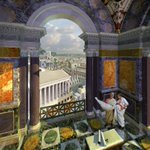




Affordable luxury.
To the casual observer it looks like a tapestry - but the design is actually printed onto the cloth.
Detail from a 17th-century wall hanging. Seen at Boston Manor, West London.


Pretty much every offensive war Rome ever waged was ‘in defence of our allies’, including, least convincingly, the conquest of Britain.

Important point this. Makes you wonder about Augustus’s famous zinger ‘I found Rome a city of brick and left it a city of marble’. Did it ring slightly hollow? The marble was literally a facade.

Si monumentum requiris, circumspice.

Few men better embodied the ambition of Victorian England than Isambard Kingdom Brunel.
This remarkable photograph was taken in 1857 during preparations to launch the SS Great Eastern, then the largest ship ever built.
Brunel stands among his colleagues at Millwall in London, overseeing one of the most ambitious engineering projects of the age.
A remarkable photograph of the man who helped build the modern world.
Follow @OaksAndLions for more fascinating photos from England’s past.

Counterpoint: in a city of a million people that’s crawling with disease, it’s a good idea not to have regular famines as well.

Rome handed out free grain to 40,000 citizens in 73 BC. By 46 BC, Julius Caesar found 320,000 people lining up for their monthly ration. That eight-fold expansion happened in under three decades, and it shows you how welfare states actually grow.
No Roman senator stood up and announced a plan to addict a third of the city to government bread. It happened incrementally, through political competition. Each magistrate who wanted votes expanded eligibility. Each expansion normalized the next one. The citizen who once considered the dole shameful eventually expected it, then demanded it, then organized politically to protect it.
This is the core mechanism free market thinkers have identified across every era: once you create a transfer program, you create a constituency for that program. Recipients vote. Administrators build careers. Grain merchants who supply the state develop a stake in keeping the contracts flowing. The political economy locks in.
Caesar, to his credit, actually cut the rolls back to 150,000 through verification audits. It was one of his more economically coherent moves, though the Senate still murdered him. His successors quietly let the numbers climb again.
What did the dole require? Massive grain imports from Sicily, Sardinia, and Egypt, organized through state logistics at state expense, funded by taxation and conquest. When the conquest revenue dried up, the obligation remained. Rome had written a check against future military success, and future military success eventually failed to arrive.
The lesson is not complicated. Distribute a benefit and you distribute dependency. Distribute dependency and you distribute political power to whoever controls the distribution. The grain dole didn't weaken Rome overnight, but it made every subsequent reform politically impossible.

Second this. With Pliny you feel that you are in the presence of a very distinct personality. Eccentric, cantankerous, insatiably curious. This comes through even in translation.

People underestimate the extent to which Augustus’s morality laws were regime ‘messaging’. He’d overthrown the constitution and Rome’s traditional governing class - the main targets of these laws. The legislation helped explain why an Augustus was necessary.

We think the collapse in birth rates is a modern problem. It is not. The most powerful man in the world once faced the exact same thing, and he was so alarmed he passed laws to force his people to have children.
This was not a modern government: it was Rome 2000 years ago...
The emperor was Augustus, and by his reign the Roman elite had grown wealthy, comfortable, and reluctant to marry or raise families. Men preferred bachelorhood and affairs to the burden of a wife and children.
Augustus found it alarming enough to legislate. Around 18 BC and again in AD 9, he pushed through the Lex Julia and the Lex Papia Poppaea, a sweeping set of laws designed to engineer a baby boom by decree.
The measures were direct: unmarried men and childless couples faced penalties on what they could inherit. Those who married and had children were rewarded with faster careers and public honors. Women who bore three or more children were granted a special legal freedom, the ius trium liberorum, the "right of three children," releasing them from male guardianship.
The state was, quite literally, paying its citizens to reproduce and fining them when they did not.
It didn't work...
The laws were resented, evaded, and endlessly tinkered with, and Rome's elite went on having small families anyway. The historian Cassius Dio records Augustus standing before the childless men of Rome and shaming them to their faces: "You are committing murder in not begetting in the first place those who ought to be your descendants." A city, he warned them, is not its buildings but its people: "For it is human beings that constitute a city, not houses or porticos or market-places empty of men."
Now look at the numbers today. For a population simply to hold steady, women need to average about 2.1 children each. South Korea recently hit 0.72, the lowest rate ever recorded for any country on earth, and even after a small rebound to 0.8 in 2025, it remains less than half of what a country needs to sustain itself. Italy and Japan sit near 1.2, China around 1.0, Spain near 1.1. The United States is about 1.6, the United Kingdom 1.5. According to the UN, more than half the world's countries are now below that line.
History doesn't repeat itself, the saying goes, but it often rhymes, and this pattern is old and eerily familiar. A society climbs to the height of its wealth and comfort, and at that very peak its people stop having children, and no law, no incentive, no sum of money seems able to talk them back into it.
Rome tried, with the full power of an empire behind it, and failed. At its height the city held more than a million people, a size no European city would reach again for 1700 years, until London in the 1800s.
The Roman historian Livy, writing as the Republic gave way to the empire, said his was an age that "can endure neither its vices nor their cure." Two thousand years later, staring at the same problem and just as unable to solve it, we may be watching the beginning of the same story...
A civilization does not always fall to an enemy at the gates. As the historian Arnold J. Toynbee once said: “Civilizations die from suicide, not by murder.”

When Roman writers talk about superstitio they mean 'religious practices I disapprove of'. Superstitio could cover everything from foreign cults to magic to improper use of ritual for selfish ends. It's not a synonym for 'belief in Rome's gods'.

Anyone with a remedial knowledge of Roman culture is aware that none of the literate Romans held superstitious beliefs about the gods.
Cicero does not even present notion of “true belief”, which the cargo-cultists in the DR advocate for, in his “On the Nature of the Gods”. Instead he analyzes Stoicism, Epicureanism, and Skepticism, all philosophical interpretations which presuppose deism and/or “atheism”. Plato himself is fundamentally an atheist who believes gods can and should be censored and destroyed at his own discretion.
Notice how Keith doesn’t actually even dispute the claim in Myth to Power here, he just smugly implies it is wrong. Keith doesn’t actually believe in the gods himself, he’s literally just baiting idiots.


A golden Victory / Nike watching over the home of a wealthy Ephesian. Apt symbol for one of the Empire’s winners.

Antony only looks like a bad bet for Cleo in hindsight. He controlled the richest provinces, most of the tax base, the most experienced generals, majority of elite opinion. V unlucky that their opponent, a sickly 22 year old, turned out to be a political and strategic genius.

A goddess in suburbia
18th-century statue of Flora goddess of flowers, springtime and unofficially, Rome’s prostitutes - who did good business at her festival.
Seen in West London

They could have called it the ‘Apollo Program’. And when they got there they could have said ‘The Eagle has landed’.

Did you know that the Emperor Nero sent Roman soldiers on an expedition to investigate the source of the Nile?
They travelled up the Nile until they reached ‘huge marshes, the limit of which even the natives did not know, and no one else could hope to know; so completely was the river entangled with vegetative growth, so impassable the waters by foot, or even by boat, since the muddy overgrown marsh would bear only a small boat containing one person.’

