

Partner, Mayfield (@MayfieldFund); Previous CEO @ Gigya (Acquired by SAP); Father of 3 girls.
Joined May 2007
- Tweets540
- Following817
- Followers1.4K
- Likes146





Founders building app startups are constantly thinking what startups OpenAI and Anthropic are going to eat next. For clues, it's helpful to look at the data they are buying.
Mercor helps AI labs procure data from experts for training frontier AI models. By reviewing the ~400 job listing, you can see where they are headed.
Here is what type of data AI labs are buying (share %, can by multi-label):
- Finance & Investing (FP&A, IB, credit, audit): 65%
- Legal & Compliance: 46%
- Design / creative / video: 44%
- Healthcare & Clinical: 25%
- Science & Engineering benchmarks: 23%
- Enterprise Ops: 11%
- Physical trades & manufacturing: 8%
- Coding & SWE training: 6%
Why these areas?
* Massive labor spend (e.g., financial services, healthcare)
* AI App startup success (e.g., legal w/ Harvey & Legora)
* Frontier R&D (e.g., hard science & physical world)
What does this mean for startups?
Labs are moving up the app stack, trying to run the successful Claude Code playbook. Next up? Looks like finance, legal, and healthcare.
Will this work?
Maybe. Anthropic and OpenAI will be successful to a certain extent, but it might not be as easy as coding, and even in coding companies like Cursor carved out an incredible market position.
Where workflows are complex and distribution is sales led, startups can and should continue to pursue these application areas despite AI labs ambitions.

The new Series A is the old Series B. Over the last decade, we added a stage called “pre-seed” and shifted every name down one rung. I tested this hypothesis by looking at the valuation data by round type, comparing 2015 to 2025.

I wrote a survival guide for how SaaS CEOs should respond to the disruption brought about by AI. Six months later, I wanted to see how that advice held up.

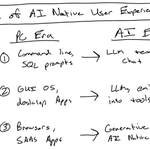
The UX of AI apps are seriously broken IMO. My guess is we'll look back years from now and it will look very different.

The open text box reflects AI’s technical origins: LLMs, developer tools, and engineers accustomed to expressing intent through text. It asks users to adapt to the model rather than designing the experience around the work they are trying to accomplish.
Perhaps the next AI UX will likely be contextual, multimodal, generative, and collaborative: systems that understand the work in front of us, generate the right interface for the task, produce editable artifacts rather than streams of chat bubbles, and make agent actions visible, permissioned, and reversible.
This might sound heretical, but in some ways, the next generation of AI products may look less like today’s chat interfaces and more like SaaS: structured, contextual, and purpose-built but dynamically generated around the task at hand.

Wondering how defensible your startup is from Claude?
For fun, I built an app for founders asking this question.
Check out the Startup AI Defensibility Report Card: workapp.ai/p/bfe6d50f-01b7-4…


Claude Code means code is becoming commoditized. Claude Cowork means agentic work is becoming a platform feature.
The question I've been thinking about is if both of those trends accelerate, what is defensible for AI agent companies?
--
My current “Top 10” for AI Agent defensibility:
1. Own a complex system of action.
Build multi-user queues, handoffs, escalation paths, and approvals. If removing the LLM still leaves you with a valuable workflow product, you are closer to defensible.
2. Human-in-the-loop mandate.
High-stakes decisions where errors have legal, financial, or safety consequences require human judgment and accountability.
3. Build proprietary workflow logic.
Focus on domain-specific policies, exception taxonomies, deterministic checks, and regression tests for agent behavior. As coding gets cheap, maintaining correctness under change is the hard part.
4. Accumulate a context graph.
Capture the graph of decisions made, exceptions resolved, and outcomes achieved. General agent platforms can read your data, but they cannot replicate your history of action and resolution.
5. Pursue a regulatory moat.
Agents can’t get licensed, certified, or audited. Compliance requires human accountability chains.
6. Achieve a proprietary data flywheel.
Not static data—but live, continuously generated data from operations that compounds in value.
7. Physical world or marketplace integration.
Physical infrastructure and marketplaces create moats that are capital-intensive to replicate.
8. Earn trust through distribution.
A defensible go-to-market likely requires a considered purchase and domain expertise selling into a particular buyer or vertical.
9. Security posture.
Autonomous agents create a new security boundary. You need sandboxing, scoped credentials, and audit trails to survive enterprise scrutiny.
10. Sell outcomes, not software.
Offer throughput guarantees, accuracy SLAs, and reduced operational risk.



I had the opportunity to meet Steve Kerr - 9 time NBA Champion. I asked about the secret of championship teams. His answer surprised me: Joy.
Joy in celebrating the team's success-essential to chemistry and winning.
Joy that fuels energy, resolve, and resilience over the ups and downs of a long season.
Joy that keeps the team loose, despite immense expectations.
Joy that propels a competitive spirit, vital for growth and development
This stuck with me.

CEOs need to make sure managers are doing the right things; managers need to make sure the team is doing the things right.

$6.7T in AI data center capex is projected by 2030.
I've been thinking about the same thing that is everyone's mind - is the revenue there to justify it?
Global ad spend ($1T) and software ($0.6T) aren’t enough. The math only works when you factor in labor.
$30T of annual white collar labor spend can be unlocked as AI Agents touch every enterprise role.
As I meet with founders building AI Teammates, I can see this will happen.
The real question is how long will it take.
The reality: <10% of enterprises are actually scaling Gen AI in production (Mckinsey).
It's not if, but how long it takes.
