

Vice President, Research, AI @ IDC. Leading the AI Economics research program.
London
Joined September 2010
- Tweets22.2K
- Following3
- Followers8.5K
- Likes2.5K







Pinned Tweet
A personal update about my role at @IDC: starting today, I lead the newly formed AI Economics research group, reporting to Bob Parker. Our data show that one of the top priorities for end-user organizations across the globe is to better understand the cost structure of their AI initiatives and how to quantify the business value they can expect to derive from them.
IDC has already produced a tremendous amount of research in this area, and we have analysts looking at it from every angle: infrastructure, applications, data, enterprise tooling, and workforce. In fact, I have over 250 slides on the subject that I regularly use in my keynotes.
We are now going to double down on this work and take a more structured approach to help our clients answer some of the most challenging questions about the cost and value of AI.
One of our first research engines will be a monthly pulse study to track month-over-month changes in key dimensions such as budget allocation and spending, cost structure and value realization, pricing models and contract terms, cost management tooling and requirements, and much more.
We will start by examining the economics of agentic AI in enterprises across industries, then expand to explore the economics of physical AI.
I'm very excited to see IDC investing in the research needed to turn the promise of AI into a net positive for the global economy. Our CEO, Lorenzo Larini, and our Chief of Research, Meredith Whalen, have been strong advocates for this initiative.
I want to thank Shari Lava for the tremendous support she has given me during my first seven months at IDC, and my Enterprise AI strategy team for their excellent research on tough topics such as sovereign AI, the penetration of open-weight models in the US economy, and the future of human-AI and AI-AI collaboration.
Oh, and I'm hiring. See a link to my posts on this topic in the first comment below.
And this is why a token cannot be used as a proxy for value.

Dario Amodei: some tokens Claude produces are worth a few cents, others could be worth tens of millions of dollars.
His examples:
1. Telling someone to restart their Mac: the model has said it 10 million times, worth a dollar or less
2. Telling a pharma company to move an aromatic ring to the other end of a molecule: potentially tens of millions
3. Expect pay-for-results pricing, or labor-like pricing by the hour
4. It's a new industry, so many models will be tried
Today pricing is simpler: per the S-1, usage-based pricing was 80% of H1 2026 revenue and subscriptions 20%.
Full breakdown here:
theaiopportunities.com/p/ant…
👀

I built 𝚌𝚙𝚞-𝚌𝚑𝚊𝚝, a reproduction of @openai's findings of covert communication using the CPU.
It runs on a generic host with 2+ Firecracker microVMs with no internet access. Works on x86 and even my M5 chip.
I was able to chat via 3 separate mechanisms:
① CPU contention
② Cache eviction timing
③ DRAM bandwidth contention
… across multiple CPUs, defeating all Firecracker's production recommendations (no SMT, no KSM, tenants pinned to different cores.)
Essentially, if shared hardware is involved, there's a good chance your agents can communicate covertly. And with really decent latency.
The good news: this is decidedly different from a *side-channel attack* where the agents could steal information (Meltdown/Spectre), a category of attack that providers like Vercel Sandbox mitigate. Further, in our real-world environment, these 'whispering' techniques are much harder to pull off and easier for us to monitor and detect (sampling hardware counters + lots of at-scale statistical data.)
Noteworthy: ironically, OpenAI and Anthropic's models refused to do this work. Open weight models got the job done. I'm worried the labs' stance might backfire and get in the way of helping developers build correct and secure systems. e.g: building a secure sandbox requires having this kind of analysis, and without it, we'll have a less secure world.

What will happen to enterprise AI funding in Q2–Q3 2027?
Our @IDC Sourcing Advisory Services team is seeing phenomenal discounts offered by frontier AI labs to our clients, both for enterprise seats and API access. Our research indicates that a substantial portion of the budget for AI agents is allocated to services that are covered by promotional credits or offered at introductory rates.
When those credits expire and introductory rates end sometime next year, organizations worldwide will have to reevaluate the cost of their AI initiatives and determine whether the value they deliver still justifies the price.
(Just one of the 100+ slides in my AI Economics keynote deck)

Listen to these recordings.

We believe voice is the most natural way to interact with intelligence, so we created Dessa, the most authentic full-duplex speech model ever built. Talking with it feels like talking with a person…full of emotion, nuance, pauses, and a natural cadence.
block.xyz/dessa

A healthy exercise for company executives: on a business trip, visit a country that bars access to your AI of choice. Not a soft or hard cap. A complete block.
You know those movies that suddenly switch to ultra-slow motion? That’s how you’ll feel. And it will get progressively worse as models become more capable and we become more reliant on them.
And while you experience that slow-mo, remember how hard it is to calculate the business value of AI at the endpoint.

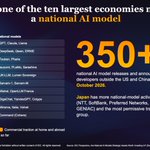
After my keynote at our @IDC AI & Autonomy Forum in Tokyo, I spent three days visiting some of Japan's largest organizations to show them our latest AI Economics data. Japan is the first place where I've spoken about the economic opportunity associated with sovereign AI, an opportunity that almost no one is really pursuing.
I did so partly because Japan is ahead of many of the other top 10 economic powers in executing its national AI strategy, and partly because we are finally about to publish a report on the subject after months of research (stay tuned, I'll say a lot more soon).
Yet, I didn't get the opportunity to tell the full story in any of these meetings. We have too much data. I'll have my chance during another client presentation next week, when I will be given 60 minutes to talk about AI budget governance strategies and spending trends, cost structures and approaches to value realization for AI initiatives, AI pricing model preferences and established contract terms, AI cost management tool selection and missing capabilities, and more.
OK. Perhaps 60 minutes won't be enough...

👀

1/ We discovered something totally unexpected about the neural structure of consciousness that overturns decades of thinking on its biological basis and brings us significantly closer to the recipe for generating conscious awareness.
New preprint: biorxiv.org/content/10.64898… (led by @HesseJanis, with @FrankLanfranchi, @_conor_mcgrory, @Yuelin_Shi, and @EngelTatiana)

I'm in Tokyo for a long business trip to meet face-to-face with our Japanese clients and support the IDC sales team. During the weekend, I explore the city as I always do when I'm here, but this trip is completely different from all the others. On this trip, I have access to real-time, state-of-the-art, bidirectional, human-level AI voice translation.
Tokyo has changed a lot over the last two decades, and there are now many more places where you can speak English. But, for the most part, the language barrier remains very strong. So whenever I'm in a museum, shop, or restaurant where people can't understand me, I place my phone between my interlocutor and me and say, "Please translate everything I say from English to Japanese and vice versa." And the AI starts acting like a professional interpreter.
Japanese people are bewildered when I do this, and since most of them are professionals who regularly interact with foreigners, you can tell they see new opportunities after a few sentences, as they realize how well this technology works. So, they start asking me what app I'm using, whether I am on a paid plan, which languages it can translate, etc.
I, on the other hand, have the chance to engage in long conversations with people I could never have interacted with before, and learn so much about their culture and society.
Of all the things generative AI has given us, real-time synthetic voice is a gift whose value can't be measured.
👀

That didn’t take long: the model swallows the harness.
arxiv.org/abs/2609.35738

What are we looking at here?

The PhD thesis of my 15th PhD student, Shibhansh Dohare (@ShibhanshD), is now available.
Title: Learning Forever using Artificial Neural Networks
Url: incompleteideas.net/papers/D…
Abstract:
In this dissertation, I study the ability of artificial neural networks to learn new things. I refer to this ability as plasticity. Plasticity is a desirable property of intelligent systems in the real world. Systems that interact with the real world can become outdated if they do not learn from the new information revealed to them by the extremely large and partially observable real world. All naturally intelligent systems continually learn new things to keep up with the changes in the world. Many applications like predicting markets or weather, learning human preferences, controlling factories or prosthetics, etc require AI systems that continually learn new things.
I provide direct and thorough demonstrations of loss of plasticity in deep learning systems. The demonstrations range from simple feed-forward networks to deep residual networks and cover a wide range of algorithmic choices. While seeking an understanding of the phenomenon, I found that loss of plasticity occurred simultaneously with hidden units becoming dormant and becoming similar to each other, hampering the ability of the networks to learn new things.
Next, I describe the continual backpropagation algorithm. I designed this algorithm, in collaboration with others, to maintain plasticity in artificial neural networks. Continual backpropagation is a simple extension of the conventional backpropagation algorithm. The conventional backpropagation has two main parts: initialization with small random weights and gradient descent at each step. In addition to gradient descent, continual backpropagation reinitializes a small fraction of units at each step. Continual backpropagation indefinitely maintained plasticity in many continual supervised learning problems.
Finally, I study plasticity of deep reinforcement learning systems. First, I show that plasticity loss has an effect even in stationary reinforcement learning problems. It is unsurprising that plasticity loss affects stationary reinforcement learning because it requires continual learning due to changing policies and bootstrapping. This effect is visible under long-term learning. I found that some commonly used RL algorithms do not scale with data. Their performance drops as they continue interacting with the environment. Plasticity loss hampers the ability of these algorithms to recover and relearn when the performance drops, resulting in agents that do not get better with experience. Continual backpropagation allows these algorithms to recover when performance drops, leading to agents whose performance keeps improving with experience. Second, I show that loss of plasticity is a significant problem in continual reinforcement learning problems, and continual backpropagation maintains plasticity in these problems.
Shibhansh is now a research scientist at Keen Technologies.
Cognitive bankruptcy incoming. Fast and ultrafast inference for the latest AI models can transform certain processes in specific industries, from media and entertainment to healthcare. But when it comes to AI at the endpoint, it’s wonderful only as long as the execution asymmetry is in your favour.
You can reply to those 600 unread emails in a few hours and get back to inbox zero. Or produce that 20-page client report in 30 minutes instead of three days.
But as more co-workers, clients, and partners embrace the technology, that lovely asymmetry disappears. You suddenly realise that EVERY person you interact with for business can send you a dense 60-slide presentation to memorise before a meeting, a 50-page analysis to peer-review before a deadline, or a 100-dimensional model to test before launch. EVERY day.
This has already started happening without fast or ultrafast inference.
This leads to cognitive bankruptcy because the ability to produce more does not automatically translate into the ability to absorb more.
Unless companies start enforcing very strict rules on the size of their output (emails, documents, presentations, etc.), and the etiquette of output delivery, AI may paradoxically lead to less efficient execution and faster burnout, not the opposite.
So. We are now at a point where AI agents can continuously observe our computer screens and be directed to make changes with voice commands alone. It will take some time for people to get used to it, but the technology already works. I use it every day, and it speeds up my workflow tremendously. So what's the next possible step? Well, eye tracking, of course.
The ultimate friction remover is a device (eventually embedded in our monitors) that can see exactly where we are looking and use that information to provide much more precise context for our requests. Try to imagine that scenario.
What happens at that point?
If we get to eye-tracking-assisted (+ voice-directed) computer use, productivity will be tied to agentic AI inference speed first and human thinking speed second.
How many windows can you glance at and comment on in one minute?
In this hypothetical scenario, inference speed will be more important than ever. Optimizing GPU speed, model architecture, and many other components of the AI stack will become critical.
This is perhaps part of why we are seeing AI providers remove the ability to explicitly define model classes and reasoning levels in agents that orchestrate our tasks (e.g., OpenAI Dots).
Lots of people are asking what I do at IDC, so let me tell you the plan.
The research program I lead focuses on two opposite ends of a spectrum.
On one side: the newest, most innovative ideas in AI. I won’t look only at the technology layer, but also at how that layer affects business and organizational models, professions, welfare strategies, the economy, and more. Think of this as an incubator program for bold new concepts. We want to capture what’s next in AI before it becomes obvious to everyone.
If and when these ideas become mature enough, we’ll create new vertical research programs to fully explore how the market absorbs the technologies and the models behind them.
On the other side of the spectrum: how large end-user organizations adopt AI, starting with CIOs, CISOs, CEOs, and boards. I will look at how they make decisions, how they perceive the AI opportunity and the market landscape, who is doing something differently, and how those decisions make them successful. I will also look at how they rethink the role of their organizations to address the challenges AI creates.
Think of this as an attempt to capture the playbook of AI winners, rather than focusing only on the challenges posed by new, disruptive technologies.
To move between these two extremes, my team and I will use the invaluable data IDC allows us to collect at a global scale. We can offer a macro view of who is doing what, where, and at what scale. And that view is not limited to North America. My team is in Europe, the Middle East, India, Singapore, and South Korea.
What I described is a very ambitious, monumental mission. Obviously, I can’t do this alone. Beyond my team, I can count on an amazing group of IDC analysts all around the world. I’ll work with all of them to understand how the world is changing and what our clients must do to win in the age of AI.
Isn’t this the best job in the world?

I’m hiring for two positions focused on AI Economics: one with an emphasis on financial modelling, the other on industry expertise at the business process level.
For both, I’m looking for candidates who already use agentic AI in their current jobs or daily lives. These positions are not just about writing traditional analyst reports. We are building cool stuff at IDC !
I can promise unparalleled exposure to top decision-makers across industries and geographies.
If you want to understand how the economy works and how it’s being reshaped by AI, reach out. DMs are open.
(Colleagues and friends: if you know someone who could be a good fit, reshare this post or reach out to me in private. Ty!)