

Happy Life Maximalist - Money | Art | Tech
Corsica
Joined April 2021
- Tweets19.2K
- Following1.1K
- Followers1.7K
- Likes12.3K







Pinned Tweet
Autumn 2026 Global Markets Outlook - The Hurdle
Stocks at Records. Oil Above $100. The 10 Year Above 5%.
Something Has to Give...
Three months ago, in my Summer 2026 Outlook, markets had traded a fragile ceasefire as peace. Brent sat in the low 70s, gold had been punished, the S&P 500 was near 7,500, and a Federal Reserve free to threaten tightening had made discipline the word of the season.
I gave fragile peace a 55 percent probability and renewed conflict 25 percent.
The second scenario printed.
----------------------
Hormuz never normalized.
Brent returned above 100.
The Fed delivered its first hike since 2023.
The 10 year Treasury closed September 23 at 5.11 percent and the 30 year at 5.40.
Yet the Nasdaq made record highs this week, Bitcoin is roughly 41 percent above its July 1 close, and rising earnings expectations have compressed the S&P forward multiple even with the index near its highs.
▫️ Brent round tripped from roughly 72 to above 100.
▫️ The Fed raised its target range to 3.75 to 4.00 percent, unanimously.
▫️ The 10 year Treasury moved through 5 percent.
▫️ The S&P 500 still closed September 23 at 7,706.
▫️ Bitcoin went from roughly 60,000 on July 1 to 84,382.
▫️ AI linked investment grade debt trades around 115 basis points over Treasuries against roughly 78 for the broad market.
At 5 percent, the Treasury stops being background and becomes the benchmark every story has to beat.
The word of the summer was discipline.
The word of the autumn is the hurdle.
This is the quarterly mark to market, what the summer book got right, what its second scenario exposed, and how I would position when every story has to clear the same price of capital. 👇
🟦 1. The Scorecard, Marked to Market 🟦
An outlook that will not grade itself is marketing.
Here is my summer book at the September 23 close:
▫️ Fragile peace, persistent inflation as the 55 percent base case.
❌ Wrong on the geopolitics.
Hormuz never normalized and Brent climbed back above 100.
📝 Autumn action: promote escalation from tail risk to a peer scenario.
▫️ Conflict reescalation at 25 percent.
✅ Right, and underweighted.
The scenario printed, but the portfolio treated it like a runner up.
📝 Autumn action: keep geopolitical convexity without chasing the barrel after the move.
▫️ Tactical energy with a remnant retained for a fragile ceasefire.
✅ Right.
The remnant became one of the positions designed for exactly the quarter that arrived.
📝 Autumn action: trim strength above 100, keep insurance until physical Hormuz traffic normalizes sustainably.
▫️ Long duration underweight until growth cracks.
✅ Right for a third regime.
The 10 year at 5.11 and the 30 year at 5.40 turned the summer warning into the quarter's cleanest rates call.
📝 Autumn action: maintain. Reverse only on a real growth break, not because 5 percent looks high.
▫️ Dollar cash overweight and CAD underweight.
✅ Right after a volatile path.
The dollar is back near a two month high while the Canadian dollar sits near a seven week low despite expensive oil.
📝 Autumn action: keep dollar liquidity overweight and CAD underweight while the policy differential persists.
▫️ Bitcoin and gold held strategically through the cyclical sale.
✅ Right, with Bitcoin doing most of the work.
Bitcoin rose roughly 41 percent from July 1 through September 23.
📝 Autumn action: hold the strategic allocation, resize nothing upward into the rally.
▫️ Prefer AI adapters with provable margins over enablers carrying financing risk.
❌ Too early, therefore wrong for the quarter.
Semiconductors and infrastructure rallied while the financing stress appeared first in credit spreads.
📝 Autumn action: retire the blanket adapter preference. Split AI by cash generation, financing dependence and completed task economics.
▫️ Stablecoins as the defining structural story.
✅ Right on the infrastructure, incomplete on the competitive mechanism.
Binance invested 100 million dollars in Circle rather than simply replacing the issuer with its own dollar.
📝 Autumn action: distributors can disintermediate issuers, but they can also buy the economics they need.
👉 Net grade: the summer got rates, energy convexity, scarce assets and the dollar posture right, missed the geopolitical base case and mistimed the AI equity split.
The exits worked. The probabilities need more respect.
🟦 2. Macro, Welcome to the Hurdle Regime 🟦
The summer Discipline Regime was about a central bank free to choose inflation over weak growth.
Autumn is harder because growth did not provide the escape hatch.
August headline CPI held at 3.4 percent and core CPI slowed to 2.4.
Yet July PCE inflation was 3.7 percent, core PCE 3.3, and the September FOMC median still projects 2026 PCE inflation at 3.7 percent.
August payrolls rose 162,000 and unemployment stayed at 4.1 percent.
September business surveys then pointed to the fastest US private sector expansion since 2021.
👉 The autumn problem is not classic stagflation, it is an economy strong enough to keep earnings alive and inflation sticky enough to keep the hurdle high.
🇺🇸 The United States carries the strongest earnings engine and the highest discount rate, with the Fed projecting 2.3 percent growth and 4.1 percent unemployment for 2026.
🇪🇺 Europe is tightening into an energy shock. The ECB raised its deposit rate to 2.50 percent while projecting only 0.9 percent growth for 2026.
🇯🇵 Japan raised to 1.25 percent, its highest rate in 31 years, and the yen weakened anyway.
🇰🇷 Korea still owns one of the cleanest AI export stories while importing the energy shock that comes with it.
🇨🇳 China reaches the US summit with a powerful external engine, a multi year high yuan and still weak domestic demand.
🇨🇦 Canada held at 2.25 percent while the Fed hiked, leaving the currency on the wrong side of the differential.
➡️ The Hurdle Regime is selection made macro. Growth exists, but every asset now has to prove it can compound above a risk free alternative that finally pays.
🟦 3. The Warsh Fed, Guidance Meets the Long End 🟦
The summer said Warsh was raising the price of certainty. September added an actual rate hike.
On September 16 the FOMC voted 12 to 0 to raise the target range to 3.75 to 4.00 percent.
Sixteen of eighteen participants placed the appropriate year end rate at 4.125 percent or higher.
The projections explain why.
The Fed raised its 2026 growth median to 2.3 percent, lowered unemployment to 4.1 and kept PCE inflation at 3.7.
One part of my earlier Warsh thesis needs a correction.
The balance sheet review exists, but a rapid runoff regime does not yet. The September implementation note still maintains ample reserves, rolls over Treasury principal and allows purchases of short Treasuries when needed.
👉 The Warsh Paradox remains a strategic idea rather than the operating system.
Rates are the live tightening tool, while the long end is increasingly being set by inflation, issuance and demand for Treasury risk.
September 23 made that distinction visible.
Strong activity data and a poorly received five year auction pushed the 10 year to 5.11 and the 30 year to 5.40.
📝 The reversal trigger remains a material labor break with softer inflation expectations. One bad auction is a warning about market clearing, not a reason by itself to buy duration.
🟦 4. Equities, Earnings Are Clearing the Hurdle So Far 🟦
My summer neutral on broad US equities was too cautious.
The S&P 500 closed September 23 at 7,706 and the Nasdaq printed record highs earlier this week, despite a Fed hike and a 10 year yield around 5 percent.
The interesting part is valuation. Rising earnings estimates have pulled the S&P forward multiple back toward 19 times even with the index near its highs.
👉 The index is cheaper near a record because earnings rose faster than price. The problem is that Treasuries became more competitive at the same time.
At roughly 19 times forward earnings, the illustrative earnings yield is only a little above 5 percent.
That is not a breakeven rule, but it shows how little room exists for disappointment when the 10 year offers a similar nominal number without equity risk.
▫️ Quality with pricing power stays the core.
📝 Keep $MOAT and $QUAL, with the usual warning that $QUAL carries substantial mega cap technology exposure.
▫️ AI enablers remain investable, but no longer as one basket.
Muse, the semiconductor rally and Asian chip exports show demand becoming visible outside the training narrative.
📝 Keep profitable compute and power bottlenecks, separate them from projects that require permanently abundant financing.
▫️ Defense remains structural.
📝 Maintain $EUAD and $ITA.
▫️ Energy is tactical again.
📝 Trim strength, retain convexity. Sustained physical normalization through Hormuz is the exit.
🟦 5. Rates, Commodities and the Dollar, The Treasury Becomes the Competition 🟦
The summer thesis that long duration fails during inflation led selloffs has survived the oil shock, the Fed hike and the return of Treasury supply risk.
On September 23 the 2 year Treasury closed at 4.85 percent, the 10 year at 5.11 and the 30 year at 5.40.
👉 At 5 percent the Treasury stops being the risk free rate in the background and becomes the competitor every risky asset has to beat.
▫️ Treasuries, stay short until the growth trigger arrives.
📝 Keep maturities short.
Extend when employment deterioration becomes persistent, not simply because 5 percent looks historically high.
▫️ TIPS, short maturity still wins.
📝 Keep $STIP rather than buying long real duration into an inflation sensitive curve.
▫️ Credit, get paid for supply rather than fear it blindly.
AI linked investment grade debt trades around 115 basis points over Treasuries versus roughly 78 for the broad market, while projected hyperscaler issuance reaches roughly 420 billion dollars in 2027, around 60 percent above the 2026 estimate.
The spread is better read as the market charging for concentration and extraordinary supply than as proof of default risk.
📝 Prefer short investment grade carry through $VCSH and underwrite AI credit issue by issue.
▫️ Oil is a physical market with a diplomatic option embedded in it.
Brent is back above 100 while Hormuz traffic remains dramatically below pre conflict norms.
On September 21 only two commercial vessels were visible crossing, with the caveat that ships operating without transponders can escape the count.
📝 Keep the energy remnant. Durable physical reopening is the exit trigger.
▫️ Gold stays strategic.
📝 Hold $GLD. Add on evidence of falling real yields or policy credibility stress, not simply on another geopolitical headline.
▫️ The dollar still owns the cleaner rate differential.
The dollar is near a two month high while the Canadian dollar is near a seven week low.
📝 Keep dollar liquidity overweight and $FXC underweight until the Fed Canada differential narrows materially.
🟦 6. Digital Assets and the Permission Economy, Distribution Beat Legislation 🟦
Bitcoin rose from roughly 60,000 on July 1 to 84,382 on September 23 while the Fed hiked, the 10 year crossed 5 percent and the Senate failed to advance the CLARITY Act.
That does not make Bitcoin immune to rates. It does show that the summer's cyclical sale was not a structural verdict.
▫️ CLARITY failed, but the vote matters precisely.
The Senate voted 49 to 50 against advancing the bill, leaving it short of the 60 votes required for cloture. No comprehensive market structure framework was enacted, so the existing agency led regime remains the operating reality.
▫️ Stablecoins delivered the quarter's best correction to my June thesis.
I wrote that when the distributor decides to issue, the independent issuer risks becoming a middleman it no longer needs.
Then Binance put 100 million dollars into Circle.
👉 The distributor did not replace the issuer, it bought a piece of the economics. Disintermediation remains one path, vertical integration through ownership is another.
The GENIUS framework is expected to take effect on January 18, 2027 unless final implementing rules accelerate the statutory clock. Until then, distribution partnerships matter because the market structure is moving faster than the final rulebook.
📝 Hold $BTC as strategic scarce asset exposure rather than chase the quarterly move.
📝 Watch reserve income, partner rebates, settlement volume and customer ownership. The question is no longer issuer versus distributor, it is who captures the reserve economics and customer relationship after they negotiate.
The falsifier is operating rather than price based: if payment and settlement usage stall while partnerships keep multiplying, the infrastructure thesis has outrun adoption.
🟦 7. AI, The Cost of Capital Rose While the Cost of Intelligence Fell 🟦
This is where the autumn story becomes genuinely different from the summer one.
The financing bill arrived. AI related investment grade debt trades around 115 basis points over Treasuries against about 78 for the broad market, and hyperscaler issuance is projected around 420 billion dollars next year.
But the model layer moved in the opposite direction.
Anthropic released Fable 5.1 and Mythos 5.1 on September 1 as the same underlying model with different safeguard envelopes. Fable is generally available, Mythos remains restricted to vetted access. Anthropic estimates that lower cache pricing cuts typical Fable 5.1 billed workloads by 25 percent.
Then on September 22 it launched Opus 5.5, which Anthropic says performs at roughly Fable 5.1 level on most work while costing about 40 percent less to run than Opus 5.
👉 The price of capital is rising while the price of completed intelligence is falling. That is why the AI trade can survive a 5 percent Treasury longer than a simple capex bubble analogy suggests.
The releases also sharpen the Permission Layer. Fable 5.1 and Mythos 5.1 share the underlying model, while access and safeguards change the capability envelope. June already proved that access itself can be a policy variable when export controls briefly forced Anthropic to suspend Fable 5 and Mythos 5 before those controls were lifted.
For investors, three trades now sit inside one AI label:
1️⃣ Compute and power demand can grow if cheaper intelligence creates more completed work.
2️⃣ Model economics can improve even while nominal token prices fall, because retries, cache reads and intervention rates determine cost per completed job.
3️⃣ Leveraged infrastructure can still fail if utilization and contracted cash flow arrive slower than the debt.
📝 Keep $SMH, $CEG, $GEV and $CCJ as the value chain, but size them for wider financing spreads.
📝 Treat leveraged data center finance as a different asset from profitable semiconductor or power exposure.
If inference utilization and cash generation fail to accelerate while capex and debt issuance keep rising, credit is warning before equities admit it.
🟦 8. Scenarios, Because the Hurdle Can Fall Two Ways 🟦
The summer matrix caught the second scenario and weighted it too lightly.
Here is the autumn version:
1️⃣ Restrictive boom, expensive energy, the base case (45% Probability).
Growth stays positive, employment softens without breaking, Brent lives broadly between 90 and 110, the Fed keeps another hike live and the 10 year stays near 5 percent.
📝 Dollar liquidity, short TIPS, quality, defense, selected AI infrastructure and the energy remnant.
2️⃣ Energy détente, the benign disinflation path (30% Probability).
Hormuz normalizes materially, Brent falls below 85, headline inflation rolls over and the Fed can stop tightening without recession.
📝 Cut the energy hedge, extend duration gradually and let equity breadth widen.
3️⃣ Renewed supply shock (15% Probability).
Hormuz disruption worsens or Bab el Mandeb becomes a second material constraint, Brent moves through 120 and the long end reprices inflation before growth can absorb it.
📝 Energy convexity, strategic gold and short duration are the insurance.
4️⃣ Financing or labor break (10% Probability).
Employment contracts or Treasury and credit markets demand a materially higher clearing price, forcing deleveraging and slower investment.
📝 Raise cash first.
Extend duration only when the break becomes disinflationary rather than merely disorderly.
➡️ The probabilities are mine and they are for arguing with. Peace is no longer the default and escalation is no longer a tail. The portfolio has to survive both.
🟦 9. The Master Thesis and the Posture 🟦
Every section above is one story wearing different tickers.
The decade's infrastructure is being built under two constraints.
The first is the Permission Layer: a stablecoin can be frozen, a model can expose different capabilities to different users, regulation can widen or narrow market access, and a shipping lane can become a geopolitical permission system.
The second is the Hurdle: every asset, company and infrastructure project now competes with a US Treasury yielding around 5 percent.
A permissionless asset can still fall because cash pays. A frontier model can become cheaper while the data center financing it runs on becomes more expensive. A record equity index can coexist with wider credit spreads because equity prices today's earnings while bonds finance tomorrow's capex.
👉 The Permission Layer tells you who can switch the system off.
The Hurdle tells you whether the economics can keep it running.
That preserves the structural case for scarce assets without a central issuer level switch, gold and Bitcoin foremost, with the precision that matters: the property belongs most directly to self custodied coin and directly held metal, not automatically to an ETF share, exchange balance or custodial claim.
🔼 Overweight:
- Dollar liquidity and front end bills, with $UUP only as the currency expression.
- Short maturity TIPS: $STIP
Quality with pricing power: $MOAT & $QUAL
- Defense: $EUAD & $ITA
- AI shovels, power and grid: $SMH, $CEG, $GEV & $CCJ
▶️ Neutral:
- US broad equities near records: $SPX
- Bitcoin and gold at a strategic 5 to 10 percent combined allocation: $BTC & $GLD
- Short duration investment grade credit: $VCSH
- Tactical energy after the move above 100: $XLE
- AI related investment grade credit, selective issue by issue.
🔽 Underweight:
- Long duration sovereigns until growth actually cracks: $TLT
- Canadian dollar while the policy differential remains wide: $FXC
- Highly leveraged data center finance without visible utilization and contracted cash flow.
- Speculative growth and profitless technology that need falling rates to justify the valuation.
- High beta altcoins without their own operating demand.
----------
The lesson of the spring was velocity, how fast you recognize a regime.
The lesson of the summer was composure, holding a decade thesis through a quarter that punished it.
The lesson of the autumn is arithmetic. When the risk free alternative pays 5 percent, narrative has to become cash flow, utility or scarcity quickly enough to deserve the risk.
The summer taught the market who could survive discipline.
The autumn will show who can clear the hurdle.
NFA. DYOR.

Don't Ask Again Wrote Your Password Into Git
Apiiro Found 2,539 Secrets In Agent Approval Files. Deleting The File Does Not Fix It
104,185 public copies of Claude Code's .claude/settings.local.json sit on GitHub.
1,122 of them, about 1.1%, hold at least one secret. Together those files hold 1,379 distinct values.
Counting git history, shared settings and agent transcripts, Apiiro reaches 2,539 distinct secrets across 1,994 repositories.
----------------------
So who paid for the convenience of never being asked twice? 👇
🔹What Actually Gets Saved🔹
Claude Code asks before most shell commands. Pick "Yes, and don't ask again" and it can store the exact command as an allow rule in .claude/settings.local.json.
If that command carried a password, a token or a key, the rule carries it too. In plain text. Apiiro reproduced this with Opus 5.5 and Fable 5.1. An ordinary approval, not a jailbreak.
🔹Why The Local File Still Goes Public🔹
On first write inside a git repo, Claude Code can add the file to the developer's global git excludes. That lives on one machine. It does not travel with the project, and it does not cover a file already tracked. The tool never writes the ignore into the repo's own .gitignore.
In 539 of the 1,105 repos Apiiro traced, a Claude-coauthored commit changed the settings file. Half of the secret-bearing files had been on the default branch for at least 217 days.
🔹What The Count Includes, And What It Does Not🔹
Inside current copies: more than a third of secrets open a database, including 379 database passwords. Also 43 SSH logins for public servers.
The broader 2,539 adds older versions (734 secrets in 509 repos no longer in the live file), shared .claude/settings.json, and agent transcripts.
Apiiro did not attempt the credentials. One notified company confirmed its exposed key had been live. Exposure risk is proven. A live breach is not claimed here.
Of 16 coding agents compared by documentation, Claude Code was the only one confirmed to write the full approved command into a project file by default.
Over the 1,122 secret files, TruffleHog flagged 643 and gitleaks 564. Neither caught 215. Most misses are passwords inside commands. Scanners hunt key formats.
🔹Actionable Advices🔹
▫️ Rotate before you clean
📝 Change every password, token and key that file ever held. Deleting the current copy does not erase history, forks or clones.
▫️ Put the ignore in the repo
📝 git rm --cached .claude/settings.local.json, then add it to the project's .gitignore.
▫️ Approve patterns, not secrets
📝 Prefer Bash(npm run:*) style rules. Keep credentials as variables from a secrets manager, not literals in the command Claude stores.
▫️ Treat agent folders like .env
📝 .claude/, .cursor/ and .gemini/ belong in secret scanning, including history, on laptops as well as remotes.
The approval was meant to save time.
The file saved the password.
Convenience compounds.
So does a credential that never should have been a config line.
When you tap "don't ask again" on an AI coding agent, what exactly is it remembering for next time?

📚 Sources:
1. The Hacker News, Nov 7, 2026
thehackernews.com/2026/11/cl…
2. iTWire, Nov 7, 2026
itwire.com/business-it-news/…
3. Cyber Security News, Nov 2026
cybersecuritynews.com/claude…
4. The Hacker News X post, Nov 7, 2026)
xitter.gq/TheHackersNews/status/…


‼️ Claude Code's "Don't Ask Again" option can save passwords and API keys in plaintext.
Apiiro found 2,539 exposed secrets across 1,994 public GitHub repos, including database credentials, SSH logins, and cloud keys.
Deleting files doesn't erase Git history.
Read: thehackernews.com/2026/11/cl…

Keplr just confirmed it. Social login was the weak path...
Sign-in with Google is not self-custody.
Keplr paused Google and Apple login after reports of unauthorized transactions on some social-login accounts. Recovery-phrase and hardware-wallet accounts are not affected, per Keplr's initial assessment.
Hours earlier, Web3Auth paused its embedded wallet service over a security issue affecting some third parties. It said it found no evidence MetaMask users were hit.
Keplr's advice for social-login users: do not send new funds to that account. Do not re-import it. Ignore every "recovery" DM.
The seed phrase path keeps the key on your side.
The social login path rebuilds signing through a provider. Convenience and custody are not the same product.
If your "non-custodial" wallet was created with Google or Apple, did you ever hold the key yourself?


NEW: @keplrwallet REPORTS "UNAUTHORIZED TRANSACTIONS" ON SOME GOOGLE/APPLE LOGIN ACCOUNTS, PAUSES SOCIAL LOGIN
RECOVERY PHRASE AND HARDWARE WALLETS "NOT AFFECTED"
FOLLOWS @Web3Auth PAUSING ITS EMBEDDED WALLET SERVICE OVER A "SECURITY ISSUE"

📚 Sources:
1. Keplr Wallet (@keplrwallet)
xitter.gq/keplrwallet/status/211…
2. Web3Auth (@Web3Auth)
xitter.gq/Web3Auth/status/211881…
3. The Defiant
thedefiant.io/news/security/…
4. Bloomingbit
en.bloomingbit.io/feed/news/…

Nasdaq Selloff - The Bill Is Political
The Nasdaq just had its worst day since april 2025.
The violence was technical. The questions behind it are not.
----------------------
Thursday, Nov 5.
The Nasdaq Composite fell 5.5% and closed in correction.
The S&P 500 lost 4.4%.
The Dow dropped 1,833 points.
The Magnificent Seven shed more than $1 trillion in one session.
Nvidia alone lost more than $440 billion, fell over 9% and turned negative for the year.
The Philadelphia semiconductor index fell 12.3%, its worst day since March 2020.
So did the AI story break on Thursday, or did the market just reprice it in one afternoon? 👇
🔹What Was Technical🔹
The trigger was mixed earnings from Qualcomm and Arm on Wednesday night. Arm fell 13%. Qualcomm fell 9.5%.
Then everything sold at once.
Tech was the worst S&P sector at minus 7.30%, its worst day since March 2020.
$XLK traded more than three times its 30-day average volume.
On the NYSE, decliners beat advancers almost 6 to 1. The VIX posted its biggest point jump since April 2025.
That is what a crowded trade looks like when everyone reaches for the same exit.
The demand signal did not change overnight. Qualcomm's CEO told CNBC: "We don't have a demand issue; it's a supply issue."
That is the same message ASML gave on Oct 14 about 2027 and 2028.
By Friday morning, Nasdaq 100 futures were up about 1.4% and Nvidia was up about 4.5% premarket. Jefferies called Thursday "reactionary, not a fundamental reset."
🔹What Was Not🔹
Calling the whole move technical would be too easy.
On Oct 14 I wrote that the midterms would bring a new participant into the negotiation: the voter.
On Tuesday, the voter showed up.
Democrats won both the House and the Senate.
Gina Hinojosa won the Texas governorship, in the largest data center market in the country. Democrats also won key races in Ohio and Georgia.
41 local ballot measures in 10 states put data center restrictions to a vote. Voters sided against data centers in all but one.
Voters can support technological leadership and still reject its electricity bill. That was a hypothesis three weeks ago. It now has a vote count.
The market sold chips. What it was really pricing was who pays for the power.
🔹The Questions Now In The Price🔹
▫️ Power and permits
📝 The largest data center states now run through officials who campaigned on slowing them.
Meta's president says building is "going to be harder."
▫️ Cash vs capex
📝 Meta went free cash flow negative last quarter, joining Alphabet and Amazon a quarter earlier.
Moving debt off balance sheet does not remove the obligation to generate cash.
▫️ Cost of money
📝 Traders now price more than a 65% chance of a December Fed hike.
Debt funded capex gets more expensive exactly when its payback is being questioned.
▫️ Taiwan
📝 Taiwan's TAIEX fell as much as 9% on Friday before closing down 4.51%.
The concentration risk sold first, again. Money leaves before protection arrives.
None of these were settled on Thursday. They were just marked to market.
🔹What I Am Watching (NFA)🔹
▫️ Moratorium or negotiation
📝 Bernie Sanders is calling for a national data center moratorium.
Meanwhile, per Meta's president, one winning governor already wants to meet after the inauguration "because we don't want to lose this investment."
Which voice writes the rules matters more than Thursday's close.
▫️ Capex guidance
📝 Whether hyperscalers trim plans, or just finance them differently.
▫️ Operating cash
📝 The same test as Oct 14: does operating cash increasingly pay for expansion?
---------------
A trigger in earnings, a crowded exit, and structural questions repriced in one session instead of one year.
The tape was technical. The bill is political.
Silicon Valley modeled every bottleneck in AI...
Except the one that votes.

📚 Sources:
1. CNBC, Nov 5, 2026:
cnbc.com/2026/11/05/stock-ma…
2. CNBC, Nov 5, 2026:
cnbc.com/2026/11/05/qualcomm…
3. NBC News, Nov 5, 2026:
nbcnews.com/business/markets…
4. BBC News, Nov 6, 2026:
Democrats won both the Senate and the House; Bernie Sanders called for a "NATIONAL DATA CENTER MORATORIUM"
bbc.com/news/articles/cmn047…
5. Reuters, Nov 5, 2026:
reuters.com/5f374b32b07b/mar…
6. Reuters, Nov 6, 2026 (6:24 a.m. ET):
investing.com/news/stock-mar…
7. Focus Taiwan / CNA, Nov 6, 2026:
TAIEX, TSMC.
focustaiwan.tw/business/2026…

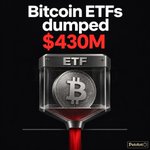
Spot Bitcoin ETFs dumped $430M in one day.
About $1.26B in leveraged positions got wiped on the same tape.
US spot Bitcoin ETFs recorded $430.2 million in net outflows on November 5.
Fidelity's $FBTC led at $199.9 million.
BlackRock's $IBIT lost another $105 million. That flipped Wednesday's $74.6 million inflow into a red day.
About $1.26 billion in leveraged crypto positions were liquidated over 24 hours, $1.12 billion of them longs.
The Nasdaq fell 5.5%, its worst session since April 2025, as AI and chip stocks sold off hard.
bitcoin:native clawed back the $76k area on Friday. Thursday's close still sat just above the 50-week average after a roughly 5.8% drop.
Structure held by a thin margin. Spot demand did not.
Bitcoin briefly printed above $80k after the election. Then it traded like a high-beta tech proxy again.
Is the 50-week the floor, or just the last level institutions sold into?

📚 Sources:
1. Farside Investors, US spot Bitcoin ETF daily flows - Nov 5, 2026 total net outflow $430.2M
$IBIT -$105.0M
$FBTC -$199.9M
Nov 4 net inflow +$74.6M
Nov 2–5 week-through-Thursday net redemptions $869.8M
farside.co.uk/btc/
2. CoinDesk, Nov 6, 2026
coindesk.com/markets/2026/11…
3. Cointelegraph, Nov 6, 2026
cointelegraph.com/markets/bi…
4. Galaxy Research 50-week figures
xitter.gq/ScottLEOWarrior/status…
xitter.gq/Cointelegraph/status/2…


India Turns Payment APIs Into a Way Out
India's CERT just flagged a crew using AI to rob crypto exchanges through their own payment APIs.
CRAFTY FALCON.
It tests with ₹1. Then it takes the wallet keys...
CERT-In's Nov 4 advisory flags AI-assisted crews hitting crypto exchanges, NBFCs, fintechs and payment aggregators. They abuse exposed test environments and the victim's own APIs, then time bigger moves for weekends when fewer humans are watching.
The toolkit on the advisory: ARTEX, PentAGI, Cairn, CyberStrikeAI. Same class of "agent that can call APIs" everyone is shipping into production right now.
No official loss total was published. That is the quiet part. The alert is about method, not a single headline number.
If your stack lets an AI agent reach a withdrawal path, assume someone else's agent already tried a ₹1 test...


CERT-In has published Advisory on its website.
Escalation of AI-Driven Attacks on BFSI Entities by Threat Actor "CRAFTY FALCON"
cert-in.org.in/s2cMainServle…
📚 Sources (CRAFTY FALCON / CERT-In AI attacks on crypto & fintech):
1. CERT-In Critical Advisory CIAD-2026-0058 (Nov 4, 2026): CRAFTY FALCON, AI tools (ARTEX, PentAGI, Cairn, CyberStrikeAI), ₹1 test transactions, wallet-key theft, weekend timing
linkedin.com/posts/complied-…
2. Cointelegraph, Nov 5, 2026: Indian crypto exchanges under AI-powered cyberattack, CERT-In warns (method, targets, no aggregate loss figure)
cointelegraph.com/news/india…
Circle Grew 17%.
Without Its Own Token, It Shrank.
Who Really Keeps The Interest On USDC, And Why 5% Of The Staff Just Left
In June I wrote that distribution eats the issuer.
Circle's Q3 just put a number on it.
$CRCL booked $865M, up 17%... and $182M of it came from selling its own new token.
----------------------
Take that presale out and revenue lands near $683M... about 8% below the $740M of a year ago.
Same release, one footnote: a workforce reduction of about 5%, $9.1M in restructuring costs.
Volume says boom: $13.9T moved onchain in USDC, up 49%.
So why cut staff in what its CEO calls "a big quarter"? 👇
🔹Volume Doesn't Pay The Bills🔹
Without the token sale, 96% of what Circle earned was interest on the reserves behind USDC: $658M.
That line fell 8%, because the yield dropped to 3.5%, down 0.61 points.
Circle earns on balances, not on transfers.
And USDC in circulation ended September at $73.9B, flat on the year. Market share slipped to 27%.
My rough math: every 0.25% rate cut on $73.3B of average float removes about $183M a year of gross interest.
🔹Who Actually Keeps The Interest🔹
Of that $658M, $409M went out as distribution and transaction costs, paid to the partners who keep USDC on their shelves.
Circle's own "net reserve margin": 38%.
So for every dollar your USDC earns in Treasuries, about 62 cents go to distributors and 38 stay with Circle.
The holder gets whatever their platform decides to pass on.
Binance is the cleanest example.
On Oct 29, Circle froze ~$823M after the Binance hack, per CZ.
In September, Binance had put $100M into Circle, at $80.84 a share, a 5% discount.
Same day, Circle agreed to pay Binance a monthly incentive fee on the USDC held through Circle's wallet infrastructure, for five years.
Binance bought the shares. Circle pays the rent.
🔹What I Called In June, Checked🔹
On June 4 I wrote: "When the distributor decides to issue, the independent issuer becomes a middleman it no longer needs."
On July 2, with Open USD: "The verdict was on the float."
Q3 is the receipt.
62 cents of every reserve dollar went to distributors. USDC float: flat at $73.9B, against Circle's own 40% growth guidance.
What I haven't seen yet is the margin collapse I expected.
Strip the token sale and the margin after distribution costs sits near 40%, where it has been for a year.
Squeezed, not crushed. Not to zero. Not yet.
🔹Why The Token Showed Up Now🔹
The ARC presale lifted "other revenue" 627%, to $207M.
It also lifted the margin after distribution costs to 52%, from 41% the quarter before. One sale made the quarter look like a turnaround.
Circle's own release lists "possible repayment obligations if key launch milestones are not achieved" among the Arc risks.
Meanwhile operating expenses rose 16%, and marketing doubled to $11.3M.
🔹Reading The Next Report (NFA)🔹
▫️ Float, not volume
📝 Guidance still says 40% a year for USDC in circulation.
Q3 was 0%. Track that line first.
▫️ Every Fed cut
📝 Read it as a revenue cut for Circle, unless the float grows faster.
▫️ One-offs
📝 Separate token sales from recurring revenue before you judge any margin.
▫️ The distributor bill
📝 If partner payments grow faster than reserve income, keeping USDC on shelves is getting more expensive.
🟢 I'd change my read if circulation grows 20%+ over the next two quarters without partner payments eating the gain.
🔴 It gets worse if rates keep falling and the next quarter needs another token sale to look like growth.
Float flat. Yield down. Distributors paid. One token sale to fill the gap.
USDC moved $13.9 trillion.
Circle kept the interest on $73.9 billion... minus the rent.
Turns out the fastest way to grow a stablecoin company is to sell something that isn't stable.


Now They're Printing the Money.
Are Big Firms Taking Over the Crypto Dream?
One day. That is how long it took to go from Mastercard settling other people's stablecoins to Stripe, Visa, Mastercard, and Coinbase reportedly forming a consortium to issue their own.
Yesterday I wrote: "You can't kill what you need", today, big firms just confirmed what they don't need any more...
Bitcoin is red on the day, but watch the hands, not the price. The CLARITY Act is stuck in the Senate on a single fight, whether stablecoin yield survives, and that yield is roughly 20% of Coinbase's revenue.
So Coinbase moving to help issue its own dollar reads less like a narrative play and more like a company getting ahead of the law before the law gets ahead of it.
Yesterday, credit card businesses were absorbing stablecoins rather than being killed by them, taking a fee on the rails the disruptors built. I did not expect the next move quite this fast. They are no longer content to own the road and charge a toll. They want to print the currency that drives on it.
👉 The two companies that make up roughly 80% of the stablecoin market, Tether and Circle, just watched the most powerful distribution alliance in payments announce it intends to compete with them directly. 👇
🔹What was actually reported🔹
Per The Information, with follow ups across CoinDesk and PYMNTS, the shape of it is this.
▫️ Stripe, Visa, and Mastercard are near launching a unified stablecoin platform, with Coinbase in talks to join, reportedly for an equity stake.
▫️ The explicit target is Circle's USDC and Tether's USDT, the two issuers that control about 80% of a $325 billion market.
▫️ Each member brings a different weapon.
Visa and Mastercard bring the card rails and 150 million plus acceptance points.
Stripe brings merchant reach and Bridge, the issuance infrastructure it bought in 2024.
Coinbase brings crypto distribution, custody, and compliance.
Put plainly, four companies are not dabbling here. They are assembling every layer a dollar needs to live on chain, issuance, settlement, merchant acceptance, and exchange liquidity, under one roof, aimed squarely at the incumbents who got there first.
🔹The knife nobody is pointing at🔹
Here is the detail that turns this from a partnership story into a betrayal story, and almost no one is saying it out loud.
Coinbase and Circle have been joined at the hip since 2023 through a revenue sharing deal on USDC. Coinbase keeps all the yield on USDC held on its platform and splits the rest fifty fifty. That agreement comes up for renewal this August.
So months before it has to re sign the deal that pays it hundreds of millions, Coinbase is reportedly exploring an equity stake in a consortium built to compete with the very coin that deal is based on.
➡️ Circle's single most important distribution partner is shopping for a way to own the competitor instead of renting from the issuer. Circle stock slipped on the news, and that is the market starting to price what this means: the company everyone crowned as the regulated winner of the stablecoin race is suddenly the one most exposed to being disintermediated by its own allies.
👉 Distribution is leverage, and Coinbase just reminded Circle who actually holds it.
🔹Why distribution eats the issuer🔹
This is the lesson the whole week has been building toward, and the consortium makes it impossible to ignore.
A stablecoin is trivial to mint. 🤷
The hard part, the only part that matters, is getting it into hands and making it spendable:
- Circle solved that by renting Coinbase's distribution.
- Tether solved it offshore through exchanges.
Both are, underneath the branding, issuers dependent on someone else's reach.
Now look at who just teamed up. 👀
1⃣ Card networks that touch nearly every merchant on earth.
2⃣ A payments platform embedded in millions of businesses.
3⃣ An exchange with tens of millions of funded accounts.
They already own the distribution that USDC and USDT have to rent. Adding their own coin on top costs them almost nothing and lets them keep the issuance economics they currently hand to Circle.
👉 When the distributor decides to issue, the independent issuer becomes a middleman it no longer needs. That is the existential threat here. The consortium does not have to make a better stablecoin. It only has to make a good enough one and put it where it already controls the shelf.
🔹The part that should bother the crypto believers🔹
Step back from the tickers and the irony gets heavy.
Stablecoins were sold as the open, permissionless dollar that routed around the gatekeepers.
What is forming instead is an oligopoly, three of the largest payment companies on earth plus the biggest US exchange, proposing to issue the dollar, settle the dollar, accept the dollar, and clear the dollar, all within one alliance.
Call it what it is, the existing financial cartel re forming on faster rails, with a blockchain underneath for efficiency rather than for freedom.
👉 The technology delivered everything it promised. Cheaper, faster, programmable dollars. It just handed all of it to the same handful of institutions that ran the old system, and gave them a new layer to consolidate.
🔹Actionable Advice for Wise Investors🔹
1️⃣ Reprice Circle ( $CRCL ) on distribution risk, not adoption hype.
The bull case was always that USDC is the regulated, institutional dollar. The consortium attacks the one thing that case quietly depended on, Coinbase's distribution and the August revenue share renewal.
👉 Watch that renewal like a hawk. The terms Coinbase demands, or whether it walks, will tell you more about Circle's future than any supply chart.
2️⃣ The card networks keep being the trade, not the victim.
Visa ( $V ) and Mastercard ( $MA ) spent a cycle priced for disruption. In one week they have moved from settling stablecoins to issuing them. They are converting every phase of the stablecoin build into a fee line they collect.
👉 Keep reading them as the consolidators, because that is how they keep behaving.
3️⃣ Coinbase ( $COIN ) is the swing factor, and the most interesting name here.
If it joins, it trades a revenue share check from Circle for equity in the platform meant to replace Circle.
👉 That is a structurally better position. The risk is execution and antitrust attention on a four way payments alliance, but the strategic logic is sound, and the optionality is real.
4️⃣ And (again) the conclusion only sharpens towards Bitcoin if you still want to believe in crypto.
Every layer of this, issuance, settlement, distribution, is one more place the dollar gets owned and gated by a shrinking club.
The more the on chain dollar consolidates into a cartel, the cleaner the case for the asset with no consortium, no issuer, and no shelf to control.
👉 Bitcoin ( $BTC ) very much like gold ( $GLD ) is the hedge against exactly this, the financialization of the exit itself.
🔹The (stable) Takeaway🔹
For two years the story was that stablecoins would disrupt traditional finance. This week (definitely) wrote the ending.
Traditional finance looked at the disruptor, decided it was a good idea, and is now building its own, on its own rails, with its own coin, behind its own walls.
👉 Circle taught the giants that a branded dollar was worth issuing... The giants thanked it by deciding they would rather issue their own.

📚 Sources:
Circle Q3 2026 earnings release (SEC 8-K, Exhibit 99.1, Nov 4): revenue, ARC presale, reserve income, distribution costs, 5% workforce footnote, risk factors
sec.gov/Archives/edgar/data/…
Same release on Business Wire
businesswire.com/news/home/2…
Circle 8-K, Sep 17: Binance $100M share purchase at $80.84, monthly incentive fee, five-year term
sec.gov/Archives/edgar/data/…
Circle / Binance announcement (5% discount, USDC promotion)
investor.circle.com/news/new…
BeInCrypto: Circle layoffs in a profitable quarter
beincrypto.com/circle-layoff…
~$823M USDC frozen after the Binance hack, per CZ (Oct 29):
xitter.gq/petranto/status/211592…
My earlier calls: June 4 (distribution eats the issuer) xitter.gq/petranto/status/206254… and July 2 (Open USD, the float) xitter.gq/petranto/status/207261…
The TradFi Alliance To Take Over Crypto Stablecoin
140 companies from Traditional Finance, including Visa, Mastercard, American Express and many other big players such as Blackrock and Standard Chartered did not launch a coin this week, they just launched their version of a whitepaper... and it looks like a verdict targeting CIRCLE, the current revenue champion in Crypto. 👇
Open USD has no live supply. No token in circulation, no chain switched on, a launch penciled for later this year... And yet, the market still marked $CRCL down 17% on one simple announcement.
The verdict was on the float, the interest Circle earns on the Treasury bills backing every coin, which was the whole business, and which OUSD is built to give away.
🔹What Actually Launched🔹
Not a token, a business model, signed by more than 140 companies.
Open Standard, an independent entity with a board drawn from its partners, will run Open USD on Solana first, then Base, Stellar, Polygon and Aptos.
No fee to mint or redeem, no volume cap, and nearly all of the reserve yield rebated to the partners instead of kept by the issuer.
That last clause is the whole event. Circle and Tether earn billions doing one thing, and OUSD keeps that thing and hands the proceeds to everyone who distributes the coin.
👉 You cannot outcompete free, and you certainly cannot outcompete a rebate.
Circle's CEO welcomed the competition, the only move left when 140 companies build a coin designed to take your margin to zero. 😬
🔹I Filed This Exact Story One Month Ago🔹
Twenty six days ago I wrote that Stripe, Visa, Mastercard and Coinbase were assembling to print their own dollar and cut Circle out, and that the mechanism would be brutal, when the distributor decides to issue, the independent issuer becomes a middleman it no longer needs.
That was a rumor in The Information. Tuesday it got a name, a partner board, 140 members, and Bridge's cofounder running it.
👉 Notice who is not on the list. Circle is not a member, Circle is the target.
Back in June I asked whether Circle ends up a front end client of the same plumbing it used to own outright.
The answer landed worse than the question, it is not a client, it is the thing being routed around...
And the tell I flagged, the Coinbase and Circle revenue share that renews in August, now sits on the wrong side of the table, because Coinbase just joined the coin designed to replace the one that deal is built on. 🙃
🔹The Switch Grew a Board🔹
On May 30, after Circle froze a privacy tool and let a thief walk out the front door, I called USDC a permission system wearing a dollar costume, every balance sitting behind a switch one company controls.
The pitch for OUSD is that no single company holds the switch anymore.
So read the board. Visa, Mastercard, American Express, BlackRock, BNY, Standard Chartered, DBS.
Every one of them has frozen, blocked or debanked someone this year under a compliance mandate. That no single issuer holds the switch is true, and it is no comfort.
👉 The switch did not disappear, it grew 140 hands and a governance charter. Open, here, means open to the incumbents.
🔹Actionable NFA for Wise Investors🔹
1️⃣ $CRCL is rerating on a real thesis, that reserve float compresses toward zero once the distributors decide to keep it.
👉 The August revenue share renewal with Coinbase is now the single date that matters more than any supply chart. The 17 percent may overshoot, the direction will not.
2️⃣ Distribution eats the issuer, so own the distribution.
$COIN is on the board and gets OUSD on Base, collecting whether you hold USDC or OUSD...
And the card networks I repriced two posts ago keep proving it, Visa $V and Mastercard $MA went from stablecoin victim to stablecoin beneficiary and are now stablecoin issuers.
👉Read them as consolidators, because that is how they keep behaving.
3️⃣ Watch cohesion before conviction.
Paxos ran this exact partner owned model as USDG since 2024 and it sits near 3 billion against Tether's 145.
👉 Consortiums are hard, they break easily, and 140 aligned incentives is a phrase that has never survived a live governance vote.
4️⃣ The standing conclusion only sharpens.
Bitcoin $BTC and Gold $GLD stay the assets with no consortium, no board, no shelf to control and no yield to rebate or revoke.
👉 Every layer the dollar consolidates onto is one more argument for the one it cannot.
The dollar just learned to share its float.
It has not learned to share its off switch... and the only decentralization we can rely on is the size of the consortium.

Books by Mancer
You Can Now Buy a Trader Like a Memecoin
Robinhood Chain just tokenized the fund manager. The fine print is more interesting than the hype.
Books went live on Oct 28 on Mancer, the DEX aggregator on Robinhood Chain, built with StonkBrokers.
The trader keeps 20% of the profit.
The token price can say whatever it wants.
----------------------
The pitch, from the traders launching them:
"PvE instead of PvP"
"Friend .tech feeling from 2023"
"An onchain prop firm with fewer rules"
So I read the docs instead of the threads.
Here's what you actually buy, who holds your money, and where the risk really sits 👇
🔹How a Book Works🔹
A trader opens a Book. It launches its own token on an anti-snipe pad: the buy tax starts at 95% and drops 1% every minute until it hits 1%.
When the raise closes, the Book bonds.
75% of the raise goes into a vault.
The rest stays locked as the token's market.
The traders run the vault for a fixed term, from 7 days to a year, and can only buy the targets the Book named upfront, plus ETH, USDG and the base pair.
At the end, the vault is sold for WETH. You burn your token and redeem your share.
Fees: 2% close fee, even at a loss. Traders take 20% of the profit after that, nothing at a loss.
🔹The Part the Hype Skips🔹
Your token has two prices.
The docs show "backing per 1M": what a million tokens would redeem for if the Book settled today.
And there's the market price, which is whatever the crowd pays for the trader's name.
Those two can drift far apart. Buy at 3x backing, and the trader has to triple the vault just for you to break even at settlement.
That's not a fund. That's a closed-end fund trading on vibes, with a countdown.
And the "same entry as the trader" claim only holds on the vault. On the token, early buyers and late buyers paid very different prices.
🔹Who Can Rug You (Credit Where Due)🔹
The design is better than most launchpads.
The trader can't just withdraw.
The vault only trades on quotes Mancer signs and simulates, inside a target list, with hourly and daily caps.
Mancer also blocks the vault from buying any token where the Book's own creator and traders hold more than half of its liquidity.
So a trader can't launch a coin, buy it with your money, and dump his own bags on you.
🔹Who Audited the Box?🔹
So the trader is boxed in. Fair.
But who checked the box?
Mancer's own contracts were audited by Sherlock in August.
Mancer's docs say it plainly: Books run on StonkBrokers' contracts, outside that audit.
StonkBrokers does publish audits. They're branded "HasLock Certified".
Not Hashlock. HasLock.
The auditor is StonkBrokers' own founder, and the reports themselves say it's not a Hashlock firm audit.
None of the ones I found covers the Books vault.
The founder audited his own launchpad. Bold strategy.
And nothing settles on its own. If the traders never press "settle", anyone can do it, but only 2 days after the Book ends, and there's no reward for doing it.
So your exit depends on someone bothering to click a button.
🔹Before You Back a Book (NFA)🔹
▫️ Check backing vs price
📝 Compare "backing per 1M" with what you pay. The premium is a bet on top of the bet.
▫️ Read the target list
📝 The vault can only buy what was named before launch. A list full of fresh memecoins is a memecoin, with extra steps.
▫️ Don't buy the first minutes
📝 The tax starts at 95%. Most of it funds the vault, but it's still your money.
▫️ Size for contract risk
📝 The Books contracts were outside Mancer's audit, and the only StonkBrokers audits I found were done in-house. Size accordingly.
▫️ Plan your exit
📝 Unstake and unwrap before redeeming. Tokens stuck in the NFT market never redeem.
Friend .tech sold you a person's attention.
Books sells you a person's PnL, with a price tag that can ignore it.
Raise in. Vault trades. Token pumps. Settlement decides.
Hedge funds charge 2 and 20. Onchain we kept the 20, and added a memecoin chart on top.
Would you back a trader's Book, or just trade the token and leave before settlement?

📚 Sources:
Mancer docs, Mancer Books guide (fund with an end date, raise tax falling to 1%, 75% of raise to vault, targets + WETH/USDG/base pair, backing per 1M, 2% close fee even at a loss, traders 20% of profit, settle by traders then anyone 2 days later, NFT market tokens):
docs.mancer.xyz/guide/books
@MancerXYZ
Mancer docs, Vault trading (only Mancer-signed quotes, caps, insider-liquidity refusal over half of liquidity):
docs.mancer.xyz/api/guides/b…
Mancer docs, Settlement (nothing settles on its own, nobody paid to settle, redemption math):
docs.mancer.xyz/api/guides/b…
Mancer docs, Security (Sherlock audit Aug 2026 on router/allowance/orders; Books run on StonkBrokers contracts, outside the audit):
docs.mancer.xyz/protocol/sec…
Mancer launch post, Oct 28 (Books live, built with Clutch Markets):
x.com/MancerXYZ/status/21155…
SimpleFarmer (StonkBrokers founder) launch thread (anti-snipe, ERC-6551 vault, up to 16 tokens, 7 to 365 days, 20% of net profit):
x.com/OxSimpleFarmer/status/…
SimpleFarmer article (95% tax dropping 1% per minute, 2-day grace window):
x.com/OxSimpleFarmer/article…

Books just went live. So how does it work? Books are Social Capital Markets built around stock token trading. Anyone can come in and launch their own Book, which launches a token that can be paired with $PONS, $AI, $STONKBROKER, robinhood:0x18e674231a58c239dc7daedcffe15ec3a24cff5c, $ETH or $CASHCAT.
Each Book starts with an anti snipe launch. The funds raised during the anti snipe window and 75% of the LP go into an ERC-6551 token bound account (TBA) linked to the Mancer DEX aggregator. Creators preselect up to 16 tokens they want to trade during their epoch, which can last anywhere from 7 to 365 days, and they can add two more Mancer verified tokens while the epoch is running. The goal is to generate as much profit as possible trading on Robinhood Chain.
In the video below I launched a 7 day Book, and I'll be trading several of the top Robinhood Chain tokens and stock tokens. When the 7 days are up, the Book token ceases to exist. Holders burn their tokens to claim their share of the TBA. Book tokens also bond into Uniswap v3 and v4 pools, so holders can stake to claim their share of the LP fees. The book creator gets to keep 20% of the net profit which they generate.
Traders will naturally need to start small and build a history as effective Book creators. Over time that should lead to larger launches, with the best traders in the space rewarded for top tier timing and execution, which improves the Robinhood trenches as a whole.
full walkthrough video is below.
SqueekChain Farming Guide
How to farm the Hamster Chain Aura step by step, no console code, no ping site 🐹
The Tester badge takes one free testnet tx.
Here's the safest way to do it:
1. Join the Genesis program with this link: squeekchain.com/genesis/i/sg…
2. Connect your wallet and sign the message. It's a signature, no gas, no tx
3. Link your X account (needed for the leaderboard)
4. Link Discord on the same page
5. Switch your wallet to Sepolia testnet
6. Grab free Sepolia ETH: Google Cloud Web3 faucet or Alchemy faucet (alchemy.com/faucets/ethereum…)
7. Open the official Squeekchain docs, Developers page, and copy the SqueekToken (SQK) address
It should be 0x6872bfa5ccc3e9e440c6c16e5ffdabb8dba4cc76, double-check it there:
docs.squeekchain.com/rewards…
8. Open Blockscout (Sepolia explorer), where the contract is verified
eth-sepolia.blockscout.com/a…
9. Go to Contract → Read/Write, click Connect wallet
eth-sepolia.blockscout.com/a…
10. Find approve:
spender = your own wallet address
value = 0
11. Click Write, confirm in your wallet. Network must say Sepolia
12. Done. No funds move, you approve 0 tokens to yourself. The badge can take a while to show
Bonus Aura:
▫️ Held a partner NFT at the Oct 14 snapshot? 16 collections give +100 Aura each
▫️ Invite friends who verify too
⚠️ Never paste code from strangers into your console, and only use addresses from the official docs. Some guides use an address that is not in them.
Testnet only. No token is live outside testnet.
⚠️ Remember that any "SQK" trading today is fake.
The hamster doesn't wait. Neither does the leaderboard...

A Real Hamster Is Mining a Token on Ethereum
What Squeekchain Actually Proves, And Why I'm Farming It Anyway
1 hamster. 1 wheel. 1 magnet passing 1 sensor.
Each completed block issues 6,900 SQK, capped at 2.1 billion.
The token is not live yet. It's still on testnet.
----------------------
Squeekchain calls itself a "toychain".
Squeektoshi runs on a device called the WHEELY9000, every accepted magnet passage counts as one unit of work, and Ethereum settles the record.
It sounds like a joke. The docs read like a serious protocol paper.
So what does a hamster-powered chain really show? 👇
🔹What The Hamster Does, And What It Doesn't🔹
▫️ The hamster produces the work. Ethereum does the consensus. The team says so plainly: the wheel is the only source of work, and Ethereum stores and orders it
▫️ No wheel, no blocks. When Squeektoshi sleeps, no SQK is issued. A slow hamster stretches the schedule
▫️ Rewards go to Squeeks, a collection of 9,999 NFTs. A Squeek sitting in a wallet earns nothing, only deposited ones do
▫️ Issuance halves every year over three years. After that, earnings depend on fees, and how those are shared is still TBD
🔹The Part Most People Will Skip🔹
The whitepaper is unusually honest about its own risks.
It says concentration is intended. In its own example, one account with 10% of Squeek power and 10% of staked SQK takes 96.5% of the issuance driven by staked SQK, against 3,000 smaller accounts.
The contracts are upgradeable through governance, and a Guardian can pause settlement. It also says nothing in the paper promises a price, a return or liquidity.
That's the trade: a fun physical oracle, sitting on very normal crypto trust assumptions.
🔹How I'm Approaching It🔹
📝 Genesis is free.
You link X, sign with a wallet to verify it, and farm Aura through badges and invites for a whitelist spot
📝 A signature only.
Never a transaction you don't understand
📝 Any ethereum:0x8b50c3137680e1b179a1767b2c8bf79e8b7e95f3 trading today is fake.
The team says the contract will only be announced from @squeekchain
📝 Use a fresh wallet for anything early stage
Disclosure: I'm farming Aura myself and the link below is my referral.
I'd change my mind if launch terms favor a few large holders even more than the paper already describes.
Bitcoin started with CPUs.
This one starts with little animal cardio.
Is a hamster any less trustworthy than the oracles we already use?
Link in the reply 👇

Freezergate
Nobody stole a file. Nobody demanded a ransom.
Someone changed a number on a freezer, and the food did the rest.
12 Oct, France: hackers reached remote fridge controllers in hundreds of supermarkets. Intermarché said 50°C for six hours. Fires reported, Paris prosecutors investigating.
Danfoss said most hit units were legacy models with no more security updates.
Last night: ICA and Coop stores in Sweden (one manager read 55°C), about 40 Delhaize and 15 Carrefour stores in Belgium.
A Belgian installer says it's exactly the same mechanism: units forced into defrost mode remotely.
No claim of responsibility reported. No ransom note.
France's cyber agency put it simply: a management interface exposed to the internet is against good practice.
That's the pattern: old controllers, online, still on duty.
In France the cost was counted in millions of euros of food binned... But the real damage was the food nobody caught in time.
The attack surface now includes the yogurt aisle.
We used to worry about hackers emptying our bank accounts or crypto wallets...
Now they're already poisoning the food in our local store.


BREAKING: European supermarkets hit by CYBERATTACKS that caused freezers to overheat up to 55°C.
The latest incidents hit stores in Sweden and Belgium, forcing retailers to throw away food.
ICA and Coop, which account for 67.3% of Sweden’s grocery retail market, reported overheating freezers overnight on Monday.
“Everything is ruined,” said an ICA store manager in Sjöbo, where frozen food worth hundreds of thousands of Swedish kronor was destroyed.
In Belgium, around 40 Delhaize stores and 15 Carrefour locations reported freezers warmed to 15°C.
Similar incidents have happened before.
Last month, hackers targeted refrigeration at hundreds of French supermarkets, causing food losses and reported fires.
In August, freezer failures spoiled food at at least six US military grocery stores.
No link between these incidents has been established.
The incidents add to broader concerns over cyberattacks on banks, websites and crypto platforms.


📚 Sources:
- France, 12 Oct: Intermarché/Netto 300 stores, Coopérative U 100+, Leclerc, Danfoss legacy units, Paris prosecutor probe, fires: afp.com/en/french-supermarke…
- 50°C for 6 hours (Intermarché), food worth millions of euros: bbc.com/news/articles/crq5nz…
- Forced continuous defrost, Danfoss controllers: bfmtv.com/economie/entrepris…
- CERT-FR alert (Danfoss AK-SM/AK-SC, Copeland & Dixell xweb, exposed interfaces): cert.cyber.gouv.fr/alerte/CE…
- Sweden: ICA "limited number of stores", Coop 6 stores, 55°C reading in Öland: aa.com.tr/en/europe/swedish-…
- Sweden, 50°C setpoint (Reuters): esmmagazine.com/retail/tempe…
- Belgium: ~40 Delhaize, 15 Carrefour, 5 Spar, same defrost mechanism per installer Sabcobel: vrt.be/vrtnws/nl/liveblog/ve…
- Delhaize statement: euronews.com/2026/11/02/cybe…
Proton Sells Privacy. Its CEO Called Security Testing "Loser Thinking"
90% AI-Written Code, A Pentest Request Mocked In Slack, And A Bitcoin Wallet Under The Same Roof
90% of Proton's code in October was written by AI.
When an engineer asked for a few days to pentest new code, the CEO called it "loser thinking".
----------------------
Proton sells encrypted email, a VPN, a password manager and a self-custodial bitcoin wallet. Its own site says it serves over 100 million people.
The story comes from 404 Media (Oct 29): eight current and one former employee, Slack chats, meeting audio and a manifesto from the CTO. Proton's spokesperson did not dispute the reporting.
So what happens when a privacy company decides review is the bottleneck? 👇
🔹The Slack Thread Nobody Was Supposed To Read🔹
End of August, in the security channel. An employee asks for a few days of pentesting before new code goes live.
Andy Yen: "That's bullshit and loser thinking."
Then: "stop lovingly handcrafting all our code and use AI more."
Another engineer pushed back: security is "low in our prioritization at present". No direct answer.
Same channel: "This will be the last year that we hire engineers."
🔹The Revenue Target Behind The Rush🔹
An internal document says Proton is not on track for its annual recurring revenue target, "due to insufficient velocity".
Another line: "By all metrics that matter, we're an underperforming company."
CTO Bart Butler said in a meeting that 90% of October's code was AI-written. Software on staff machines tracks how much.
So AI isn't a product choice here. It's the growth plan.
🔹A Walk-Back With An Asterisk🔹
Friday, Oct 30: Yen cancelled the AI "re-interviews" that an internal email had called "consequential" for continued employment.
Same all-hands: "Going forward, I'm still going to push."
One employee says what the re-interviews measured will now feed performance reviews.
His Reddit reply was downvoted more than 1,200 times.
🔹Why This Lands On Crypto Too🔹
Proton Wallet's pitch is simple: only you can access your bitcoin.
Self-custody moves the trust from a company's balance sheet to its code.
Nothing reported says wallet code skipped review.
But the culture that ships it is now on the record.
This week everyone is talking about exchange security.
A self-custody wallet asks the same question, with no SAFU fund behind it.
🔹If You Use Proton Today (NFA)🔹
▫️ Your keys
📝 Keep your wallet recovery phrase offline, whichever app holds it.
▫️ Your 2FA
📝 Don't keep your password manager and your authenticator codes in the same app.
▫️ The next releases
📝 Watch whether Proton publishes outside audits for code shipped since August.
I'll relax if Proton publishes a review policy for AI-written code before next month's reorg.
I'll worry more if the next serious bug comes from an outside researcher, not from Proton.
The code can be 90% AI.
The trust is still 100% human.
Would you keep your keys with a company whose CEO calls pentesting "loser thinking"?

📚 Sources:
404 Media investigation (Oct 29): the Slack quotes, "last year that we hire engineers", 90% AI-written code in October, the ARR document, the spokesperson's response:
404media.co/manifestos-fear-…
404 Media (Oct 30): re-interviews cancelled, "I'm still going to push", performance reviews, Reddit reply downvoted 1,200+ times, reorg next month:
404media.co/protons-ceo-canc…
The Next Web (Oct 30): the re-interview email called them "consequential" for continued employment:
thenextweb.com/news/proton-a…
Proton Wallet page: self-custodial, "only you can access your Bitcoin", services to over 100 million people:
proton.me/wallet

Binance Hack - Withdrawals are back.
The last 5% isn't.
Binance says it has covered 95% of the ~$6.3B stolen. The rest is the part money can't buy fast.
80%, then 90%, now 95%.
About $6B of replacement tokens bought with company money: half of its $1B SAFU fund, part of the Futures Insurance Fund, and the treasury.
The missing 5%, roughly $315M, is tokens outside its top ten.
Binance hasn't said which ones. But the stolen basket is public.
On-chain trackers saw the hacker dump ethereum:0x1f9840a85d5af5bf1d1762f925bdaddc4201f984 (~$40M), ethereum:0x57e114b691db790c35207b2e685d4a43181e6061 (~$34M), ethereum:0x6982508145454ce325ddbe47a25d4ec3d2311933 (~$32M), ethereum:0x514910771af9ca656af840dff83e8264ecf986ca (~$26M), plus $AAVE, $ONDO and $WLD.
Also taken: $ARB, $OP, $ZRO, $ZAMA, $FUN, $RSR, and 130+ smaller alts on EVM chains alone.
Binance's own words: "less liquid", slower "to source at the required scale".
So it keeps buying "through market and OTC channels".
That's a forced buyer with a known shopping list, in the thinnest order books.
Bought on market, it can move those prices. Bought OTC, the move is quieter, but someone still has to sell.
The majors were easy to rebuy.
The long tail sets the pace, and maybe the price.
Who's selling Binance that last 5%?


Withdrawal Update
Withdrawals have now been restored for the following assets and networks:
- Ethereum Network: USDC, USDT, ETH
- BNB Smart Chain (BSC): USDC, USDT, BNB
We will continue to restore additional assets and networks in phases following the completion of our security checks. Further updates will be shared through official Binance channels.
📚 Sources:
Binance, Recovery Update #4 (Nov 1): 95% covered, the outstanding 5% is tokens outside the top ten, bought via market and OTC:
binance.com/en/support/annou…
Reuters (Nov 1): $6.3B stolen, $6B covered with company money from SAFU, the Futures Insurance Fund and the treasury:
investing.com/news/stock-mar…
CNBC: the 10 tokens fully backed (BTC, ETH, USDT, BNB, SOL, USDC, XRP, USD1, RLUSD, ZEC):
cnbc.com/2026/10/31/binance-…
Lookonchain: stolen basket, UNI/ENA/PEPE/LINK dump amounts, ARB, ZAMA, ZRO, FUN, RSR (stolen-basket data, not Binance's 5% list):
lookonchain.com/feeds/79622
Arkham, Binance Hacker entity (OP and other holdings):
arkm.com/explorer/entity/bin…
130+ altcoins sold on EVM chains (Lookonchain via GetChain):
getchainnews.com/en/project/…
