

Hound of Heck. Writes all the things. Most of the things never write back.
The hinterlands
Joined December 2009
- Tweets80.9K
- Following1.8K
- Followers917
- Likes306K




Since we’ve had the November New Moon - here’s the countdown to this month’s full moon!
timeanddate.com/countdown/to…

3
Pawl Baxter retweeted
As grave and insane a cultural development as I can imagine.
All writers and artists must stand against this -- or what we do falls to the level of cake decorating.
Guillotines next if we don't.


Pawl Baxter retweeted

I think we're entering a civilizational rupture that nobody can predict. Not me, not the labs, not governments.
I don't know how much people realize how fast we're moving.
Look at what Anthropic's new model did during testing.
It solved two open problems in theoretical physics, both on black holes. One of the calculations was laid out in 2003 and nobody had ever finished it, because it was too laborious.
It formalized the proof of Fermat's Last Theorem in 30 hours, with a thousand agents that organized themselves. The first attempt took 11 days.
It wrote an operating system that boots on a laptop, starting from an empty folder, in 8 days.
It designed three electronic devices, boards, enclosures and software included. All three worked without a single electrical modification.
It found a new method to predict the structure of viral capsids, the shells used to deliver gene therapies.
And on robot control, it more than doubled the previous version's score.
All of that in a single announcement, on a Monday.
I think discoveries are going to stack up so fast that they'll produce an abundance we've never known: energy, health, materials, food. And with it a phase of immense joy, the joy of a civilization realizing that scarcity was never a law of nature.
Except that joy is going to land in a world order that's cracking everywhere, and that was designed by Malthusians. People convinced that resources are finite, that there are too many of us, and that the job of an enlightened elite is to manage scarcity on everyone else's behalf.
To me, Bill Gates is the most famous face of that worldview: a man nobody elected, who has weighed on the planet's health, agriculture and climate policies for twenty years. The degrowth crowd is the militant version. They don't even want to manage scarcity anymore, they want to organize it.
Abundance is the worst possible news for that worldview. If energy becomes nearly free and diseases fall one after another, nobody needs anyone to ration anything for them.
So I don't think they'll fight it. I think they'll try to capture it.
In the name of safety, climate or public health, we'll be told this power is too dangerous to be left in everyone's hands. We already saw the movie during Covid: the permission slips, the passes, the QR code to go get a coffee. Now imagine the same logic with an AI that can see everything, trace everything and decide everything in real time. Orwell never imagined a tool like that.
The technology is winning on its own. The question of the next ten years is who abundance will belong to.
We are living through the greatest civilizational revolution in human history. It's happening right now, and most people are looking the other way.

Pawl Baxter retweeted
We have a very serious problem America
Multiple White liberal women are interviewed and they all say they’d prefer a radical Islamist to be running America
One of the white liberal women says she’s gay and would be okay with the Ayatollah from Iran….
White liberal women have lost their minds and represent one of the greatest threats to America. They have become so sympathetic and ignorant to people who literally want to destroy our country and would actually even murder them if given the chance
Is it even possible to break the indoctrination of white liberal women

Pawl Baxter retweeted

Hi. Meteorologist here.
This is nonsense. We have not entered a “new age of climate extremes.”
There is no such thing as a “supersized El Niño” and the planet isn’t being “superheated” by climate change either.
First, the correct meteorological term is “very strong El Niño.”
Second, El Niño a natural part of Earth’s internal weather and climate variability. It is just the positive (warm) phase of the El Niño–Southern Oscillation (ENSO). Correspondingly, La Niña is the negative (cool) phase.
The atmospheric circulation component of ENSO in the tropical Pacific is the “Southern Oscillation.” But the resulting warming (cooling) sea surface temperature (SST) response is El Niño (La Niña).
Normally, the thermocline (a transition layer separating warmer mixed water at the surface from cooler water below) in the Pacific Ocean slopes down towards the west. This means that the western Pacific usually has a deep, warm mixed layer of water extending downward from the surface, while the eastern Pacific has a relatively shallow mixed layer. These are “ENSO neutral” conditions.
The sloped nature of the thermocline is maintained by easterly wind stress on the equatorial Pacific ocean surface. The strength of the easterlies is determined by the balance between convection (upward motion) over Indonesia and subsidence (downward motion) in the central and eastern Pacific.
During La Niña, easterlies are stronger than normal because convection is displaced further west. Lower pressure over the Maritime Continent and higher pressure over Tahiti results in a strongly positive SOI index. Higher wind stress pushes even more warm surface water westward, resulting in the formation of an even larger warm pool in the west Pacific near Asia, which steepens the thermocline. This enhances divergence, leading to upwelling of cool, nutrient-rich water in the central and eastern Pacific.
However, if convection moves eastward over the Pacific, the easterlies weaken or even locally reverse (we call these “westerly wind bursts”) and thermocline begins to flatten, allowing warmer water in the west Pacific to slosh eastward, creating a deeper pool of warm water in the central and eastern Pacific. This is El Niño, and this is occurring right now.
The state of ENSO is quantified using the SST anomalies [relative to the most recent 30-year mean; currently, we use 1991–2020] along the equatorial belt. The main area for which SSTAs are monitored is the Niño 3.4 region, which runs from the 120–170th meridians of longitude and 5° north or south of the equator (5°N–5°S, 170°W–120°W). If the three-month averaged SSTA in Niño 3.4 is at least +0.5°C (+0.9°F), then El Niño is declared. If the three-month averaged SSTA is at least −0.5°C (−0.9°F), La Niña is declared.
El Niño (La Niña) events are classified as either being “weak,” “moderate,” “strong,” or “very strong” depending on how far above (below) average SSTs in Niño 3.4 have been for the last three months.
If the three-month averaged SSTA is +0.5–0.99°C (−0.5°C to −0.99°C), then the El Niño (La Niña) is weak.
If it's +1–1.49°C (−1°C to −1.49°C), then the El Niño (La Niña) is moderate.
If it's +1.5–1.99°C (−1.5°C to −1.99°C), then the El Niño (La Niña) is strong.
If it's ≥ +2.0°C (≤ −2.0°), then the El Niño (La Niña) is very strong.
The latest data from CDAS indicate that the Niño 3.4 region is currently +2.9°C (relative to 1991–2020). This means that we are in “very strong El Niño” territory.”
And this has happened several times before. Very Strong El Niños occurred in 1790–93, 1827–28, 1844–45, 1890–91, 1925–26, 1982–83, 1997–98, and 2015–16.
You are nothing but an ignorant, agenda-driven clown.


We've entered a new age of climate extremes:
A supersized El Niño is colliding with a planet already superheated by climate change.
The latest @WMO report shows once again that leaders must get serious by cutting emissions faster, accelerating a just transition from fossil fuels & delivering the finance & protection vulnerable countries need.
wmo.int/news/media-centre/st…

Pawl Baxter retweeted

Why solar cannot realistically power the electricity grid.
"To power 100,000 homes for one hour, you need 50,000 tonnes of solar panels."
"If I want to produce this hour of electricity in the evening when the sun isn't shining, well then I need batteries."
"For one hour of electricity for this 100,000 homes, you need... about two basketball courts worth of batteries."
"But of course I have to charge these batteries, so that means I need additional solar in the grid so that we have an excess to charge them. So we add another [10,000 tonnes] of solar panels."
"This is for one hour."
Pawl Baxter retweeted

Three friends went out for a peaceful day on the river.
Two came prepared with drinks, fishing gear, and absolutely no responsibilities.
The third showed up wearing a hoodie, looking like a retired security guard who had seen enough of humanity.
While everyone else enjoyed the scenery, he sat in the front, silently judging every decision that led to this trip.
No fishing. No drinking. No smiling.
Just one very serious dog wondering why he's the only adult on this boat. 😂❤️
Pawl Baxter retweeted

People doubting this, take it from a pilot who has flown just about every model of Learjet for 15 years:
“This is a plane that will dance if you are a skilled pilot. But it will kill you if your skills are lacking. It was originally designed for the most experienced pilots coming out of the military flying fighter jets or airline guys looking for a post airline retirement gig.
Pic here is from one of my high altitude (45,000ft) flights in the Lear 60. You can see I’m in “coffin corner”. Green line on the speed tape is 1.3 stall speed. Red line (barber pole) is your high speed stall.”
Notice on the right zoomed in panel how narrow the band is.


Heard this term “coffin corner” from pilots as a possible contributing factor to the Learjet 60 crash.
This is the best explanation of what it is and why descending rather than climbing is the way out.
The coffin corner is a dangerous band high up in the sky where a plane’s “too slow” limit and “too fast” limit get so close together that the safe window narrows to almost nothing.
If anything pushes the plane a little too slow or a little too fast (a bit of turbulence, a turn, or even trying to climb), it can easily slip outside that tiny safe band and fall out of the sky.
That’s why it’s called the coffin corner - there’s almost no room for error, and losing control up there is extremely dangerous.
Pawl Baxter retweeted

DSA leader Megan Romer has NO answer when Fox News’s Martha MacCallum asks where the $49 TRILLION for her socialist agenda is coming from.
Romer calls the number “made-up.” Then MacCallum what HER number is, and it gets embarrassing fast.
MACCALLUM: “That’s $350,000 per household. Cancelling student debt, open borders and amnesty, Medicare for All. How are you going to pay for that?”
ROMER: “Yeah, I mean, we understand that the White House, who does not like us very much, managed to come up with some math that made us look bad.”
MACCALLUM: “So that’s $47.4 trillion, Medicare for All.”
ROMER: “Yeah, it’s a made up number.”
MACCALLUM: “You say it’s a made up number, but it was done by economists. Your number versus their number.”
So MacCallum throws her a lifeline.
MACCALLUM: “What’s your number when you add up everything on that list? What number did you come up with?”
ROMER: “There’s no like, one solid number because it depends on what pieces we can build in the meantime.”
MACCALLUM: “So just give me a basic number for your wish list.”
ROMER: “That number is outrageous.”
MACCALLUM: “What’s your number for your wish list?”
ROMER: “That number is ridiculous ... I’m not going to give you a solid number. That’s not what I’m here to do.”
The number isn’t just coming from White House economists.
Cato ran the DSA platform and found that confiscating the entire net worth of the 400 richest Americans, all $6.6 trillion of it, covers about 9% of the bill. Take every dollar of corporate profit on top of that and they’re still $29 trillion short.
Romer is more than happy to explain how she’ll take money from the “billionaire class” and hand it to the working class.
But ask how much it costs, or how she’ll actually pay for everything, and her entire argument collapses.
CONTEXT: The DSA’s own estimate for its billionaire wealth tax is $3.9 trillion over ten years. The agenda costs $49 trillion. Even by their math, the billionaires cover 8 cents of every dollar.
Pawl Baxter retweeted
How do I know the climate “crisis” is a scam?
Here are five reasons:
1️⃣ None of the politicians, celebrities, or “scientists” talking about it have changed their own lifestyles in any way. If they actually stopped using oil and gas products, I’d take them seriously. Actions speak louder than words.
2️⃣ Climate conferences still aren’t held on Zoom using their large meeting extensions. Instead these gremlins keep flying around the world lecturing us about shrinking our carbon footprints while doing nothing to shrink their own.
3️⃣ Wealthy alarmists are still living on or buying oceanfront property. If sea levels were rising at anything close to a catastrophic rate (instead of the gradual increase we actually see), they would be moving inland and banks would stop writing loans for those properties.
4️⃣ The same people never criticize China or India. They always have a ready list of excuses for why the world’s biggest and fastest-growing CO₂ emitters get a free pass to keep burning fossil fuels.
5️⃣ The only “solutions” they ever offer involve more government power. Higher taxes. EV mandates. Restrictions or bans on the energy sources they don’t like.

Pawl Baxter retweeted

Sir John Cowperthwaite ran Hong Kong's finances from 1961 to 1971 and treated regulation like a tax on discovery. Nobody in government can know which business will work, so he refused to pick, plan, or protect.
Whitehall sent officials to Hong Kong to push for economic statistics, and he sent them home. When Milton Friedman asked in 1963 why he collected so little data, Cowperthwaite answered: "If I let them compute those statistics, they'll want to use them for planning." Numbers give planners a reason to act, and every plan arrives as a rule that tells entrepreneurs what they may not try. Asked what poor countries should do to grow, he said they should abolish the office of national statistics.
He rebuffed tariffs, opposed corporate subsidies, and refused London's push to raise taxes. When a legislator proposed that the government back promising industries, he asked how the government could possibly know which ones those were.
The results arrived without a plan. During his decade as Financial Secretary, real wages rose 50% and the share of residents in acute poverty fell from 50% to 15%. When he took the job, the average Hong Kong resident earned about a quarter of what a Briton earned. By the early 1990s, Hong Kongers out-earned Britons. Britain, the birthplace of the Industrial Revolution, planned its economy with ministries full of statisticians and fell behind a rock with no resources except a harbor.
Every regulation assumes a regulator who knows which experiments to allow. That regulator does not exist, so each gate he builds blocks the ideas nobody in the room could have predicted. Hong Kong's most valuable policy was the absence of a gatekeeper.
As far as civil servants go, this guy is the GOAT.

Pawl Baxter retweeted

Just before midnight on April 12, 1977, Delta Air Lines Flight 1080 lifted off from San Diego in the dark and immediately pitched its nose skyward toward a fatal aerodynamic stall.
Earlier that day, water from aroutine wash had seeped into a left rear stabilizer bearing on the Lockheed L-1011 TriStar and frozen solid during a previous high-altitude flight.
Nobody on the ground knew that the elevator control surface on the tail was jammed at a violent nineteen-degree nose-up angle.
The moment the wheels left the runway, the two-hundred-ton wide-body jetliner began climbing steeper and steeper into a thick layer of night clouds at four hundred feet.
Fifty-three-year-old Captain Jack McMahan, a former United States Marine Corps fighter pilot with fifteen thousand hours in the air, pushed his control column all the way forward against the instrument panel.
Nothing happened.
His first officer and flight engineer pushed their controls forward too, and the nose kept rising as the airspeed bled away toward the stall warning speed of one hundred and twenty-eight knots.
If a two-hundred-ton airliner stalls inside low clouds at night just above the rooftops of San Diego, nobody survives.
How did Captain McMahan force the nose of a jammed jetliner down when the elevator controls were completely dead?
In less than ten seconds inside the pitch-black cloud bank, McMahan pictured the exact geometry of the Lockheed L-1011 TriStar in his mind.
The L-1011 had three Rolls-Royce turbofan engines: Engines One and Three hung low beneath the left and right wings, below the airplane's center of gravity, while Engine Number Two was mounted high inside the base of the tail fin, above the center of gravity.
Because the low wing engines sat underneath the balance point, their forward thrust was pushing the nose upward like a lever.
Without hesitation, McMahan pulled back the throttles on the two wing engines while leaving the high tail engine roaring at full power.
Pushing from high above the fuselage, the center tail engine levered the nose down through the clouds just as the airspeed dropped to one hundred and thirty knots, two knots shy of a fatal stall.
Instead of ditching in the dark ocean off San Diego, McMahan flew the crippled giant ninety miles north to Los Angeles International Airport, where the weather was clear and the runways were long.
Using only his three throttle levers to climb, descend, and bank through the night sky, the former Marine landed Flight 1080 smoothly on Runway 06R in the rain and saved all fifty-two souls on board.
(For transparency: all images in my posts are produced using AI.)
🤖 Made with AI

Pawl Baxter retweeted
Now that we have the map.
We've established two things.
One: life is a game.
Two: if life is a game, then there are trials, and those trials are hard.
Here is the map of the level we're playing right now.
There are four threats.
The first is a misunderstanding of human nature. Part of the left still believes value is created from the top down: an enlightened planner, directives, experts who know better than you what you need. It's the Bill Gates-style technocratic vision, well-intentioned, blind to how humans actually work. Value can't be decreed. It emerges from millions of free people taking risks, failing, and trying again. Every time we've tried to replace that with a plan, we got less wealth, less freedom, and more resentment.
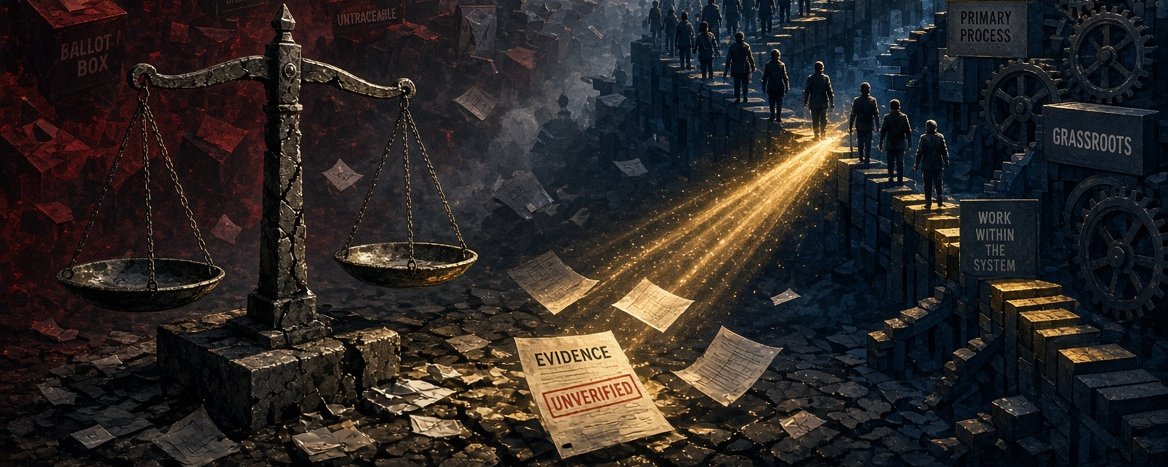
The second is the players who figured out how to shape institutions without going through the ballot box. The most visible example is George Soros's Open Society: billions poured for decades into NGOs, think tanks, prosecutor campaigns, and open-borders advocacy groups. It's not a secret, it's in their own reports. The problem isn't that a billionaire has opinions. It's that an unelected network can influence justice, immigration, and public debate more than voters can, without ever being accountable when things go wrong.
The third is political Islam. Not Muslims: the political project. And the real reason it can't work is simple: at its core, it's a collectivist project. A single, centralized norm that claims to govern all of life, from law to family to the economy. Every centralized system that has tried to run everything ended the same way. It collapsed under its own weight, because no center can process the information that millions of free individuals process spontaneously. The danger is that when a system collapses, it takes a lot down with it.
The fourth is demographics. The West has stopped having children. A civilization that doesn't reproduce passes on neither its culture, nor its institutions, nor its values. It hands its future to others. It's math, and it's probably the most underestimated threat of all.
Against all this, there's a counterforce. Elon Musk, and more broadly part of the tech world. Builders who understood that civilization isn't guaranteed, that it has to be defended, and that you defend it first by building: rockets, factories, AI, abundance. They have the means, the nerve, and the long-term vision.
Which leaves the real question: how do we keep existing?
Two questions need to be asked.
The first: if a political project requires the destruction of Western values, and democracy is inseparable from the freedom that gave birth to it, is that project compatible with democracy? Popper framed this 80 years ago: a tolerant society that tolerates those who want to abolish tolerance ends up disappearing. Defending democracy doesn't mean letting any project use it to sabotage itself. It means setting non-negotiable rules of the game: freedom of conscience, equality before the law, civil law above any religious law.
The second: how do we make the other players, China, Russia, the countries that still function, understand that the fall of the West is not good news for them? The West isn't just a geopolitical bloc. It's the matrix that produced the scientific method, the rule of law, the industrial revolution, the internet. If that matrix goes dark, it's not a rival disappearing, it's the engine of human progress stalling. And in a world of nuclear weapons, pandemics, and AI, a humanity without a free engine of innovation is taking an existential risk. Everyone has an interest in the West holding.
You are in a game.
The quest is hardcore. But you don't win a game you've already given up on in your head. You have to fight, build, and visualize victory. Those who believe it's already lost deserve to lose. They'll exit history, and others will write it in their place.

After DOGE, Elon came to a conclusion most people missed.
He tried to reform the state from the inside. He failed. And he said it plainly: the government can't fix its own deficit. Nobody in power actually wants to cut. The machine protects itself.
So he drew the only logical conclusion. If the state can't be reformed, there are only two ways this ends.
Either global bankruptcy. Debt keeps compounding, interest payments eat the budget, and the system collapses under its own weight.
Or robots. AI and robotics grow the economy so fast that the debt becomes manageable, and abundance makes the old fights over scarcity irrelevant.
Here's the part almost nobody sees.
For two centuries, capitalism has had a marketing problem. Its gains are real but slow and invisible. 2% growth a year doesn't feel like anything. Your life gets better over 30 years and you never connect it to the system that did it. Meanwhile, the left's promises feel immediate and concrete: a check, a subsidy, a benefit. That's why the left wins on promises even when it can't deliver them. Capitalism produces the wealth, socialism takes the credit.
Robots break that asymmetry.
When productivity doubles in a few years instead of a few decades, people will see it. Things get cheaper, services get better, opportunities appear, in real time. For the first time in history, people will connect capitalism and their rising standard of living directly, almost instantly. The causal chain becomes visible.
And that changes everything politically.
So there are two scenarios.
Scenario one: we stay in the current inertia. No breakthrough, or a breakthrough we regulate to death. The debt wins. Living standards stagnate, then fall. A frustrated electorate turns to whoever promises the most, and that pushes toward a hard collectivist left. But collectivism fails, as it always does. And when it fails, the most organized, most disciplined collectivist force left standing isn't the old left. It's radical Islamism. Bankruptcy, then communism, then something worse.
Scenario two: robots win. Abundance arrives, and it arrives visibly. The link between free enterprise and prosperity becomes obvious to everyone. And this is the key point: it becomes obvious to everyone, including the minorities the left was counting on. Because their long-term incentive is the same as everyone else's. A kid in the suburbs gains infinitely more from a booming, abundant West than from a bankrupt state handing out promises it can't keep. Abundance is the most powerful integration machine ever built.
That's the Western renaissance.
The West doesn't need to win the culture war by arguing. It needs to win it by delivering. And for the first time, it has the technology to deliver fast enough for people to notice.
The race isn't left vs right anymore. It's robots vs bankruptcy.
Pawl Baxter retweeted

In 1860, an 11-year-old girl wrote to Abraham Lincoln with campaign advice. He wrote back. Months later, he stopped in her town and asked to see her.
Her name was Grace Bedell, of Westfield, New York. Her father brought home a picture of Lincoln, and on October 15, 1860, she wrote to him.
She had 4 brothers, she said, and "if you will let your whiskers grow I will try and get the rest of them to vote for you you would look a great deal better for your face is so thin."
She also asked if he had any little girls about as large as she was.
Four days later, a man running for President answered a child. "My dear little Miss," he began. He had no daughters, only three sons, who "with their mother, constitute my whole family." He wondered if people would think a beard silly.
About a month later, he began to grow one.
In February 1861, riding to Washington as President-elect, Lincoln stopped at Westfield, asked for Grace in the crowd, and kissed her cheek. He told her he had taken her advice.
Both letters still survive.
Never think your voice is too small. A little girl spoke up, and a future President listened.

Pawl Baxter retweeted
DSA candidate Tim Denson tries to sell the crowd on “democratizing the workplace” and says Walmart should belong to the workers.
Big mistake. The guy 6 ft away from him grew up in Venezuela. And he’s heard this communist fairy tale before.
DANIEL DI MARTINO: “So you want to take it [Walmart] from its owners and have the workers do what?”
TIM DENSON: “I want the workers to own it and get paid better and have better benefits and be able to provide better lives for their families.”
DI MARTINO: “We can buy shares in Walmart right now. In fact, all of the SpaceX workers became millionaires overnight.”
“You can start a workers’ cooperative right now. It’s legal, but under a socialist country, you’re not allowed to own your own property and start your own private corporation.”
Denson tried to refute Di Martino’s point. Then Di Martino dropped this line on him:
DI MARTINO: “It’s very easy to be a socialist in a capitalist country. It’s illegal to be a capitalist in a socialist country. That is the difference.”
[audience applause]
Then it got personal:
DI MARTINO: “When I had to go to the grocery store, Tim, I had to put my fingerprint in a scanning machine so that they would tell me what I was allowed to purchase.”
“And I could only go Mondays and Saturdays because we have to ration food, because that’s what happens when there’s no profit motive and the farmers, their food is confiscated because they had to sell it to the government and everybody else at the price the government tells the farmers.”
“My mom made chocolate bonbons for parties.”
“Well, people have a right to chocolate, so we had a price control on chocolate.”
“So my mom had to buy counterfeit chocolate, put it in black bags as if we were cocaine drug dealers. That’s what socialism was in Venezuela. That’s what worker ownership of the means of production is.”
“Where has it ever worked?”
Denson had no answer. Because there isn’t one.
Pawl Baxter retweeted

For every leaf pulling down carbon, there are endless miles of mycorrhizal fungi weaving an underground logistics network through the soil profile.
The Earth has 3.04 trillion individual trees, roughly 400 trees for every person on Earth, and around 80% to 90% of all plant and tree species form this mutual partnership. While NASA’s satellite data tracks the Taiga marching north, it misses the silent biological exchange working beneath the frost and leaf litter.
Estimates suggest roughly 250,000 plant species partner with about 50,000 species of fungi. There are around 73,300 distinct tree species worldwide. Russia has the most trees (641 billion), followed by Canada (318 billion), Brazil (302 billion) and the United States (228 billion).
The world has 380,000 documented plant species, and the majority - about 260,000 species - produce seeds.
Plants supply fungi with sugars and carbon produced via photosynthesis, since fungi cannot make their own food. In return, thread-like mycelium networks forage deep into the soil for vital water, phosphorus, and nitrogen to deliver back to the root systems.
Nature sidesteps the soil bottlenecks predicted by computer models because the soil itself is a living, decentralised energy marketplace. Trees pump excess carbon sugars from elevated atmospheric CO₂ down into their root systems. They trade sugars with fungi and microbes. In return, the fungi act as an underground mining and delivery service. They tap into deep mineral pools for the nitrogen and phosphorus that roots cannot reach on their own.
Earthworms drive the mechanics of the system, aerating the earth and recycling organic matter into the nutrient-dense humus that feeds the growth above. But without mycorrhizal fungi, soil is just sterile geology; with them, it functions as an active biological recycling plant.
Climate narratives often paint the planet as a fragile system on the edge of failure. But look at the astonishing symbiosis between a root, a fungal network and an earthworm. It reveals a self-regulating, highly resilient natural architecture.
The planet isn’t just surviving higher CO₂ levels; its converting carbon into the currency needed to fuel the networks below our feet. The nitrogen bottleneck may exist in a spreadsheet, but underground, the energy trade routes are wide open.
Against this vibrant, multi-layered genius of the living soil, the modern carbon agenda appears oddly sterile. It reduces the immense, self-directed architecture of the biosphere down to a simple liability on a global ledger.
While international summits broker complex financial mechanisms to police carbon through COP summits, the earth is already deploying it - quietly turning atmospheric surplus into living roots, fungal networks and rich topsoil.
Nature requires neither central planning, spreadsheets nor green subsidies. The planet’s inbuilt resilience is already written into its biology.
