

Houdini Technical Artist
Brighton - UK
Joined February 2020
- Tweets162
- Following294
- Followers250
- Likes764




Pinned Tweet
Recently released a big update to Houdini Engine for Godot. This is an updated introduction video:
youtu.be/CSmCCTkfPCU
There's a discord server for Houdini Engine in Godot now discord.gg/bAw7Pv8ETG
Here's the updated introduction video to @sidefx #Houdini Engine in #GodotEngine
youtu.be/cviGlmKmFQ8
A proper announcement with detailed videos, instructions etc. will follow, but I just released the first big update to #Houdini Engine in #GodotEngine
The main focus of this update was usability, so you can get HDAs to work without writing any code.
github.com/peterprickarz/heg…
For some basic documentation, check the wiki for HEGoNode3D github.com/peterprickarz/heg…

Finally got this working! Houdini point clouds can now spawn any node class by name, parent them, and set any property(even custom ones) based on a dictionary attribute. You can even create objects(like the CapsuleShape3D) and set their properties - recursively.

Getting somewhere with the biome generation demo for #Houdini Engine in #GodotEngine

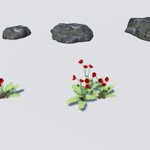
Not the most sensible thing to do, but to keep testing #Houdini Engine in #GodotEngine, I made two more generators - poppies and rocks. Also significantly improved the tree shader. I feel like it's gonna come together to be a pretty neat biome generator example.
On a side note, I'm actually starting to quite enjoy the process of working with this Houdini Engine integration from a user POV. Making an HDA and getting it to work in Godot is pretty straightforward at this point, and I'm noticing that I'm spending more and more time playing with it just for the fun and creativity of it.


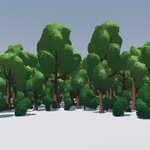
Needed some tree models to build an instancing example for #Houdini Engine in #GodotEngine. The natural solution: A tree generator :D
Now off to actually work on the instancing example...


Another progress update on the UI for #Houdini Engine in #GodotEngine
Basic generated input UI, as well as multiparm support. Tooltips are now also shown.
As always, everything is exposed to GDScript, so you can build your own UI using the same functions.
Working on the first big update to Houdini Engine in Godot, finally bringing auto generated parameter interfaces, as well as auto cook functionality. I also improved error/log prints, which now include any cooking messages coming from the Houdini node graph.
To go into a bit more detail, this UI just relies on a couple of methods and a stash property(to store parameter values) existing on the Godot node implementing the HDA, so it'll work both with a default node I'll provide, but you can also use it in conjunction with any custom node that handles outputs in any way you want.
Additionally, this entire UI is generated via GDScript, so if you wanted to make your own custom UI based on the data provided by the GDExtension, you absolutely could.
It doesn't support all types of parameters yet, and most importantly doesn't handle multiparms at this point, but that's right on my list after I add generated UI for inputs.
Hopefully I'll manage to release the update this month.
Exciting news, I just released a first version of the #Houdini Engine integration for #GodotEngine
The github has some basic documentation in the wiki, and I also made a YT-Video
I'd really appreciate any feedback, suggestions etc.
youtu.be/5iYb76kwDjU
github.com/peterprickarz/heg…
After a long time, another progress update on #Houdini Engine in #GodotEngine
Geo can now be fetched from Houdini in a recursively split dictionary - in this case based on materials for the sci-fi panels - could be anything though(collisions, LODs etc).
Getting really close to an initial release.

Update on #Houdini Engine in #godotengine
A lot of refactoring, and I finally got an instancing example!
To give a bit more insight into my thought process and what I'm doing, the plan is to first expose a very convenient API to GDScript/C#, which allows directly handling nodes, inputs, parameters, attributes and mesh/point data.
I will then build a default HoudiniAssetNode, similar to Unreals HoudiniAssetActor - which is going to be a good default configuration and works with a bunch of predefined attributes, which should work great for simple tools and quick prototyping.
What you see here, is the output of a HEGoAssetNode.fetch_points() function, which is fed a config resource file. This config defines which attributes I want to read, filter and split by - This is quite extensible, as the splitting works recursively. As the config is just a tres, it's easy to create your own custom ones in editor!
Let's say you generate a house consisting of multiple meshes and instances, the meshes have collisions and lods, defined by attributes(imagine hego_surface_id, hego_material, hego_collision, hego_lod_level etc.)
Now the config can be set up in a way that when calling fetch_surfaces, you'd get a nested dictionary structure, first split by surface_id, then collision, and finally lod_level. The GDScript can then use this data to correctly instantiate the surface meshes, set up LODs and collisions.
An additional config on the fetch_points could divide points by a hego_res and hego_override_material attribute, filtering by hego_multi_instance = 1, and only retrieving "loose" points etc.
Let me know if you'd be interested in a quick and dirty devlog type video - I will properly present everything when I'm ready, but until then I would be up to share my process in more detail if people are interested.
Another update on #Houdini Engine in #GodotEngine
Got tracking node ids to work nicely, and setting parameters works now.
Still not a dynamically generated UI for parms, that's for much later. Focusing on the GDScript API for now.
#Houdini Engine in #GodotEngine update:
Getting closer to a minimum viable product in terms of it being useful. Now supporting actually connecting inputs to an HDA.
Still gotta add some way to track node ids and make sure not to create duplicates though.
Progress Update on #Houdini Engine in #GodotEngine
Our boy made it!
Basically exposed a function to gdscript that fetches the output geo of an HDA as a surface array.