

Simplifying blockchain for degens. I talk about marketing and communities. Worked with 15+ brands Builder & Evangelist @seraprotocol | Ambassador @Brave & $BAT
Joined September 2023
- Tweets3.7K
- Following124
- Followers165
- Likes8K




Wohooo, let's goo!!

Privacy is central to @brave and @AttentionToken. We're working with @ShieldFi to extend that privacy to trading for Brave's 130M+ monthly users.
Now live on Shield Swap: a private $BAT trading pair. Users can trade and provide liquidity without exposing balances or strategies.
1
12

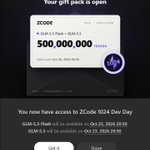
Thank you @zcode_ai, will be shipping a lot this weekend!


Happy 1024 & happy weekend, devs.
500M free tokens on ZCode: GLM-5.3 (200M) + GLM-5.3-Flash (300M). 200K packs, while they last.
Claim now. Use Oct 23 15:00 – Oct 26 01:00 UTC.
Update to the latest ZCode, claim in-app, then switch to Start Plan.
zcode.z.ai

33
Just got my wallet drained
I have zero clue how this happened, I have not connected my wallet literally anywhere shady, I only realised something is wrong when I saw a few notifications from the robinhood app
By the time I checked, the hacker had already drained the wallet entirely by leaving only about $2.
The wallet had over $500, which I had saved as liquid funds.
One another weird part was that my balance kept fluctuating between $50 and $2 when I was checking it (video attached).
This is the wallet address where the funds were transferred: F7p3dFrjRTbtRp8FRF6qHLomXbKRBzpvBLjtQcfcgmNe
And it holds over $2.8 million in assets
I know my $500 isn't that big of an amount for someone to take it seriously, but can we do something to recover?
In 2009, Martti Malmi sold 5,050 Bitcoin for $5.02.
He later mined 55,000 BTC on his laptop and later sold most of them.
But the reason he got involved with Bitcoin is more interesting than the money he missed.
2009: a 20-year-old finds Bitcoin
- Martti Malmi was a computer science student in Finland when he discovered Bitcoin.
- He emailed Satoshi Nakamoto and offered to help.
- Satoshi accepted.
- Malmi worked on the website, documentation, forums, and Linux support.
- He also kept his node running when the Bitcoin network typically had just 3 to 5 peers online.
October 12, 2009: the first known Bitcoin-to-dollar trade
- Malmi sends 5,050 BTC to New Liberty Standard.
- In return, he receives $5.02 through PayPal.
- That's roughly $0.001 per Bitcoin.
- But he wasn't simply cashing out.
- He later explained that he made the sale to help New Liberty Standard launch the first Bitcoin trading service.
- Bitcoin needed a way for people to exchange it for ordinary money.
Someone had to get things started.
2009-2010: mining on a laptop
- Malmi kept mining.
- He says he accumulated more than 55,000 BTC.
- At times, his laptop produced 200 to 300 bitcoins a day.
- He joked that he only turned off the miner when he wanted to play Counter-Strike.
2011: real life catches up
- Bitcoin reaches roughly $15 to $30.
- Malmi sells more than 10,000 BTC to buy a studio apartment near Helsinki.
- For a 22-year-old who hadn't had much money, it was a big deal.
- Then he leaves his job.
- Finding another one takes longer than expected.
- He ends up selling most of his remaining bitcoins at prices as low as $3.
Years later, he looks back.
- Malmi has acknowledged that holding all those coins would have made him a billionaire.
- But he also says he doesn't feel he lost anything from the Bitcoin adventure.
He helped build the network, He met great people, He contributed to something he believed mattered.
Malmi's first sale helped someone launch a trading service.
His work helped more people use Bitcoin.
And his story became part of the history he helped create.


1
2
451

In 1992, two computer scientists proposed making spam expensive by forcing computers to do work.
16 years later, a similar idea would become one of the foundations of Bitcoin mining.
The original problem was junk email.
1992: the inbox problem
- Cynthia Dwork and Moni Naor publish a paper called 'Pricing via Processing or Combatting Junk Mail.
- Their observation was simple.
- Sending email was cheap.
- Sending millions of emails was cheap too.
- And when sending a message costs almost nothing, spammers have very little reason to stop.
- Their solution? Make the sender's computer do some work before a message gets through.
The clever part
- The sender might spend 10 seconds computing a proof.
- The recipient could verify it in 0.01 seconds.
- Those were example timings from their paper, not fixed requirements.
- For one legitimate email, the cost would be small.
- For millions of unsolicited messages, the computational burden could add up.
- The sender pays in computing power rather than money.
1997: Adam Back takes the idea further
- Back develops Hashcash, a proof-of-work system designed to combat spam and abuse.
- It uses partial hash collisions.
- Finding a valid result requires repeated computation.
- Checking that result is cheap.
Sound familiar?
2008: Satoshi Nakamoto
- Satoshi's Bitcoin white paper explicitly references Hashcash.
- But the purpose has changed.
- Instead of making email spam expensive, Bitcoin uses proof-of-work to help secure a distributed transaction history.
- Miners repeatedly hash candidate blocks until they find one meeting the network's difficulty target.
- Other nodes can verify the result quickly.
- The work helps determine which chain the network accepts and makes rewriting past transactions computationally expensive.
A problem with junk email helped inspire a mechanism that became central to Bitcoin's security.
Dwork and Naor weren't designing Bitcoin mining in 1992, they were trying to make spam less attractive.
The lesson?
Sometimes the most consequential technologies begin as solutions to problems that seem completely ordinary.


1
1
50

In 1975, a cryptography expert rejected Ralph Merkle's paper on secure communication.
The reason? Transmitting key information openly was considered extremely dangerous. But Merkle kept going.
Today, his work is part of the foundations of modern cryptography.
1974: the idea
- Merkle is an undergraduate at UC Berkeley.
- He proposes a way for two people to establish secure communications without having previously shared a secret key.
- His professor rejects the proposal.
- Merkle drops the course but continues working on it.
1975: another rejection
- He submits a paper to Communications of the ACM.
- An anonymous reviewer writes:
"Experience shows that it is extremely dangerous to transmit key information in the clear."
- The paper is rejected.
- Merkle believes the underlying idea is sound.
- He refuses to abandon it.
1978: the paper finally gets published
- 'Secure Communications Over Insecure Channels' appears in Communications of the ACM.
- His work introduces what became known as Merkle's puzzles, a method for establishing a shared secret over a channel an eavesdropper can observe.
- It wasn't perfect security.
- It was a different way to approach the problem.
Then comes another breakthrough.
- Merkle also invents Merkle trees, a way to organize data using cryptographic hashes.
- Bitcoin uses them to summarize all the transactions in a block into a single Merkle root.
- They allow systems to verify that a transaction belongs to a dataset without needing to process every piece of data individually.
- A concept developed decades earlier is now built into Bitcoin's architecture.
And Merkle didn't stop at cryptography.
- He went on to research molecular nanotechnology and advocate cryonics, exploring questions about manufacturing at the molecular scale and whether future technology could repair preserved biological structures.
- His interests stretched far beyond one field.
The lesson isn't that every rejected idea is revolutionary.
It's that rejection is not a substitute for examining the mathematics.
Sometimes an idea needs better evidence.
Sometimes it needs better explanation.
And sometimes the people evaluating it simply haven't understood what they're looking at.


1
35


David Chaum built private digital money long before Bitcoin existed.
His cryptography worked but his company went bankrupt in 1998.
Here's the story of DigiCash.
1982: the idea
- Chaum publishes a paper introducing blind signatures.
- The concept is clever.
- Imagine putting a document inside a special envelope lined with carbon paper.
- Someone signs the outside.
- The signature transfers to the document inside, but the signer never sees what they signed.
- In digital payments, this can let a bank authenticate electronic cash without learning its serial number.
- The bank can verify the money without being able to trace every payment back to the person who withdrew it.
1990: DigiCash
- Chaum starts DigiCash to turn privacy-preserving digital cash into a real product.
- His vision?
Pay online without leaving behind the same trail of personal information that conventional payment systems could expose.
1994: digital cash becomes real
- DigiCash demonstrates an electronic payment over a computer network.
- This is years before online shopping becomes mainstream.
- The technology is working.
- But getting people to use it is a different problem.
1995-1997: the banking route
- DigiCash partners with banks to issue its eCash technology.
- Mark Twain Bank becomes the first US bank to offer it.
- Other financial institutions explore or license the technology, including Deutsche Bank.
- But each partnership brings a dependency.
- Banks have to issue the money.
- Merchants have to accept it.
- Consumers have to choose it over payment methods they already understand.
- The network never reaches the scale DigiCash needs.
1998: bankruptcy
- Mercantile Bank, the only US bank testing DigiCash's system, ends its relationship with the company.
- In November, DigiCash files for Chapter 11 bankruptcy.
- The company is roughly $4M in debt, according to contemporary reporting.
- Chaum's cryptography wasn't the only problem.
- He later pointed to the immaturity of internet commerce, difficult software distribution, and a lack of consumer awareness about privacy.
- The product arrived before the market was ready.
The interesting part
- Chaum had solved an important cryptographic problem.
- But cryptography alone couldn't create a payment network.
- DigiCash needed banks, merchants, consumers, and a way to get all three to adopt the same system.
- Bitcoin would later take a different approach to issuing and transferring digital money, without relying on a single company to run the currency.
DigiCash didn't fail because privacy was a bad idea.
It showed how hard it is to turn a brilliant technical idea into a functioning monetary system.


1
66

Nick Szabo was the one who thought about smart contracts way before Ethereum existed.
He published this idea in 1994, Ethereum launched in 2015.
Here's what makes his story interesting.
1994: an idea ahead of its time
- Szabo proposes smart contracts.
- His definition: computerized protocols that execute the terms of an agreement.
The goal?
- Reduce reliance on trusted intermediaries.
- Lower transaction costs.
- Automate parts of contract performance.
- Make certain agreements enforceable through their design.
The infrastructure to make this work at scale wasn't there yet.
1997: he explains the idea further
- Szabo publishes 'Formalizing and Securing Relationships on Public Networks'.
- His research brings together several fields:
> Computer science
> Cryptography
> Economics
>Contract law
- He explores how software and cryptographic protocols can secure digital relationships.
- One of his examples is a vending machine.
> You insert money.
> The machine checks the conditions.
> It releases the product.
> No cashier needs to approve the transaction.
- Now imagine applying that principle to digital assets and financial agreements.
But there's a catch.
Code can execute rules precisely, It can't automatically resolve every real-world dispute or interpret every ambiguous promise.
The challenge is deciding which parts of an agreement can actually be automated.
2015: Ethereum launches
- Ethereum makes it possible to deploy general-purpose smart contracts on a blockchain.
- An idea Szabo had explored more than 20 years earlier now has infrastructure that can support a much wider range of applications.
The interesting part of Szabo's story?
He approached a problem through law, economics, and computer science together.
Sometimes the next big technological idea comes from understanding a problem that doesn't belong to just one field.


1
30

Hal Finney received the first Bitcoin transaction.
Five years later, he was dead.
But the story between those two events is worth knowing.
2009: the beginning
- January 12: Satoshi Nakamoto sends Hal Finney 10 BTC.
- Finney is one of the first people to run Bitcoin and help debug it.
- In August, he is diagnosed with ALS, a progressive disease that affects nerve cells controlling voluntary muscles.
He continues working.
2011: things get worse
- Finney retires from his day job as his symptoms progress.
- His body is becoming less capable of doing what his mind still wants to do.
- But he doesn't give up programming.
2013: writing code with his eyes
- Finney is now essentially paralyzed.
- He uses an eye-tracking system to control his computer.
- He develops software to control his wheelchair with his eyes.
- He continues programming, despite being roughly 50 times slower than before.
He later writes that programming gives him goals.
And he is still thinking about Bitcoin security.
One of his projects, bcflick, explores using Trusted Computing technology to make Bitcoin wallets more secure by enforcing daily spending limits.
He is still building.
August 28, 2014
- Hal Finney dies at 58.
- His body is cryopreserved at Alcor, following arrangements he had made more than 20 years earlier.
- Whether cryonics will ever work remains an open question.
But his work with Bitcoin is already part of history.
The detail that stays with me is that, as ALS took away his ability to move, he kept finding ways to do the work he loved.
He didn't need a motivational quote.
He needed a way to keep coding.


1
47


Hey @adcock_brett, what an amazing product you have made. Hark is honestly better than my expectations. Sooooo much better than hallucinating shitty ai claiming to be world class. Oh my goodness it does everything so well. Used it to find vendors + some shopping. Always does it's research well. GG man!
2
49
Been building around Sera for a while now, and this is probably the most exciting part of the journey.
The goal is not to build another DEX.
It's to build the infrastructure that makes FX actually work onchain, then give the ecosystem the tools to build on top of it.
And we're just getting started. 🫡

How does @seraprotocol make money?
We make money by creating impact to the world.
We believe as more and more currencies go onchain, they all need a place to exchange. As they start exchanging, anyone who provides liquidity will earn the spread.
The returns you get fluctuates with maker and taker volumes. Right now it’s 20%+ APY.
We were victims of what could have been the world’s FX settlement protocol (@terra_money). We’ve met people who understood what we are doing, invested in us, supporting us and growing with us.
As we build, we realise we are back to 2017 @ethereum, when @VitalikButerin first posted about the genesis of @Uniswap:
reddit.com/r/ethereum/s/R4Vp…
As we rebuild FX Onchain, on Ethereum, we will keep open sourcing what we’ve built to strengthen the ecosystem:
1/ Open Source Settlement Price Oracle for FX
- not RFQ, not reference rates, actual settlement rate onchain
2/ Open Source Stablecoin Payment Gateway
- so we can all make global payments, merchant payments, online payments, offline payments, at the cost of 0%, $0 and instant (seconds!)
3/ Open Source KYT/KYA for Compliant FX transactions
- updated from over 160+ sources, works with industry standards like Width.com (that combines traditional KYC, KYB and other risk indicators)
4/ Open Source ZK-Circuit for FX (Sera’s Quasi L2 release)
- so all txns can be $0, instant, frictionless stablecoin payments, users does not need to have ethereum:native, ETH-L1 compatible issuers does not have to re-issue on our L2
5/ Open Source Orderbook
- so users can see our emergency withdrawal mechanism, which means even if Sera is down or the team is dead, you can withdraw anytime on the contract level
6/ Open Source Point of Sales for Merchants
- so merchants can accept Stablecoins, pay salaries, expenses and earn yield on idle money
7/ Open Source eWallets
- so anyone can build their own branded wallet, introduce global loyalty programs powered by Stablecoins, enhance their existing neobank or fintech business
8/ Open Source Lending, Yield, Earn, Savings
- so anyone can build, customise, grow, define their own parameters and tailor their strategies
9/ Open Source Launchpad
- so crowdfunding platforms, especially for the common good, underserved victims, entrepreneurs and the greater society can raise funds in stablecoins globally
10/ Open Source Arbitraging Tools
- so anyone can hedge FX, draft FX contracts, define swaps, snipe good deals
11/ Open Source Sera.cx DEX
- so anyone can build their own stablecoin DEX
+ many more as we rebuild DeFi FX on Ethereum
All code bases will be LIVE on Sera.cx’s GitHub and will be supported by a growing base of core contributors (currently at 10+):
github.com/sera-cx
This is a glimpse of what’s to come. We wish the best journey for anyone and everyone coming onchain.
We’re bullish with ERC-4337, EIP-8141, EIP-8288 and many other advancements especially in the next 2-3 years of Ethereum’s development - formally verified, quantum resist-ed!

1
1
25
Pulkit Lather retweeted

🏎️ The grid is set. The engines are on. The hack is coming closer.
hackCBS 9.0 is set for 31st October – 1st November 2026 – 24 hours of building, breaking, learning & winning.
Ready to race your way to the finish line?🏁
🔗 hackcbs.tech
#hackCBS9 #hackathon #Tech

