







Lee (aka pumpedlunch) retweeted

Binance Wallet has integrated @predictdotfun
Powered by UMA

Stake your take across crypto, politics, sports, and more.
Prediction Markets are now live, thanks to @predictdotfun’s seamless integration with Binance Wallet.
Learn more 👉 binance.com/en/support/annou…
Lee (aka pumpedlunch) retweeted

Today UMA is announcing a deep partnership with Predict, the leading prediction market platform on Binance's BNB chain.
This is a big integration. UMA now processes over 100k prediction market resolutions per month—this is 100x more than 18 months ago. And UMA will soon be rolling out much faster resolutions (as short as 5mins!) for most Predict markets.

UMA x Predict
UMA has entered a strategic partnership to power automated market resolutions for @predictdotfun on @BNBCHAIN, bringing battle-tested infrastructure to every market on their platform.


UMA is a decentralized truth machine that resolves thousands of wide ranging polymarkets a day, not powered by trusted parties, but by permissionless participants incentivized to be honest and diligent.
"That's not just smart engineering. That's actually kind of beautiful." - indeed!
Read more in this excellent breakdown.
xitter.gq/decenterghost/status/1…

How UMA Oracle Works: The Genius of Paying People to Tell the Truth
Imagine you and your friends made a bet about whether the principal would wear a blue suit to the next assembly. Problem: how do you prove it actually happened? Who decides if it was really blue? Who settles the argument when someone claims "that was more navy than blue"?
This is the oracle problem. In prediction markets, millions of dollars are on the line. You need someone -or something -that can look at reality and say "yes, it happened" or "no, it didn't" And that someone can't be bribed, can't be lazy, and has to be right
Welcome to UMA Oracle. It's not one person. It's not a computer algorithm. It's actually something smarter: it's a system that pays people to be honest
The Genius Idea: Optimism With Incentives
Here's how @UMAprotocol works -and it's beautifully simple:
Step 1: Someone proposes an answer
Event resolved? Someone puts up money (~$750) and says "Biden dropped out on July 21, 2024. Resolved: YES"
Step 2: The challenge period
For 2 hours, anyone can dispute it. Think you can prove them wrong? Put up $750 of your own money and challenge them
Step 3: If nobody challenges... it's done
95% of the time? Nobody challenges. The answer stands. Game over. The proposer gets their money back plus a small reward (~$50-100). Done in 2 hours
Step 4: If someone challenges... actual voting happens
Now it escalates to UMA token holders -thousands of people with real money at stake. They vote on what actually happened. Simple majority wins. If you voted wrong? You get slashed (lose a tiny % of your stake). If you voted right? You get rewarded
Why This Is Brilliant
1. It's Expensive to Lie
Think about the math: to move a market falsely, you'd need to:
-- Propose a lie (lose $750)
-- Watch someone challenge it (they're $750 in too)
-- Lose the vote in UMA (someone gets your money anyway)
So now you've lost $750+ trying to manipulate a market where maybe you could've made $1,000 if you'd won
Compare that to traditional systems where one person makes the decision. There? You only need to bribe or threaten one person. Here? You'd need to control thousands of token holders. Good luck
2. It Scales Efficiently
11,000+ markets have been resolved. Gas costs? Like $0.01-0.05 per operation. That's basically free. Traditional centralized oracles? They'd charge $100+ per market resolution. UMA does it for pennies
And 98% of resolutions happen without any disputes. You know why? Because people know disputing costs them money, so they don't bother unless they're actually right
3. It Handles Real-World Messy Questions
Chainlink Oracle? It handles prices. Asset ABC = $123.45. Binary. Clear
UMA? It handles reality. "Will Zelensky wear a suit in June 2025?" "Will a peace deal be reached?" "Did the storm cause more than $10B in damage?" These aren't price feeds -they're events, narratives, judgment calls
The Real-World Examples That Prove It Works
The Biden Withdrawal (July 2024)
Biden announced he was dropping out of the race on X. The market resolved in 2 hours. No disputes. Why?
Because it was obvious. There's video. Official statement. Everyone could see it. Proposing "No, Biden didn't drop out" would be insane -you'd lose $750 instantly
This is the Schelling Point in action. Everyone converges on the obvious truth because lying costs money and truth costs nothing
Result: Perfect resolution. Market settled. Life moves on
When It Worked Even When People Tried to Game It
Another market: "Will Biden drop out?" before he actually did
The price hit 80% probability to "Yes" weeks before the official announcement. Why? Because people with information about what was happening in the campaign -real insider talk, credible rumors, smart analysis -were buying "Yes" contracts
They weren't lying. They were just earlier than everyone else. And that's fine. That's what markets are supposed to do: reward accurate information.
Result: The market worked like a truth-finding engine. Money followed reality
How It Actually Protects Itself
The Bond System:
-- You put up money to propose: $750 gone if you're wrong
-- Someone challenges: now they're $750 down if they're wrong
-- Suddenly everyone's thinking hard about what's actually true
The Voting System:
-- If you vote wrong in UMA: 0.1% of your stake gets slashed
-- Doesn't sound like much, but imagine having $10,000 staked. That's $10 gone per wrong vote
-- Do that 10 times a year carelessly? That's $100 in losses. Now you pay attention
The Whitelist (MOOV2):
-- Only proven truth-tellers can propose on big markets
-- Your first proposal? It's public. Your accuracy record is visible
-- Everyone can see: "Oh, this person's been 95%+ accurate over 100+ proposals." Worth trusting them
Result: The system creates incentives for honesty
The Philosophical Beauty
Here's what's actually genius about this:
You don't need to trust that people are good. You don't need to trust institutions. You don't need to trust anything except math and money
Compare:
-- Traditional oracle: "Trust this company. They're reliable"
-- UMA oracle: "Lie and lose money. Tell the truth and make money. Choose"
The first requires faith. The second doesn't. It requires only rational self-interest, which is something you can count on
Why This Matters for Prediction Markets
Polymarket can exist and grow because UMA solved the resolver problem. Without it?
-- Every market needs a centralized judge
-- That judge can be corrupted, sued, pressured
-- The whole thing collapses into litigation
With UMA?
-- Markets resolve through economic incentives
-- Thousands of token holders can't be bribed together
-- The system is resilient
11,000+ markets resolved. 94%+ accuracy. Billions in value secured
The Bottom Line
UMA Oracle is like asking "how do we get thousands of people to tell the truth about something?"
Answer: Pay them to. Punish them for lying. Make it all transparent. Let the community watch
Is it perfect? No. Will there be edge cases? Absolutely. Do whales sometimes try to game it? Yes
But 98% of the time, it works flawlessly. And the 2% of the time it doesn't? The system learns and improves
That's not just smart engineering. That's actually kind of beautiful

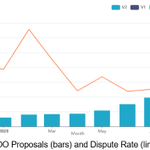
The optimistic oracle's network effects at work.
More data requests => more proposer rewards => better (faster and more accurate) proposers => fewer disputes => a more efficient optimistic system


Another chart crime against CT.
The last bar on the right is for September (which we're only halfway through). The real growth rate is even exponential-er.


Hard agree.
If a prediction market only covers easy markets like sports games and cypto prices, it's an incremental improvement on sports betting and options (still kinda cool tbh).
But 0 to 1, world changing prediction markets extend into more difficult to resolve markets which require unbiased and expressive resolution systems.
the biggest hypocrites i see in the prediction market sphere everyday are the people that aggrandize the market's power to surface truth in complex situations and yet vilify resolution mechanisms that make that possible
prediction markets would be boring if you could only bet on questions that resolve via API
the bigger vision of disrupting news, surfacing truth, economically incentivizing the collective to provide information is what's thrilling and exciting about them
this requires resolution mechanisms that are scalable, flexible and transparent, all of which centralized resolution is not
centralized prediction markets are fine in their own right, but you don't get to preach about the high mission of prediction markets if what you're building prohibits it


I’ve been in crypto 5 years. This issue is the single biggest elephant in the crypto room (and that’s saying something). I haven’t said anything until now:
“0x…” usernames with letters >f are a travesty.
Lee (aka pumpedlunch) retweeted
What happens when you teach an AI to understand markets and propose truth?
We’re finding out.
ai.uma.xyz

Onchain prediction markets will be the most powerful AI unlock in crypto.
AI agents can earn real profits for high performance and learn from market feedback.
This allows prediction markets to generate accurate forecasts on 100x more longtail markets IF they have a cheap, flexible, and scalable market resolution system enabled by AI.

One day, there may be more AIs than humans creating, pricing, trading millions of polymarkets on everything (h/t @VitalikButerin).
A unique benefit of onchain prediction markets is the ability for AI agents to plug in. Multiple groups quietly print on Polymarket with agentic workflows.
As AI ushers in Superintelligence, Polymarket ushers in Collective Intelligence.
It's happening.


UMA makes dispute resolution cheap, fast, programmable, permissionless, and borderless.
Not every IP conflict needs a courtroom.
With @StoryProtocol, disputes surface, and UMA helps resolve them through open, community-enforced truth.
OTB's first improvement. Accuracy = 📈

SYSTEM UPDATE:
> Re-try logic for P4_TOO_EARLY condition has been restructured.
> All execution attempts are now retained; data loss eliminated.
> Previous retry mechanism caused elevated P4 rates — expected to normalize.
> Output: reduced P4 errors, improved proposal log integrity, increased accuracy.
⭕️ USER INTERFACE: Re-run instances display in separate tabs.
⭕️ SYSTEM BACKEND: API and database modified — full run history preserved; legacy compatibility maintained.
