

Eclectic dabbler pursuing the modest goal of omniscience. Striving for Hasidic annihilation of self. Aramaic/Yiddish preferred but Heb/Eng are okay, I guess
Brooklyn, NY
Joined March 2017
- Tweets7.9K
- Following5K
- Followers1.7K
- Likes1.3K



Happy belated new year l'minyan shtarot! 🎉
xitter.gq/GrecoNation/status/210…


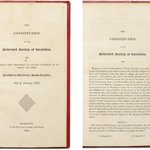
It's taken 200 years but the chaseedishe world is finally catching up with Reform Judaism from the 1820s
xitter.gq/KolHaolam/status/21126…


The Constitution of the Reformed Society of Israelites, Charleston, 1825:
Finally, they rejected out of hand the practice of public purchase of certain synagogue honors in the midst of services, a practice they disdained for both its “uselessness and impropriety.”


Uploading... 👀
xitter.gq/shlomokatz/status/2107…


I’ve noticed that our musical Hallel on Chol Hamoed Sukkos is being discussed on social media.
Many were inspired by it. Others criticized it as being some sort of “reformation” of our Avodas Hashem.
The specific, technical question is not a new one. There is room for legitimate debate in the realm of halacha and minhag.
But something else has crept into this conversation, and I think it needs to be called out.
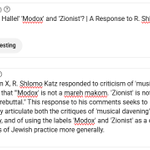
Musical Hallel is suddenly being dismissed by some as “a Modox invention.” As a “Zionist” phenomenon. As something that belongs to a supposedly “less serious” stream of Orthodox Judaism.
And that is not a Torah argument.
There is an enormous difference between a halachic debate and saying, “Of course those kinds of Jews would do something like this.”
The first is a machlokes. The second is using Torah language as cover for contempt toward other frum Jews. And we should be intellectually honest enough to know the difference.
You are completely entitled to believe that another Torah community is mistaken. Torah Judaism has never had full uniformity of minhag, hashkafah, or practice.
But disagreement in this realm demands enough respect for another Torah community to actually engage its position.
And no - labels are not arguments.
“Modox” is not a mareh makom.
“Zionist” is not a legitimate rebuttal.
Our mesorah contains fierce machlokes. Beis Hillel and Beis Shammai were not engaged in a campaign of “let’s all get along.” They believed that matters of Torah were worth arguing about.
But they argued about Torah.
That distinction matters.
Because there is something deeply unhealthy about reaching for Torah language when what you really want to say is that you do not respect the religious world of the Yidden standing across from you.
We can argue more seriously.
We can insist that Torah ideas be defended with Torah substance rather than sociological cudgels.
If there’s one thing that we can learn on this 3rd anniversary of October 7th, it is perhaps that we need to recover more honest machlokes. The art of holy disagreement while still loving and respecting our brothers and sisters who might not agree with every one of our opinions.

Did the Czar of Russia pass through the fields and towns of Belarus shortly before the Alter Rebbe said the parable of the "king in the field"?
And what are the similarities between the AR's parable and R. Nachman's tale of the "humble king"?
👇
youtu.be/O7OOkYaYBhc

What is the history of Yiddish? What is Chabad's historical relationship with Yiddish? Why has English been such a threat to Yiddish? And where does Chabad stand today?
Find out whether I discussed any of those things with @TorahKnwldgeBwl here:
youtu.be/jiZa-GVry_E

In January 1974, the US entered its first experiment with using permanent DST during the winter. Here's how the Jewish community reacted.
"Jewish Prayer Car for LIRR?" (NY Daily News, Jan 8, 1974)

The real date for this teshuva in Igros Moshe is actually from this winter of 1974, when it was published in a kovetz by the MTJ kollel


Lots of websites running with this inaccurate 'disocvered in the Moscow archives' story.
1) The MS is located in the Berlin State Library
2) It's scanned online where anyone can find it
3) It was simply mislabeled as Rashi, when it in fact alternates between Rashi and Rashbam


100 years ago, this leading Polish rabbi personally petitioned President Coolidge regarding the plight of agunos in Europe who were impacted by the draconian 1924 immigration quotas

For more context on how the immigration quotas exacerbated the plight of agunos in Europe at this time, see this recent article by Prof. Jonathan Sarna
academia.edu/144909915/