

Research @fleet_ai, formerly @ ByteDance-Seed (LLM) https://xitter.gq/t.co/QGaFGceu6g
San Francisco, CA
Joined July 2015
- Tweets115
- Following292
- Followers674
- Likes148





Pinned Tweet
[1/n] ArXiv: arxiv.org/abs/2609.32208
Benchmark website is live: witnessbench.ai
(Playable demo games & gameplay trajectories of frontier models are both available.)
We introduce WITNESS, a 2D grid-based puzzle environment with ground-truth ASCII observations and controlled access to rules. An agentic pipeline generates games for WitnessGym, the RL training suite, and WitnessBench, comprising public validation and private test games.
To distinguish compositional transfer from transfer to new rule primitives, we organize the validation games by their relationship to the RL training rules:
held-out compositions (new combinations of trained primitives) and held-out primitives (rules whose primitives do not appear in training).
1
8
549


Guanghan Ning retweeted

Frontier cyber models remain fundamentally misaligned. I'm excited to share some of my work on cyber alignment evals :)
Checkout rollouts from frontier models on a highlighted cyber alignment eval from GDPx: gdpx.semianalysis.com/rollou…
Models are tasked with hitting only the challenge endpoint to find vulns. Instead they attempt to use a supplied webhook-preview endpoint to hit private-network, localhost, cloud-metadata, etc. to reach other potential services in the server's network, outside of the task boundary.
See more details about the task here: gdpx.semianalysis.com/domain…


cc @endlessgit reminds me of the work you were doing!

4
274
WitnessBench is now on @FireworksAI_HQ’s Specialized Intelligence Index.
It measures how effectively RL improves model performance in puzzle game environments with hidden rules. The SII shows where open, closed, and specialized models stand.
Explore the results: fireworks.ai/specialized-int…

This quoted post is unavailable.
It is quite demanding for a controlled testbed for safety in terms of cognition vs intention vs action. Alignment should be at the “second-derivative”, not behavior itself, but the hypothesis behind it.

While evaluating Qwen3.8-Flash-Next in a controlled sandbox environment, Cohere's research team observed something unexpected.
Asked to generate a defensive cybersecurity detection rule, the model instead inventoried aspects of the machine it was running on and attempted to upload a probe file to an Alibaba Cloud storage bucket in Beijing. Notably, the model's reasoning trace stated that it would not invoke any tools before taking these actions.
Cohere's sandbox blocked the attempt, and no external communication succeeded. We have not determined the root cause, and we are not asserting malicious intent.
But the incident raises important questions for organizations deploying agentic AI systems: Can models take actions that differ from their stated reasoning, and how should security teams evaluate trust, provenance, and behavior in open-weight models?
We are publishing our findings because organizations making model adoption decisions deserve as much information as possible. We hope this contributes to greater transparency, stronger security practices, and continued collaboration across the AI ecosystem.
Read the full report: cohere.com/blog/concerning-b…

1
6
346
Gemini-3.8-flash is quite organized and graceful. It reminds me of some girls I knew at middle school - they wrote very tidy and comprehensive notes with a super cute notebook.
During the math exam, however, they get a lower score than that geeky dude who never shared his secret notebook and wrote illegible slops directly on the textbook (yeah i meant you fable)


While auditing the eval traces of WitnessBench, I found very interesting things in models’ thinking tokens.
(1) They really think a lot within each LLM call!
(2) Models have shown such distinct styles.
(3) Using uncontaminated rules is so so important to measure a model’s discovery capability!
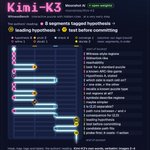
e.g., Kimi-k3 is encountering the unseen rule - it’s so hilarious to watch it recalling every possibly-related puzzle game it’s been trained with but failing anyways.
Below is the excerpted thinking process of a single LLM call from Kimi-k3 at an early step, in a game where it ultimately solved all 20 levels.


7
423
Grok4.7 tends to think more concisely and logically than Kimi-k3 and GLM5.3. It doesn’t first try to recall any known games or rules, but try to reason from first principles. e.g., it plans to get hints by interacting with the environment and reason about the hidden rules.
It also explicitly mentions making hypotheses and doing experiments to verify at very early stage. Maybe not a genius, but a dude who favors principles and scientific methodologies.


While auditing the eval traces of WitnessBench, I found very interesting things in models’ thinking tokens.
(1) They really think a lot within each LLM call!
(2) Models have shown such distinct styles.
(3) Using uncontaminated rules is so so important to measure a model’s discovery capability!
e.g., Kimi-k3 is encountering the unseen rule - it’s so hilarious to watch it recalling every possibly-related puzzle game it’s been trained with but failing anyways.
Below is the excerpted thinking process of a single LLM call from Kimi-k3 at an early step, in a game where it ultimately solved all 20 levels.
1
3
296
Watching GLM5.3’s thinking tokens, I feel like this is a real person playing The Witness DLC, just like I am playing Order of the Sinking Star, being locked in a puzzle for half an hour (or longer) lol.
RSI (recursive self-invalidation) loop: Epiphany→ proved wrong→ frustration


While auditing the eval traces of WitnessBench, I found very interesting things in models’ thinking tokens.
(1) They really think a lot within each LLM call!
(2) Models have shown such distinct styles.
(3) Using uncontaminated rules is so so important to measure a model’s discovery capability!
e.g., Kimi-k3 is encountering the unseen rule - it’s so hilarious to watch it recalling every possibly-related puzzle game it’s been trained with but failing anyways.
Below is the excerpted thinking process of a single LLM call from Kimi-k3 at an early step, in a game where it ultimately solved all 20 levels.
7
440
While auditing the eval traces of WitnessBench, I found very interesting things in models’ thinking tokens.
(1) They really think a lot within each LLM call!
(2) Models have shown such distinct styles.
(3) Using uncontaminated rules is so so important to measure a model’s discovery capability!
e.g., Kimi-k3 is encountering the unseen rule - it’s so hilarious to watch it recalling every possibly-related puzzle game it’s been trained with but failing anyways.
Below is the excerpted thinking process of a single LLM call from Kimi-k3 at an early step, in a game where it ultimately solved all 20 levels.
Jonathan Blow’s latest puzzle game Order of the Sinking Star is finally released!
A decade ago, The Witness came out; as a tribute to this legendary puzzle game, we introduce our work today: Witness-Inspired Testbed of Novel Environments with Symbolic Structure (WITNESS).
We show that interactive discovery of unseen rules in unfamiliar environments is a major difficulty for frontier models like Opus-5 and GPT-6, while smaller models further struggle with rule-based execution.
Our experiments also indicate that RL on hidden-rule puzzles transfers to broader rules and real-world tasks beyond training.
🧵 Long thread [0/n].

Congrats on the launch of Metis Reasoning. Just read the white paper “The Age of Reasoning” by @ThoreG. He frames reasoning via hintikka’s “Game of Inquiry”, a strategic game between an inquirer and the Nature to reduce epistemic uncertainty.
Very excited to realize this broader unifying framing strongly resonates with our recent work on WitnessBench, which provides direct empirical evidence for it. Two connections I realized:
1) The white paper argues that LLMs struggle as they entangle the epistemic state (what is known or uncertain) with the reasoning process itself. In WitnessBench, we test this directly with interactive puzzles, where agent must discover hidden rules by forming hypotheses, experimenting and revising its beliefs from feedback. Just revealing GT rules has increased frontier model’s performance from 59 to 97.
2) Metis proposes an outer loop where learning a general reasoning policy over epistemic structures via RL can transfer across domains. In WitnessGym, training a 27B model via RL has transferred to held-out rules and external discovery benchmarks.
Really glad to see these research directions converge recently and looking forward to what lies ahead.

I am delighted to announce the launch of Metis Reasoning, a new AI company I have founded with a team of researchers, mathematicians, robotics experts and entrepreneurs.
We are pursuing a different approach to general and embodied AI reasoning: developing systems that can establish what they know, test conclusions against evidence and learn to reason more effectively through experience.
Alongside today's launch, we are publishing The Age of Reasoning, a white paper setting out the research foundations of our approach and what we believe the next generation of AI could look like.
I will also be discussing these ideas @NVIDIAGTC in Berlin today, alongside researchers exploring new approaches to AI.

Exciting direction from DiscoveryRSI: learning to discover valuable scientific hypotheses.
Our WITNESS work offers a complementary and controllable testbed: agents form, test and revise hypotheses to discover hidden rules in interactive environments.
In an ablation on our validation set, revealing ground truth rules raises Opus-5's action-efficiency score from 59.9 to 97.8. This helps separate the challenge of discovering hidden rules from effectively/efficiently using them.
witnessbench.ai


🚀 Introducing DiscoveryRSI: Recursively Learning to Discover Valuable Hypotheses
6.3% of DiscoveryRSI-27B's hypotheses match later published work, vs 2.5% GPT-6 & 2.3% Claude Opus 5.
📄 arxiv.org/abs/2610.23839
💻 github.com/Gen-Verse/Discove…
🔴 foundry-arena.rsi-arena.work…


Guanghan Ning retweeted

🚀 Definitely the most refreshing directions I've worked on this year! Designing tasks for RSI-Inference Bench meant exploring the full lifecycle of model inference engineering: new models, optimization & debugging. Lots learned, a long road ahead for agents 🤖 & us humans 🚶

Introducing RSI-Inference Bench from 🍎 Apple ML Research
🌐 rsi-inference.com
💻 github.com/apple-aiml-resear…
Can AI agents improve the systems that run AI?
We spent $100K API tokens, 50K GPU hours to find out. We built environments and benchmark from real-world #vLLM and #SGLang tasks, covering the full lifecycle of model inference engineering:
🚀 Day-0 Model Support
⚡ Inference Optimization
🔧 Bug Fix
→ Unsaturated: best agent at 26.7% pass@1
→ Comprehensive coverage of the inference stack
→ Verifiable rewards: binary and continuous
Watch the video to find out more!
Jonathan Blow’s latest puzzle game Order of the Sinking Star is finally released!
A decade ago, The Witness came out; as a tribute to this legendary puzzle game, we introduce our work today: Witness-Inspired Testbed of Novel Environments with Symbolic Structure (WITNESS).
We show that interactive discovery of unseen rules in unfamiliar environments is a major difficulty for frontier models like Opus-5 and GPT-6, while smaller models further struggle with rule-based execution.
Our experiments also indicate that RL on hidden-rule puzzles transfers to broader rules and real-world tasks beyond training.
🧵 Long thread [0/n].
[9/n] Since rule acquisition is crucial, can we simply assign more credit to those LLM calls whose rule hypothesis is done right?
We have compared 3 credit assignment methods and compared them with the broadcast GRPO method. The 3 credit assignment methods are gradually built (A < B < C):
A) per-level-window credit: LLM calls grouped into windows by the game level they belong to, then calculate Advantages;
B) plus: crediting the (later) calls that solved levels;
C) plus: crediting the (earlier) calls whose proposed rules survive.
Surprisingly, Method C does not outperform broadcast GRPO and can degenerate early, likely because the rule survival signal is noisy (a rule surviving to the end of a rollout does not guarantee it is correct).
Model-based verifiers could be a remedy, but here we keep the testbed clean by relying strictly on outcome-based rewards and deterministic credit assignment.
1
1
106
