

Radio & maker electronics. I design hardware and run ELEKITSORPARTS. Projects, measurements & lessons from my workbench. RadHive newsletter on Substack.
Worldwide
Joined November 2015
- Tweets572
- Following204
- Followers242
- Likes390






K1FM’s four-turn magnetic loop tunes down to 1.3 MHz
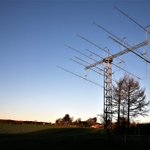
Alain, K1FM, rebuilt his single-turn magnetic loop for the lower bands. The new radiator uses one 40-foot length of LMR600 coax wound into nearly four turns, about 92 cm in diameter and spaced 80 mm apart. The PVC mast, smaller LMR400 coupling loop, and motor-driven vacuum capacitor came from the original build.
The 3D-printed clamps and spacer combs hold the stiff coax in place. The longer pieces bolt together from short sections, so they can print flat on a 15 × 15 cm bed without supports.
K1FM measured a tuning range of 1.3–6.3 MHz, covering 160, 80, and 60 meters. Reaching 40 meters would take a shorter radiator. PSK Reporter showed his 60-meter FT8 signal reaching Europe, and he reported that tuning became unstable on 160 meters during FT8 transmissions above 20 W.
K1FM’s build notes, parts list, and print-file link
k1fm.us/2026/11/k1fm-qro-loo…
#HamRadio #MagneticLoop #Antenna #3DPrinting #FT8


One Raspberry Pi HAT for RTL-SDR, LoRa, GPS, and timekeeping
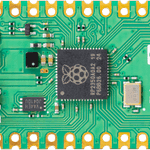
Hacker Gadgets has put an RTL-SDR receiver, an SX1262 LoRa radio, a satellite positioning receiver, and a battery-backed clock on one Raspberry Pi expansion board.
The RTL2832U/R860 receiver covers 100 kHz to 1.74 GHz, using direct sampling from 100 kHz to 28.8 MHz. It has a software-switchable 5 V bias tee to power an active antenna or preamp over coax. The LoRa radio works with Meshtastic on Linux for off-grid messaging, and the onboard clock keeps time while the Pi is powered off.
The HAT sits on the Pi’s 40-pin GPIO header, and the SDR uses a separate USB connection. There are individual antenna ports for SDR, GPS, and LoRa, with SMA and U.FL versions available. Hacker Gadgets lists the board for preorder at US$84.90.
Hacker Gadgets product page
hackergadgets.com/products/r…
Installation and configuration guide
hackergadgets.com/pages/rpi-…
#RaspberryPi #RTLSDR #LoRa #Meshtastic


59
The 2026 ARRL EME Contest wraps up November 28–29
The final moonbounce weekend runs from 00:00 UTC Saturday, November 28, through 23:59 UTC Sunday, November 29. This round covers authorized amateur bands from 50 to 1296 MHz. CW, voice, and digital modes are allowed, and every contact must be made via the Moon.
The exchange is a four-character Maidenhead grid locator. If station size or propagation prevents a grid exchange, a mutually understood signal report is allowed. Either way, each contact in the log needs both stations’ grids. Each completed contact earns 100 points, and distinct grids count as multipliers on each band.
Submit one combined Cabrillo or ADIF log for all weekends you operated. ARRL lists the deadline as December 29 at 23:59 UTC.
ARRL schedule and rules
arrl.org/eme-contest
Log submission
contests.arrl.org/arrlemesco…
#HamRadio #ARRL #EME #Moonbounce #AmateurRadio


1
148
The APRS–LoRa weather station starts logging outdoor readings
The Rev 1.0 outdoor PCB is now populated and wired to sensors. The test setup pairs an ESP32 and LoRa radio with the 3D-printed wind vane and a harness for the weather sensors.
The indoor ESP32-S3 unit receives the outdoor readings over LoRa. Its display shows temperature, humidity, pressure, light, UV index, wind speed, rainfall, and battery voltage. The web dashboard is saving temperature and humidity history to flash. The November 25 screenshot shows 279 reports in the 24-hour view, plotted as five-minute averages.
The outdoor enclosure is taking shape in CAD, with a display window, three cable glands for the sensor wiring, and a side-mounted antenna connector.
#APRS #LoRa #ESP32 #WeatherStation #HamRadio


1
1
92
Unofficial IC-705 firmware adds DMR, System Fusion, and P25 reception
BI1BIF’s firmware can now receive unencrypted DMR, Yaesu System Fusion (YSF/C4FM), and conventional P25 Phase 1 on the Icom IC-705. The November 24 v1.5.3 patch reduces audio dropouts on some YSF calls, restores playback on some P25 calls, and raises speech volume across all three modes.
APRS now keeps the last 64 received packets across a restart. FT8 and FT4 can also call a specific station and let you choose who to answer when several stations reply in the same time slot.
The patch targets Icom firmware 1.40 for Japanese, European, and US radios. Both regional builds passed recorded-signal tests. Reception and speaker audio on the radio itself still await a retest.
BI1BIF’s project and release notes
github.com/BI1BIF/IC-705-Fir…
#HamRadio #IC705 #DMR #APRS
A Raspberry Pi Pico 2 can now act as a USB voice codec for D-STAR and DMR.
Developer x0rro released xombe and xombe-stick v0.1.0 on November 12. xombe is a C library under the MIT license. It encodes and decodes D-STAR’s AMBE 2400 and DMR’s half-rate AMBE+2, and can convert between the two without decoding to audio first.
xombe-stick brings that library to the Pico 2, where it can emulate AMBE-3000R and AMBE-3003 USB devices such as ThumbDV and USB-3003. The developer reports testing with SerialDV, codecserver, AMBEserver, and ambed. The first firmware release is distributed as source for users to build.
At the stock 150 MHz, the developer measured 41% of one core for fixed-point encoding and 6% for decoding. Overclocked to 200 MHz, the board handled three full-duplex channels across both cores.
Both repositories flag that AMBE patents may still apply in some jurisdictions.
xombe library
github.com/x0rro/xombe
xombe-stick firmware
github.com/x0rro/xombe-stick
#HamRadio #DSTAR #DMR #RaspberryPi #OpenSource


69
An AM transmitter whose active element was a piece of pyrite.
In 2001, Nyle Steiner (K7NS) used a fine wire contact, or cat’s whisker, against a piece of iron pyrite to build an oscillator without a transistor or vacuum tube. At the right contact point and bias voltage, the junction showed negative differential resistance. That let energy from a battery make up for losses in the tuned coil and capacitor, sustaining a radio-frequency signal. One scope trace showed a carrier near 700 kHz.
A carbon microphone in the battery circuit varied the carrier’s amplitude with speech. Steiner reported hearing his voice on a nearby AM radio.
The hardest part was keeping the contact steady. A balanced arm inspired by a phonograph tonearm held the whisker in place long enough for the oscillator to run for several minutes.
Steiner’s original build and schematic (archived)
web.archive.org/web/20260115…
The Xtal Set Society Newsletter, July 2001, pp. 5–7
oldradios.co.nz/downloads/Ju…
#HamRadio #RadioHistory #HomebrewRadio #CrystalRadio


F4HWN 7.0 brings installable apps to Quansheng’s Fusion firmware
F4HWN v7.0.0 moves the app platform from Labs into Fusion, the everyday firmware for the Quansheng UV-K1 and UV-K5 V3. The catalog grows from 40 to 49 apps, and Fusion can resume an app that was open when you switched off the radio.
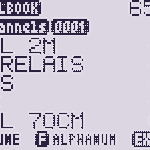
The new ChannelBook app lets you browse saved channels by scan list, a channel-name index, or memory number. CW Trainer adds on-radio Morse practice, and SetFnt offers 12 combinations of text fonts and frequency digits.
The release comes in two editions. Fusion runs the apps, while Service adds tools for radio-to-radio transfers and flash maintenance. UV Studio now installs a matching pack of fonts and menu labels after writing the firmware.
Official release notes
github.com/armel/uv-k1-k5v3-…
#HamRadio #Quansheng #UVK1 #F4HWN


A knob that changes the pattern on a steel plate
CrazyScience built a desktop Chladni plate that turns vibrations into visible patterns. At a resonant frequency, the steel plate vibrates in a standing-wave pattern. Grains bounce away from the parts that move most and gather along lines that barely move. Turn the knob to a different resonance and a new pattern appears.
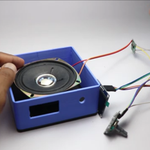
An ESP32-C3 Super Mini generates the tone, and a PAM8403 amplifier drives a small speaker. A 3D-printed coupler connects the speaker cone to the center of the 10 × 10 cm steel plate. The knob adjusts the frequency, the 1.3-inch OLED shows the setting and a pattern preview, and the firmware can save frequencies for later. The builder used semolina to make the patterns visible.
The build guide includes printable STL files, a wiring diagram, and the Arduino sketch.
instructables.com/Make-Sound…
#ESP32 #3DPrinting #Acoustics #DIYElectronics


115
Unofficial firmware brings Morse decoding and SSTV to the Icom IC-705
BI1BIF’s experimental firmware lets the IC-705 decode Morse and send and receive slow-scan TV pictures from the radio itself. The CW screen shows decoded text, estimated words per minute, and a waveform. The SSTV screen detects the incoming mode, displays the picture as it arrives, and can save it to the SD card. It can also transmit pictures stored on the card.
The project lists 23 SSTV modes, including Robot 36 and modes in the Martin, Scottie, and PD families. Operators tested CW and SSTV on a Japanese-market IC-705 running BI1BIF’s earlier v1.1.1 patch, based on Icom’s factory firmware 1.40 for that market (J140). The expanded set of transmit modes passed simulator and full-frame audio tests, with over-the-air checks for the added modes still pending.
BI1BIF credits SQ6EMM’s research into Icom’s firmware format. SQ6EMM’s repository documents the update format used by the IC-705, IC-9700, and IC-905.
SQ6EMM’s firmware research
github.com/sq6emm/ic705-ic97…
BI1BIF’s CW and SSTV project
github.com/BI1BIF/IC-705-Fir…
#HamRadio #IC705 #CW #SSTV


The Newone was a crystal radio built into a single earpiece.
The Japan Radio Museum dates this Japanese receiver to around 1926, about a year after radio broadcasting began in Japan. Its maker, 安良岡ラヂオ研究所, fitted an early fixed crystal detector inside the cylindrical handle. Unscrewing the end cap gave access to the detector.
The Newone needed an external antenna and ground. The received broadcast signal supplied the energy to drive the earpiece, so there was no battery to carry. The museum estimates that the set would only have been practical fairly close to a broadcast station.
Japan Radio Museum collection, item 11A310
japanradiomuseum.com/meseum1…
#CrystalRadio #RadioHistory #VintageRadio


52
Malahit DSP4s brings digital voice and SSTV decoding to a handheld SDR.
The new SDReleven receiver can decode compatible unencrypted DMR, D-STAR, P25, TETRA Direct Mode (DMO), and NXDN. It also decodes CW, FT8, FT4, RTTY, and SSTV directly on the radio. Decoded SSTV images can be saved to microSD as BMP screenshots.
Elecevolve lists a maximum spectrum and waterfall span of 650 kHz, up from 192 kHz on the DSP2. The vendor rates blocking dynamic range at 100 dB or more, versus 82 dB for the DSP2. USB I/Q bandwidth is 162 kHz.
The DSP4s tunes from 100 kHz to 1.62 GHz. The DSP2 reaches lower and higher, covering 10 kHz to 380 MHz and 404 MHz to 2 GHz.
Elecevolve listed the DSP4s at US$390 and showed zero stock on November 18.
Elecevolve product page
elecevolve.com/products/mala…
#SDR #Malahit #HamRadio #Shortwave #SSTV


1
176
Icom announced the IC-7110 on November 17 and plans to launch the 100 W model in Japan in late November. Its global announcement gives a winter launch window.
The IC-7100 successor delivers up to 100 W on HF and 50 MHz and up to 50 W on 144 and 430/440 MHz. The European version adds 70 MHz at up to 50 W.
The radio uses direct RF sampling below 74.8 MHz and has a detachable 4.3-inch color touchscreen with a live spectrum scope and waterfall. Dual receive lets you listen on HF or 50 MHz while monitoring a 144 or 430/440 MHz repeater.
The IC-7110 includes a CW decoder, an FT8 setup preset, D-STAR repeater monitoring, built-in GPS, Bluetooth, and firmware updates over Wi-Fi. Japan also gets the IC-7110M (50 W) and IC-7110S (10 W on HF and 20 W on 50/144/430 MHz).
On November 18, Japanese dealer CQ Ohm listed the 100 W model for preorder at the equivalent of about US$1,443 including tax. The listed reference price was about US$1,712.
Icom Japan launch announcement
icom.co.jp/news/9103/
Icom global announcement
icomjapan.com/news/4765/
#HamRadio #Icom #IC7110 #DSTAR


110
QMX Panadapter v2.0 adds RTTY to the M5Stack Tab5.
Steffen Lav (OZ1LAV)’s open-source project pairs the 5-inch touchscreen with a QRP Labs QMX/QMX+ over USB, providing a spectrum, waterfall and digital-mode operation without a PC.
Released on November 15, v2.0 brings a dedicated RTTY page alongside FT8, FT4, JS8, WSPR and CW. It receives and transmits directly on the Tab5, with matching controls in the browser.
RTTY features include automatic speed, shift and polarity detection, AFC, CQ/Answer/Exch/73 messages, and live keyboard sending. Supported speeds are 45.45, 50, 75 and 100 baud, with shifts from 170 to 850 Hz. The developer reports on-air validation of Auto against 75-baud stations; live 50/100-baud and contest pile-up testing remain outstanding.
The release also enlarges the receive-audio buffer and gives audio processing priority over the web server to address gaps and pitch drift under load. A v2.0.1 follow-up fixes the SD-card log-archive prompt when Wi-Fi is enabled.
The photos show a local Elecraft KX3 adaptation; the upstream project targets the QMX/QMX+.
GitHub — source code and firmware:
github.com/SteffenLav/qmx-pa…
v2.0 release:
github.com/SteffenLav/qmx-pa…
User guide:
tab5.lav.dk/
#HamRadio #QMX #KX3 #M5Stack #RTTY #ESP32 #OpenSource


1
104
VardeFM is a new open-source FM data modem from Norwegian amateur LB1DK, announced on November 9.
It provides a VARA-style TCP interface for applications such as Winlink Express and Pat, using command/data ports 8300 and 8301.
Both stations must run VardeFM. Its independently designed waveform cannot communicate with stations running VARA FM, including existing gateways using that modem.
Written in Rust and licensed under GPL-3.0, VardeFM runs on Windows, Linux, macOS and Raspberry Pi. Its waveform and protocol are openly documented. It uses OFDM, LDPC error correction and retransmission of missing data, with seven adaptive speed levels per mode.
• Narrow: microphone/speaker connections, 0.7–7.4 kbit/s.
• Wide: a 9600-baud data port with flat audio, 1.9–18.7 kbit/s.
These are documented modem net rates before link-layer overhead.
LB1DK reports successful initial tests with real radios, alongside a built-in two-modem simulator. Broader testing across radios, audio interfaces and operating conditions is still needed.
GitHub — code, protocol and downloads:
github.com/notepid/vardeFM
Original announcement:
lb1dk.no/blog/vardefm
#HamRadio #VardeFM #Winlink #OpenSource #DigitalRadio


2
102
The European PSK Club’s EPC QSO Party returns on November 21–22, 2026, with updated rules and a new contest website.
The contest runs from 12:00 UTC Saturday to 12:00 UTC Sunday. It’s BPSK63 only on 160, 80, 40, 20, 15, and 10 meters. Licensed EPC members can enter from anywhere in the world. Both stations send a signal report and their EPC membership number. Membership is free.
Each distinct EPC number worked normally counts as one multiplier on that band. Callsigns ending in EPC count for five. The contest has 39 categories, including a 12-hour option for all-band single operators that counts their best 12 UTC clock hours.
Cabrillo 3.0 logs are due November 24 at 12:00 UTC. Entrants confirm their upload by email, and participants with confirmed, accepted logs can download a certificate after the results are published.
Contest website
epcqso.com/
Official rules
epcqso.com/contest-rules/
Log upload
epcqso.com/submit-log/
Free EPC membership
eupsk.club/home/registration
#HamRadio #BPSK63 #EPCQSOParty #Contesting


47
FloodAid puts an emergency light and a USB power bank into one portable, solar-recharged box.
Maker taifur designed it for power outages in flood-affected communities in Bangladesh. A 9 V, 3 W solar panel charges two 18650 cells connected in parallel. The stored energy powers a COB LED panel, while a separate circuit provides 5 V USB output for charging a phone.
The orange enclosure was designed in Tinkercad and printed in PETG. It holds the solar panel on one face and the LED on the other, with a metal carrying handle on top.
The build guide includes the parts list, wiring instructions, assembly photos and two printable STL files.
instructables.com/FloodAid-a…
#DIYElectronics #SolarPower #3DPrinting #EmergencyPower #MakerProjects


57
A solar-powered APRS LoRa weather station, the PCB for outdoor-unit is taking shape.
The design fits on a 100 × 100 mm, two-layer board, with an ESP32, LoRa radio, CN3791 MPPT charging and a single 18650 cell. It supports temperature, humidity, pressure, UV, ambient light, particulate matter, wind and rain sensing.
The plan is to keep the ESP32 asleep most of the time, wake for measurements, and send updates over LoRa. The ambient sensor sits away from the main board to reduce temperature errors from internally generated heat.
The latest PCB passes KiCad’s design-rule and schematic-consistency checks. It’s been sent to JLCPCB for fabrication.
One step closer to a RadHive station in the field.


2
1
106
A Möbius receiving loop starts with an unusual coax connection.
Everett Sharp (N4CY) built roughly one-metre loops inside plastic pipe to compare Möbius and conventional shielded designs.
At the top of the Möbius loop, each centre conductor connects to the opposite side’s shield. The conventional version keeps the centre conductor continuous across a gap in the shield.
Using an Icom R75, Sharp tested different transformers and preamplifiers. In one configuration, he reported 20–22 dB nulls on local AM stations, versus 14–16 dB for the conventional loop. A null is the signal reduction found by rotating the antenna.
These were interim measurements. Later amplifier and transformer changes produced 30 dB nulls with his improved Möbius loop. The results depended on the complete receiving setup.
The report includes build photos, wiring diagrams and amplifier circuits.
Original report:
george-smart.co.uk/wordpress…
#HamRadio #LoopAntenna #Shortwave #DIYAntennas #RadioExperiments


48